Archive
Popularity Contest
The TIOBE Programming Community index is an indicator of the popularity of programming languages. The index is updated once a month. The ratings are based on estimates of the number of skilled engineers world-wide, available training courses, and third party vendors. The results are computed (somehow) from the web’s most popular search engines; Google, Bing, Yahoo!, Wikipedia, YouTube, and Baidu.
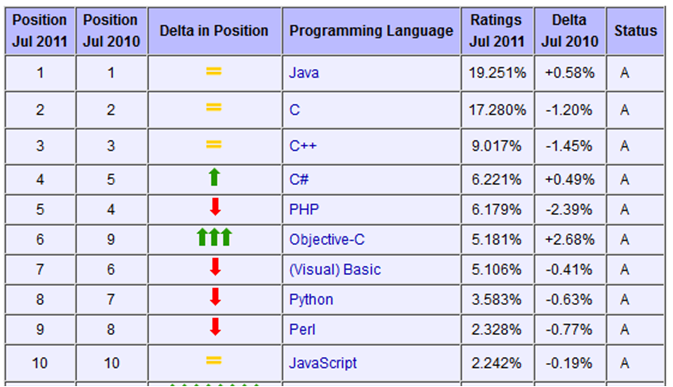
My favorite language, C++, is in third place, but quite a bit behind Java and C. I think that Objective-C took a big jump relative to last year because of the Apple iPad juggernaut. I’m bummed that my second favorite language, Erlang, didn’t even make the top 20.
Transfer Of Mental Ownership
I don’t know how to write code in the Erlang programming language, but ever since reading Bjarne Stroustrup‘s “The Design And Evolution Of C++“, I’ve been interested in the topic of programming language creation, development, and adoption. Sinisterly, I look for how much support, or lack thereof, that management provided to the language creators.
In this entertaining InfoQ video, “A Discussion Of Basic vs. Applied Research In The Software Domain And The Creation Of Erlang“, kindly and soft-spoken Bjarne Dacker recounts the development of Erlang. Here are some of my distorted notes:
Many problems that need to be solved by software are not computationally intensive, they’re symbolic.
The sequential and synchronous Von Neumann programming model does not map cleanly into the realm of real-time control systems.
The Erlang team asked: “Why are software academics obsessed with all these subtle, disparate, awkward, and complicated communication schemes like buffers, semaphores, mailboxes, rendezvous, regions, pipes? Why not just simply send messages between asynchronously running processes?”
Erlang designers took the goodies from Modula, Ada, and Chill and discarded the baddies.
By being devious and cunning, Dacker was able to subvert the corpo bureaucratic mandate that “everybody shall use the centralized IBM mainframe” and he miraculously secured approval to purchase a dedicated VAX (close to state of the art at the time) computing platform for his team.
Ericsson management wanted Erlang to be proprietary; a secret weapon that would allow them to develop their telecommunication products faster than their competitors. On the other hand, Ericsson management disallowed the usage of Erlang internally because it wasn’t an open standard (LOL!).
You can’t just throw new technology over the wall to product teams. You must create mixed teams; embedding applied researchers within product teams. You must facilitate the transfer of “mental ownership”.
In 2009, “something” happened. The number of Erlang downloads at Erlang.org started to skyrocket.
In keeping with my goal of providing a dorky graphic with each blog post, I present Mr. Dacker’s process for the successful transition of applied research knowledge into the marketplace.
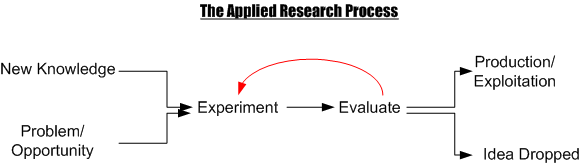
Notice that going “backward” and cycling multiple times through the mistake prone experiment/evaluate activities (which most sequential, linear, forward-only management CGHs abhor and forbid) is an integral part of Dacker’s process. The mixing of researchers with product developers occurs in the production/exploitation stage.

Why am I here?
WTF?
Meh!
D'oh!

My BTC Address



 Bulldozer00's Blog