Archive
Ironic
It’s like ten thousand spoons when all you need is a knife – Alanis Morissette
I find it curiously ironic that despite what may be espoused, software developers are often placed on one of the lowest rungs of the ladder of stature and importance (but alas, the poor test engineers often rank lowest) in many corpricracies whose revenue is dominated by software-centric products. Yet, it seems that many front-line software project managers, software “leads“, and software “rocketects” are terrified of joining the fray by designing and writing a little code here and there to lead by example and occasionally help out. In mediocre corpo cultures, it’s considered a step “backward” for titled ones to cut some code.
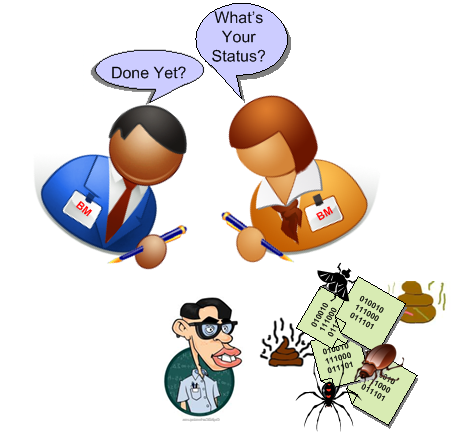
Fuggedaboud writing some code, a lot of the self-pseudo-elite dudes are afraid of even reading code for quality. Hence, to justify their existence, they focus on being meticulous process, schedule, and status-taking wonks – which of course unquestioningly requires greater skill, talent, and dedicated effort than designing/coding/testing/integrating revenue generating code.

The Law Of Diminishing Returns…
Basement Garden
After concocting yesterday’s irreverent post, the universe whispered in my ear:
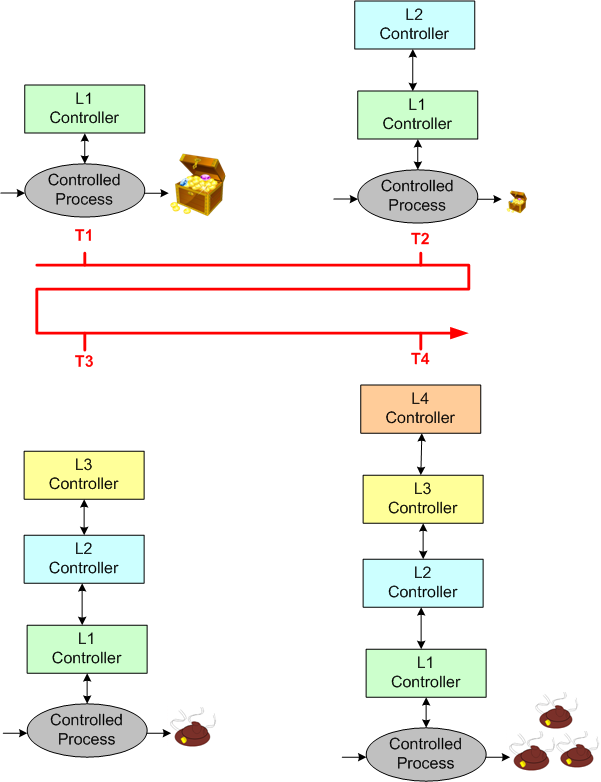
Put a visual to the saying: DYSCOs often treat their “associates” like mushrooms: Down in the basement and well fed with chit.
Since I don’t want to piss the universe off, here t’is:

Unfriendly Fire
In Nancy Leveson’s new book, “Engineering A Safer World“, she analyzes (in excruciating detail) all the little screw-ups that occurred during an accident in Iraq where two F-15 fighters shot down two friendly black hawk helicopters – killing all aboard. To set the stage for dispassionately explaining the tragedy, Ms. Leveson provides the following hierarchical command and control model of the “system” at the time of the fiasco:
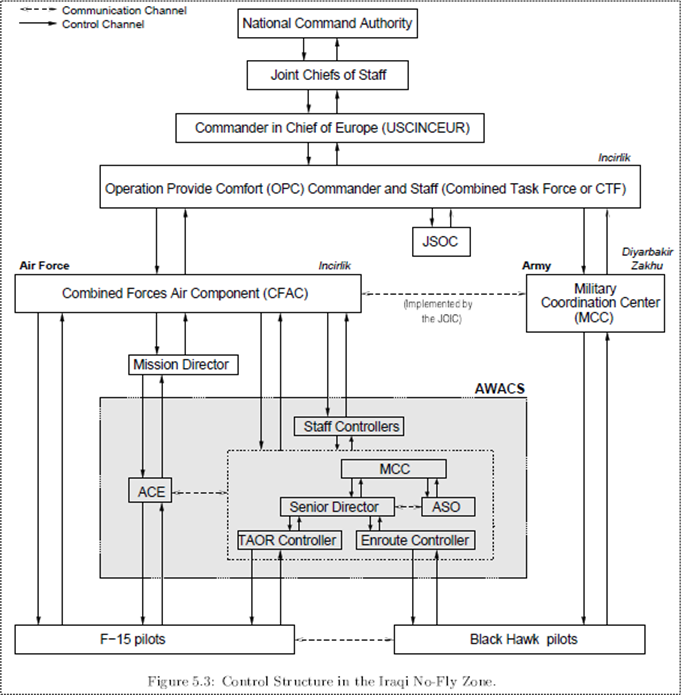
Holy shite! That’s a lot of levels of “approval required“, no?
In typical BD00 fashion, the dorky figure below dumbs down and utterly oversimplifies the situation so that he can misunderstand it and jam-fit it into his flawed UCB mental model. Holy shite! That’s still a lot of levels of “ask me for permission before you pick your nose“, no?
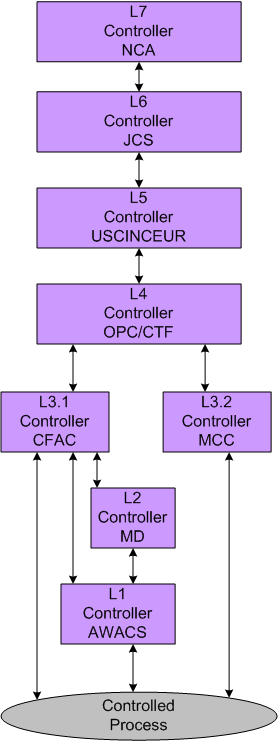
So, what’s the point here? It’s that every swingin’ dick wants to be an esteemed controller and not a low level controlleee. Why? Because….
“Work is of two kinds: first, altering the position of matter at or near the earth’s surface relatively to other such matter; second, telling other people to do so. The first kind is unpleasant and ill paid; the second is pleasant and highly paid.” – Bertrand Russell
People who do either kind of work can be (but perhaps shouldn’t be) judged as bozos, or non-bozos. The bozo to non-bozo ratio in the “pleasant” form of work is much higher than the “unpleasant” form of work. – BD00
Six “C”s
Whoo Hoo! I found another non-mainstream heretic to learn from: Mr. Alfie Kohn.
I’m currently in the process of reading Mr. Kohn’s book: “Punished By Rewards“. PBR is a well researched and eloquently written diatribe against anything that reeks of the Skinnerian dogma: “Do This And You’ll Get That“. Mr. Kohn is a staunch opponent of rewards, punishments and any other form of external control.
People don’t resist change. They resist being changed. – Unknown
Applying his rhetoric to parenting, the classroom, and the corpricracy, Alfie cites study after study and experiment after experiment in which all external motivational actions perpetrated by “authorities” achieve only short term results while destroying intrinsic motivation and ensuring long term, negative consequences – like reluctant compliance and uncreative, mechanistic doing.
The classic (and reasonable) question posed most often to Mr. Kohn is “if rewards and punishments don’t work, what alternatives are there Mr. Smartie Pants?“. Of course, he doesn’t have a nice and tidy answer, but he cites three “C”s: Choice, Collaboration, and Content, as the means of bringing out the willful best in children, students, and employees.
Much like Dan Pink‘s big 3 (mastery, autonomy, and purpose), creating an environment and supporting culture in which Alfie’s three “C”s are manifest is devilishly difficult. In familial, educational, and corporate systems, their hierarchical structures naturally suppress Alfie’s 3 “C”s while nurturing this 3 “C” alternative:

House Of Cards
Wanna play cards?

Confined Safety
In ho-hum, yawner borgs, a meticulously followed but mysteriously unwritten rule is that Domain Analysts (DA) and Software Developers (SD) remain safely within the confines of their area of expertise:

The borg’s job classification, compensation, and status-award sub-systems ensure that this “confined safety” rule is firmly in place; and silently enforced. No encroachment is allowed, lest social punishment be inflicted to “right the wrong“.
When turf transgressions in the form of hard-to-answer questions and “suggested” alternatives from an encroacher occur:

a rebuke from the (Jim) encroachee is sure to follow. If that tactic doesn’t flatten and widen the boundary curve back into place, then the big gun is rolled out: management. D’oh! Watchout!
In effective, world class orgs, there is no “confined safety” rule:

This non-horizontal, continuous, and smooth interface boundary between disciplines is not only an anomaly, but when it does miraculously manifest, it’s only temporary and local, no?
Hell, there are no rules here. We’re trying to accomplish something. – Thomas Alva Edison
A Bum Rap
Middle managers often suffer from a bum rap. There’s pressure from above to meet schedule and cost, and there’s pressure from below to trade schedule and cost for quality. Since their bread is buttered from above, the likelihood of middle managers being able to deftly handle those conflicting demands equitably is low, very low. Ya can’t blame them for capitulating to the demands from above, right?

90 Degree Rotation
The figure below shows a 3 group system that efficiently transforms a stream of raw inputs into a stream of valued outputs (they’re valued because customers want to pay for them) via the application of talent, knowledge, and skill. In this system, since all groups are on the same horizontal plane of importance, negative feedback channels are embraced, and hence, the information that flows within them blunts the rate of increase in entropy while providing a source of reflective learning.
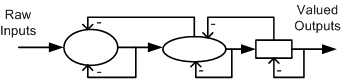
Now, let’s introduce vertical levels of “perceived importance” by rotating the system in the clockwise direction by 90 degrees:

So, you ask “why were those red verboten x’s introduced during the rotation? “. I put them there because once people start perceiving that the levels above are more important than them, they stop giving negative feedback – even when the inputs they’re given to work with turn into POPs over time. After all, if someone/group is perceived as more important than someone else, the “someone else” is likely to think that whatever they’re given as an input to work with must be good – regardless of its real quality.
Now, let’s introduce a culture of fear (which usually goes hand-in-hand with hierarchical levels of importance) into the system:

So, you ask “why were those feedback loops to “self” crossed out? “. You see, when a sub-group is an integral part in a fearful hierarchy of importance, it doesn’t critically evaluate its own work and it covers up mistakes – lest it be perceived as unworthy for promotion to the next higher level of importance by those in said level.
As startups grow, unless their founders exert Herculean force to prevent it, they start rotating to the right. The rate of rotation is often so sloooow that no one notices it until it’s too late . The feedback loops are broken, product/service quality erodes, and the fit hits the shan. D’oh! I hate when that happens. Don’t you?
A Costly Mistake For Many
In “Learning Standard C++ as a New Language“, Bjarne Stroustrup gives a slightly different take on the waterfall method of software-intensive system development:
“… treating programming as merely the handmaiden of analysis and design doesn’t work either. The approach of postponing actual discussion of code until every high-level and engineering topic has been thoroughly presented has been a costly mistake for many. That approach drives people away from programming and leads many to seriously underestimate the intellectual challenge in the creation of production-quality code.“
If your company implicitly treats software engineers like “code monkeys” and great engineers strive to “rise” into coveted management positions ASAP because the unspoken ethos is that “coders” are interchangeable cogs, then your company most likely has made costly mistakes in the past and it will most likely do so again in the future.


Why am I here?
WTF?
Meh!
D'oh!

My BTC Address



 Bulldozer00's Blog