Archive
Ignore The Messenger
The more civilized, modern day equivalent of “shoot the messenger” is “ignore the messenger“. In (so-called) enlightened organizations, couriers of bad news aren’t physically eviscerated like in the old days, they’re simply ignored – at first.
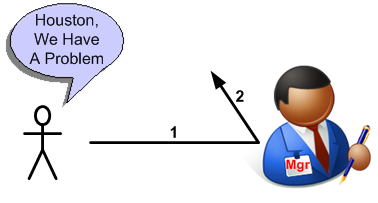
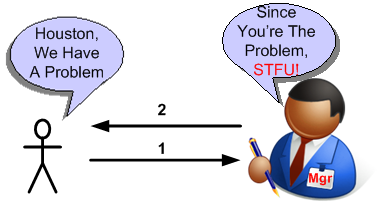
If the bearers of blasphemy don’t get the hint and continue to badger the dudes in the upper layers of the corpo cake, a stronger feedback signal is emitted in the form of cleverly disguised words. Well, they’re cleverly disguised most of the time?
Cradle To Grave Indoctrination
“Few people are capable of expressing with equanimity opinions which differ from the prejudices of their social environment. Most people are even incapable of forming such opinions.” – Albert Einstein
To me, the second sentence is the most insightful part of this quote. My subjective interpretation is that Einstein discovered that the cradle-to-grave indoctrination of most individuals teaches them to become subservient to the herd mindset prevailing during their time on earth. This indoctrination is so effective and so complete that they don’t have a clue that their capacity to think afresh has been vastly constrained by their social environment. What do you think Einstein meant when he said the words? Your interpretation is as invalid as mine.
I don’t think there’s any conspiracy theory here, it’s just the natural course of development in any society that has been “trained” to revere human-concocted hierarchical structures of governance. I say “human-concocted” because there are no hierarchies in nature. We automatically and impulsively impose hierarchies on everything we observe because that’s the only way we know how to make sense of, understand, and (attempt to) control the world. Building command and control hierarchies and requiring unquestioning subservience to those arbitrarily placed “above” you in the caste system is the way of the human race – today. Do you think this situation will remain that way for your lifetime? How about, forever?

The Art Of Rationalization
A major defense mechanism that all human beings develop over time is the art of rationalization. A perpetrator (like me and you?) of “bad” behavior who doesn’t want to be held accountable for his/her behavior always uses the skill of rationalization to disconnect and distance him/herself from personal feelings of guilt and to convince others that the manifest behavior was “noble and just”. Street smart politicians, corpo managers, so-called leaders, and over-educated experts are extremely clever and highly skilled rationalizers. They’re at the top of Everest.
“Half of the harm that is done in this world is due to people who want to feel important. They do not mean to do harm… They are absorbed in the endless struggle to think well of themselves.” – T. S. Eliot
Hitler is perhaps the ultimate example of a supremely skilled rationalizer. He not only convinced himself that the atrocities he committed against mankind were noble and just, this dude convinced an entire nation so effectively that “his” people deified him. Ominously, in many orgs around the globe, millions of little Hitlers operate unfettered. They perpetrate their “bad” behavior on their fellow human beings while (astonishingly) being rewarded for it. Blech!

All My Children
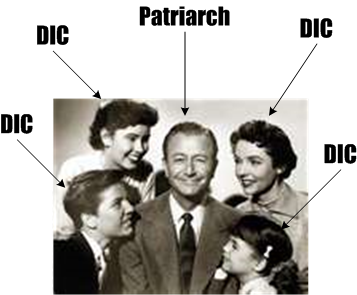
When rearranging the chairs within their stratified and siloed command and control hierarchies fails (and it almost always fails) to improve performance, mechanistically thinking patriarchs often resort to the ubiquitous centralize/decentralize cycle. However, the c/d cycle is also a stone cold loser for improving performance because all it does is spawn mini command and control patriarchies – just like daddy’s. The mindsets of daddy and his sons don’t change, so neither does performance – duh! But hey, at least there’s a lot of action taking place and it looks impressive to outsiders – til the duplication of work and resources is realized and the move back to centralization takes place.

Making A Living
In “Stewardship: Choosing Service Over Self-Interest“, Peter Block comically states:
No one should be able to make a living simply planning, watching, controlling, or evaluating the actions of others.
If corpo granite heads everywhere took that statement to heart (which they can’t, and thus won’t), they’d eliminate themselves and all the layers below them in an instant – poof! Alas, that ain’t gonna happen cuz someone’s gotta look pretty, run the show, and suck up the dough. Seriously, someone really does have to run the show to keep the CCF viable.
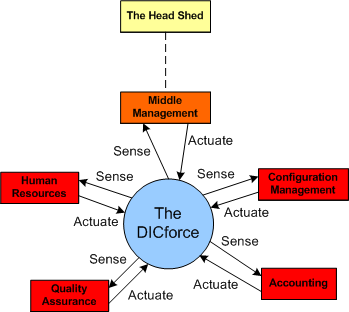
Actually, the dudes in the penthouse have others do the PWCE dirty work for them. The thugs in middle management and the pure overhead departments like Human Resources, Quality Assurance, Configuration Management, and Accounting serve nicely as the lower level sensors, alarm detectors, and actuators in the system. Because of this sleight of hand, the DICforce often targets their ire at those “support” functions and not where it rightfully ought to be targeted – the high priests living it up in the self-congratulatory head shed.
Leverage Points
In Places to Intervene in a System, systems thinker Donella Meadows lists the following 9 leverage points for keeping a system “on the rails” and in continuous pursuit of its goals.
9. Numbers (subsidies, taxes, standards).
8. Material stocks and flows.
7. Regulating negative feedback loops.
6. Driving positive feedback loops.
5. Information flows.
4. The rules of the system (incentives, punishment, constraints).
3. The power of self-organization.
2. The goals of the system.
1. The mindset or paradigm out of which the goals, rules, feedback structure arise.
The items are listed in increasing order of difficulty. Of particular interest is number 1, the “mindset” of the system controller(s). In so-called “modern” corpricracies, the patriarchical mindset of “we’re in charge and we know what’s best, so STFU and do what you’re told“, has ruled the day since the Henry Ford era. In that day, since the typical workforce was under-educated and managers actually knew how to perform and teach the work that kept a company viable, patriarchy worked well. These days, since the situation has changed (and continues to change) immensely, patriarchy can drive a company into the ground.
When managers don’t have a clue how to do the work, they ignore problems, issues, and ideas floated up from the bottom by the DICforce. This crucial feedback loop for sustained viability gets severed and the org suffers greatly for it. BMs collectively, and often unconsciously, behave this way in order not to look stupid and preserve their aura of infallible superiority. Ideas that can save six or seven figures in costs and product enhancements that may increase competitiveness go un-investigated or are killed via “it’s not in the budget”.
Maybe surprisingly to some, the vast majority of the DICforce actually buys into the patriarchical mindset because that’s the way it’s been for eons. DICs that initially don’t buy into patriarchy fall in line as soon as they are ignored or are slapped down a couple of times. Those that continue to buck the patriarchy after being “warned” are shackled or expelled for “insubordination” – another great term that reinforces the patriarchical mindset.
Closed Systems
In “Entropy Demystified“, Arieh Ben-Naim states an often forgotten fact about entropy:
The entropy of a system can decrease when that system is coupled with another system (e.g. a heating system connected with a thermostat). The law of ever increasing entropy is only valid in an isolated system.
In the figure below, the system on the left is coupled with the external environment and its members can use the coupling to learn how to adapt, dynamically self-organize, and arrest the growth in entropy that can destroy systems. In the isolated system on the right, which models a typical corpo mediocracy run by fat headed and infallible BMs who ignore everything outside their cathedral walls, there is no possibility of learning – and entropy marches forward.

A New Title Should Do It
“To solve our decreasing revenue and rising cost problems, we’ll just create a new title and insert the position into the org (thereby adding another layer to the stratified corpo cake). Voila! The problem will be solved (so let’s give ourselves a special bonus for being so smart).”
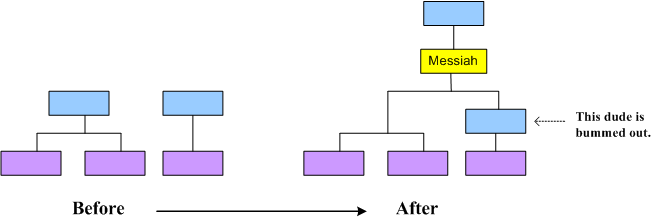
“But wait. What should the title be? Supervisor, Manager, Deputy Manager, Director, Deputy Director, General Manager? Should we bump it up by attaching a “Chief” and/or VP to the label? “We must be careful because the loftier the title, the more we’ll have to pay our new colleague (who will no doubt accomplish what we have failed to do).”

Such is the mindset of MBA trained corpo elites and their stooge press magazines like Business Week, Forbes, Fortune, et al. Do ya really think parachuting a messiah in to jumpstart an org with:
- an apathetic DICforce that is not as stupid as the head shed assumes and doesn’t appreciate management’s patronizing attitude
- an aging product development and manufacturing infrastructure (e.g. tools, processes, know how)
- an old and tired product portfolio that’s continually being usurped by competitor offerings
- a culture of undiscussable but obvious inter-group rivalry and disrespect
is realistic? Fragmented, hero-worshipping mindsets don’t clean up what Russell Ackoff calls, for lack of a better word, “messes”. Systemic thinking, along with the willingness to skinny dip, fully exposed, into the stinky mess is the only way to understand and clean up messes. Sadly, even if one or two dudes in the head shed junta are closet system thinkers and they try to speak out or take action, they’re promptly put back into their assigned slot….. and business resumes as usual…. while the mess grows ominously larger.
And now, for the bad news….. 🙂
Trust
In “Design For Prevention” (there’s no link here because the book hasn’t been released yet), friend and mentor Bill Livingston elegantly states:
Trust substitutes for search, negotiation, monitoring, and enforcement; it substitutes for hierarchical control internally and for the legalisms of contracts externally. The core elements of trust include: reciprocity, reputation, and a common semantic.
Reciprocity and reputation align motives, and a common semantic aligns perceptions. People have an innate, passionate desire to contribute, called the instinct of workmanship. Opposing this urge to contribute is fear of rejection, failure, loss, retribution, or embarrassment. Earned trust tips the balance between the urge to contribute and fear. Working in an environment of trust reinforces, validates, and supports trust. – William L. Livingston
The truth in Bill’s words ring loud and clear to me. Trust flattens the hierarchy and nurtures the emergence of a collaborative, wealth creating community. Without trust, a herd-following and hardened mediocracy is guaranteed.
Sadly, because those in the top tiers of CCHs want nothing more than to stay in the penthouse, trust is not allowed within corpocracies. Fine grained, micro-detailed work schedules (that are hopelessly out of date as soon as the ink dries) coupled with useless daily status meetings continuously destroy trust and clearly show “who’s in charge” and who’s supposed to be more important.

Don’t Say It!
One of Paul Graham’s brilliant essays in “Hackers and Painters” is titled “What You Can’t Say“. In it, he analyzes the question: “How do people in power determine what you can’t say in a given historical time period?” He goes back to the Galileo era and cites the fact that what was taboo to say in one generation became trivially “OK” to say in subsequent generations. It’s sad because over the ages many people were persecuted, tortured, and killed because of what they said in one generation, only to have their deaths become senseless in the subsequent generation(s).
I think Paul’s answer to the “what you can’t say” question is pretty much right on:
“The statements that make people mad are the ones they worry might be believed. I suspect the statements that make people maddest are those they worry might be true.” – Paul Graham
How do I know that Paul is close to ground zero? Because when I get mad those are the reasons that trigger the madness. Mr. Graham’s conclusion aligns closely with the following GBS assessment.
“All great truths begin as blasphemies.” – George Bernard Shaw
If I was GBS, I would have stated it as: “All great truths begin as blasphemies that, when stated before it’s appropriate to do so, will get you censured, fired, tortured, killed, or all of the above.”


Why am I here?
WTF?
Meh!
D'oh!

My BTC Address



 Bulldozer00's Blog