Archive
Feedback Insertion
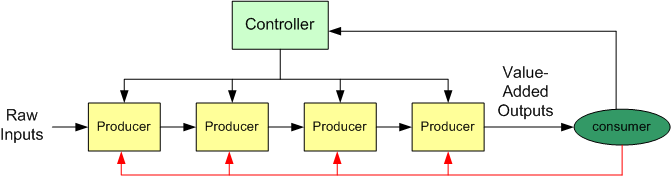
Let’s say that you come up with a great product idea that is both wanted and needed by a large market (ka-ching!). Let’s also say that your product is non-trivial and it requires specialized expertise to produce it from raw inputs to its value-added end state. After mustering up enough courage and scrounging up enough money, you become an entrepreneur – whoo hoo! So, you design the system below, hire the expertise you need, and kick off the enterprise. Of course, you rightly put yourself in the controller position and serve as the system coordinator.
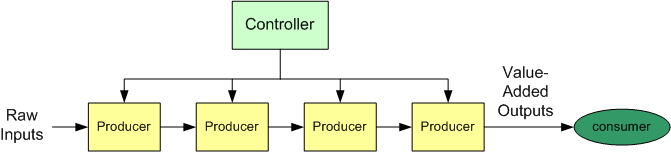
Uh, what’s missing from your design? Does the next picture below help? Still can figure it out?
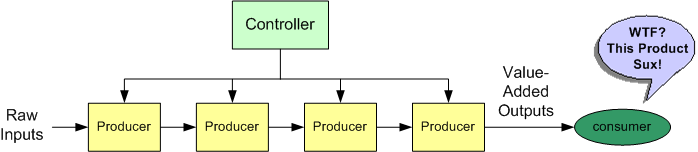
Is feedback missing? Even though your customers need and want and buy your product, how do you know when/if your quality goes down hill and/or your customers want and need new features? Voila! You figure it out and design/install a feedback channel from your customers to you, and only you:
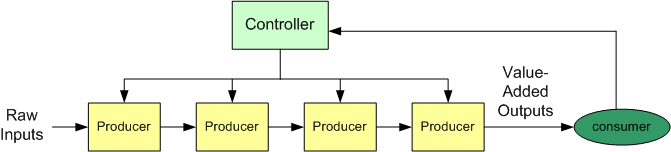
By responsively acting on customer inputs on your new feedback channel, you steer, guide, and direct your team back on track – until the complaints on the feedback channel start rising again. What’s wrong with your system now? Does the system augmentation below answer the question?
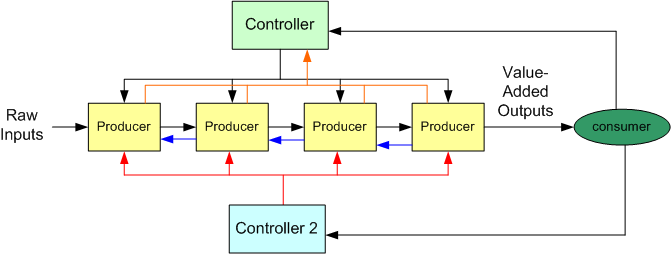
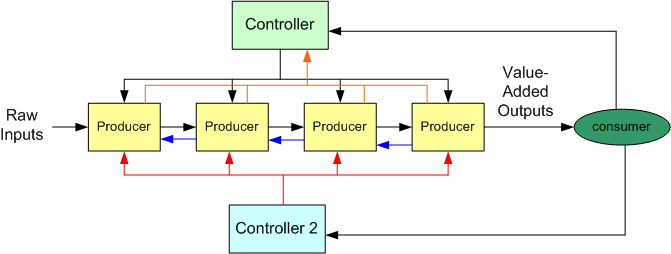
Because of increasing product complexity and your lack of in depth knowledge of it, (if you’re not an egomaniacal control freak,) you own up to the possibility that you could be misunderstanding and filtering out some customer feedback and you could be directing your team poorly. Accepting your humility, you set up a second feedback channel from your customers directly to your development team.
Now you’re back on track again – whoo hoo! But wait, something goes awry again and the customer complaint rate starts rising again. Since feedback solved your problems before, you set up additional feedback channels between yourself and your producer team and between your sub-teams:

Will this latest system enhancement work? Hell, I don’t know. Complexity begets complexity. Your increasingly complex system design might implode because of all the communication channels in the system and the fragmentation of contradictory messages that flow at high rates within the channels. If it doesn’t work, you could keep experimenting with changes to fine tune the system for stability and robustness.
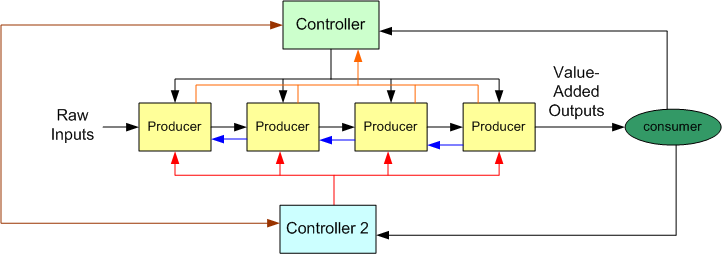
The figure below shows yet another system enhancement possibility – the addition of another controller to ensure that the production sub teams receive coherent and filtered info from your customers. It may work, but it will fail if your second controller issues guidelines, advice, commands, and orders to your production team that contradict yours.
To solve your cross-management problem, you can setup a two way channel between yourself and your second controller to resolve contradictions and ambiguities:
So, what’s the point of this long and boring, multi-picture post? Geez, I don’t know. I wrote it on the fly, in a stream of consciousness with no pre-planned point in mind.
But wait, a possible answer to the question just popped into my head out of nowhere. The point of this post is to keep adapting and trying new things when your external environment keeps changing – which it always will. One thing is for sure: don’t design your operation like the very first picture in this post – open loop. Ensure that feedback channel(s) from your customers are in place and the information that flows on it (them) is acted upon to keep your product in synch with your customers.
Sheesh, I’m finally done!
Past, Present, Future
I can’t remember who said it, but;
Feedback is information given in the present about behavior in the past that can be used to modify behavior in the future.

Just because feedback can be used to modulate future behavior doesn’t mean it actually will be used. Depending on the quality of the relationship between the feedback provider and the feedback receiver, the feedback may be taken to heart or it may be ignored. If the feedback receiver has little respect for the feedback provider, regardless of whether the provider is the receiver’s so-called “superior”, the feedback will be ignored. Oh sure, the receiver’s behavior may appear to superficially change out of fear, but counterproductive behind-the-scenes behavior will be guaranteed if the feedback is delivered as an “or else” ultimatum. On the other hand, if there is a two way connection of respect and trust between provider and receiver, the receiver’s behavior may change – if the receiver agrees with the provider’s assessment and it strikes an emotional chord within the receiver’s being.
Emotional energy, not logical deduction, is the driver of behavior. So stop being puzzled when people don’t behave “logically”.
The Commencement Of Husbandry
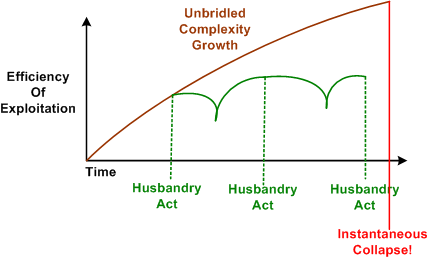
The figure below was copied over from yesterday’s post. Derived from Joseph Tainter’s “The Collapse of Complex Societies”, it simply illustrates that as the complexity of a social organizational structure necessarily grows to support the group’s own growth and survival needs, the adaptability of the structure decreases. The flat and loosely coupled institutional structures originally created by the group’s elites (with the willing consent of the commoners) start hierarchically rising and coalescing into a rigid, gridlocked monolith incapable of change. At the unknown future point in time where an external unwanted disturbance exceeds the group’s ability to handle it with its existing complex problem solving structures and intellectual wizardry, the whole tower of Babel comes tumbling down since the monolith is incapable of the alternative – adapting to the disturbance via change. Poof!
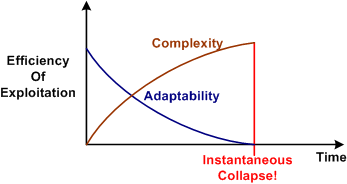
According to Tainter, once the process has started, it is irreversible. But is it? Check out the figure below. In this example, the group leadership not only awakens to the dooms day scenario, it commences the process of husbandry to reverse the process by:
- Re-structuring (not just tinkering and rearranging the chairs) for increased adaptability – by simplifying.
- Scouring the system for, and delicately removing useless, appendix-like substructures.
- Discovering the pockets of fat that keep the system immobile and trimming them away.
- Loosening dependencies between substructures and streamlining the interactions between those substructures by jettisoning bogus processes and procedures.
- Installing effective, low lag time, internal feedback loops and external sensors that allow the system to keep moving forward and probing for harmful external disturbances.

If the execution of husbandry is boldly done right (and it’s a big IF for humongous institutions with a voracious appetite for resources), an effectively self-controlled and adaptable production system will emerge. Over time, and with sustained periodic acts of husbandry to reduce complexity, the system can prosper for the long haul as shown in the figure below.
Dark Hero
In Dark Hero of the Information Age: In Search of Norbert Wiener The Father of Cybernetics, authors Flo Conway and Jim Siegelman trace the life of Mr. Wiener from child prodigy to his creation of the interdisciplinary science of cybernetics. As a student of the weak (very weak) connection between academic and spiritual intelligence, I found the following book excerpt fascinating:
Since his youth, Wiener was mindful that his best ideas originated in a place beneath his awareness, “at a level of consciousness so low that much of it happens in my sleep.” He described the process by which ideas would come to him in sudden flashes of insight and dreamlike, hypnoid states:
Very often these moments seem to arise on waking up; but probably this really means that sometime during the night I have undergone the process of deconfusion which is necessary to establish my ideas…. It is probably more usual for it to take place in the so-called hypnoidal state in which one is awaiting sleep, and it is closely associated with those hypnagogic images which have some of the sensory solidity of hallucinations. The subterranean process convinced him that “when I think, my ideas are my masters rather than my servants.”
Barbara corroborated her father’s observation. “He frequently did not know how he came by his answers. They would sneak up on him in the middle of the night or descend out of a cloud,” she said. Yet, because Wiener’s mental processes were elusive even to him, “he lived in fear that ideas would lose interest in him and wander off to present themselves to somebody else.”
This description of how and when ideas instantaneously appear out of the void of nothingness aligns closely with those people who say their best ideas strike them: in the shower, on vacation, out in nature, during meditation, while driving to work, exercising, or doing something they love. In situations like these, the mind is relaxed, humming along at a low rpm rate, and naturally prepared for fresh ideas. Every person is capable of receiving great ideas because it’s an innate ability – a gift from god, so to speak. Most people just don’t realize it.
I haven’t heard many stories of a great idea being birthed in a drab, corpo-supplied, cubicular environment under the watchful eyes of a manager. Have you?
 Note: The picture above is wrong. Exept for “what’s your status?“, BMs don’t ask DICs for anything. Since they know everything, they just tell DICs what to do.

Why am I here?
WTF?
Meh!
D'oh!

My BTC Address



 Bulldozer00's Blog