Archive
Thich Nhat Hanh
Thich Nhat Hanh (don’t fret cuz I don’t know how to feakin’ pronounce his name either) is a man with a remarkable story. This gentle Buddhist monk:
- was banished from his homeland, Vietnam, for opposing the war,
- was educated at Princeton and taught at Columbia and Cornell (thus, he’s got “authorized” credentials),
- was the main influencer of Martin Luther King’s stance against the Vietnam war,
- was nominated by Martin Luther King for the Nobel peace prize,
- has written over 100 books (I’ve read “No Death, No Fear“).

In this interview with Oprah, (yes, I’m a girlie-mahn) Oprah Talks to Thich Nhat Hanh, Thich said some Eckhart Tolle-ishly inspiring words:
If you breathe in and are aware that you are alive—that you can touch the miracle of being alive—then that is a kind of enlightenment. Many people are alive but don’t touch the miracle of being alive.
With mindfulness, you can establish yourself in the present in order to touch the wonders of life that are available in that moment. It is possible to live happily in the here and the now. So many conditions of happiness are available—more than enough for you to be happy right now. You don’t have to run into the future in order to get more.
If you are fully present, you need only make a step or take a breath in order to enter the kingdom of God. And once you have the kingdom, you don’t need to run after objects of your craving, like power, fame, sensual pleasure, and so on.
People sacrifice the present for the future. But life is available only in the present.
Deep listening is the kind of listening that can help relieve the suffering of another person. You can call it compassionate listening. You listen with only one purpose: to help him or her to empty his heart.
In the present moment, you are producing thought, speech, and action. And they continue in the world. Every thought you produce, anything you say, any action you do, it bears your signature.
Wonderful stuff, no? When I read words like those, I temporarily experience a bit of internal calm and realize that all “objects” are divine creations of the universe expressing its love for itself. Before “getting it“, I used to blow off spirituality as new age poo-poo and a collosal waste of time. I’m so grateful for my shift in understanding because before I started my quest for spiritual advancement I rarely experienced personal moments of peace.
Some words that Thich spoke in the Oprah interview hit a bit closer to home:
…we have to be ready to release our knowledge in order to come to a higher understanding of reality.
People suffer because they are caught in their views. As soon as we release those views, we are free and we don’t suffer anymore.
I can confidently say that over the years I’ve gotten better and better at releasing old knowledge, views, and opinions to make room for new and refreshing ones. For the most part, I’m less “binary” and I’m not married to my thoughts. Thus, I don’t suffer as much in terms of anger, anxiety, and fear.
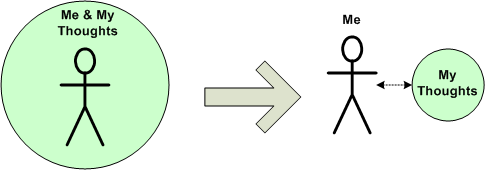
How about you? As you age, are you suffering less and less or more and more? Why?
Thought Recognition
Do you ever find yourself in the throes of an ego-tantrum, and then recognize that your monster ego is in charge, and then still continue feeding your ego with the negative energy it requires to stay viable? I do it all the freakin’ time and it always leads to feelings of post-tantrum guilt. The reason guilt invades my psyche is because of the fact that thought recognition has taken place. If that didn’t happen, then there would be no guilt. In the “old days” prior to starting my search for spiritual advancement, I had no thought recognition skill. Not one iota. Thus, there was no post-tantrum guilt.

So, in this case, is ignorance bliss? Would you rather be ignorant of when your ego is wreaking havoc, or would you rather be cognizant of the fact? Assuming that you chose the latter, do you think you could stop the ego-tantrum dead in its tracks when (external?) thought recognition occurs? If so, what’s your secret?

RIP, Dear Syd
From an acquaintance on LinkedIn.com, I just found out that Sydney Banks died in May. Syd was a simple and under-educated man who didn’t strive for fame and fortune. He was the first spiritual teacher whose words of truth penetrated my thick Newtonian thinking skull. I’m very sad to see him go.
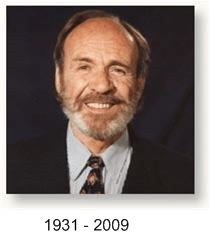
Over ten years ago, I stumbled upon obscure Syd’s work while reading Richard Carlson’s not-so-obscure “Don’t Sweat The Small Stuff — And It’s All Small Stuff”. When I read that small tome, the hairs on the back of my neck kept rising up and I found myself experiencing multiple simple, indescribable, and joyful moments of being. It was weird because the words were so simple, yet they were also very profound to me. I kept saying “WTF?” to myself as I turned the pages.
After finishing “Sweat“, I devoured all of the rest of Carlson’s books and they all had the same endearing effect on me. Curious as hell, I scoured the footnotes and bibliographies to find out where Carlson came up with such impactful and profound thoughts and words. Through at least one level of indirection, I discovered that Syd Banks was at the root of a whole ecosystem that revolved around his work: “The Three Principles – Mind, Consciousness, Thought“. Stunningly, West Virginia University, a stereotypical academic bastion of logical and mechanistic thinking, paid tribute to Syd’s spiritual work by initially naming the West Virginia Initiative for Innate Health after him.
I’m really thankful that I serendipitously discovered the work of Sydney Banks. Rest in peace my dear friend from afar.
Doing And Being
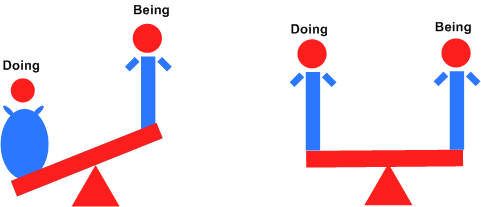
Echkart Tolle has stated that every human being has an inner purpose and an outer purpose. According to Mr. Tolle, our inner purpose is “being” and our outer purpose is “doing”. Along similar lines, Mother Theresa once said something to the effect that “the west is materially rich (from doing) but spiritually poor (from not being)”. I’m on-board with these related insights because I’ve realized them through personal experience. How about you?
A problem that I see with western cultures is that most people have their self worth totally fused with “doing”, while “being” is often disdained, looked down upon, and interpreted as sloth/laziness. There is no balance, and I’m one of those unabalanced (lol!) people. Do I have “factual evidence” to back this up? Of course not. I’m not a world renowned expert and I only speak from personal experience. Plus, I like to make stuff up.
Oh Goody, A New Discovery
It’s funny how virtually every person has the tendency to constantly seek out references that confirm and validate his/her “beliefs”, while at the same time ignoring evidence to the contrary – no matter how strong the disconfirming evidence is. As a member of this non-exclusive club myself, the latest self-medicating anti-hierarchy book that I’m reading is called “The Age Of Heretics: A History of the Radical Thinkers Who Reinvented Corporate Management“. The content on changing corporate governance is interesting, but the multiple references to spiritual teacher and mystic G. I. Gurdjieff are what really kindle my curiosity.
Over the past 10+ years, I’ve read the works of many well known spiritual teachers in an attempt to counter my tendency to rely solely on a logical and mechanistic engineering mindset to travel through life. Since Gurdjieff is new to me, I’m gonna look into his work. Thus, the next book in my reading queue is titled Gurdjieff.
.
Collapsing The Wavefunction
I’m in the process of reading a third book on quantum physics. It’s called “The Self-Aware Universe”, and it is written by physicist Amit Gotswami. According to Q-physics, no localized object exists until a conscious observation is made. The universe is comprised of non-localized, infinitely distributed “waves” described by Schrodinger’s wave function equation. The wave function equation characterizes the “waviness” of matter and it displaces Newton’s F=ma as the universal law of motion. Even though Newton has been convincingly dethroned as the king of “materialistic reality”, Q-physics is consistent with Newton’s classical physics for “big” objects, which are all comprised of quantum waves. Thus, for (almost) all practical purposes, Newton’s laws can be leveraged in the macro world to “control” and enhance our environment to some extent.
When a subjective and conscious observation is made and discrete objects are “detected” at a point in space and time, the instantaneous collapse of the wave function occurs. The figure below woefully attempts to graphically depict this mysterious and miraculous process. On the left, we have “no”-things, just an infinite collection of waves. On the right, we have a bunch of (supposedly) independent “some”-things after the collapse. If, as most rational and educated people think, conscious observation is subjective and person specific, then why is there so much consensus on the post-collapse appearance of the world? In other words, why do most people see the same set of objects after they each independently and subjectively collapse the wave function? If you’re thinking that I have an answer for this subjective vs. consensus enigma, then you’re mistaken. I’m dumbfounded but enamored with the mystery of it all. How about you?

Suppose that you and I separately “collapse the wave function” and (miraculously?) agree on the appearance of the external world the engulfs us. Referring to the example above, assume that we transcend the first communication barrier between us and we agree that a post-collapse triangle exists, a rectangle exists, a pair of ellipses exist, etc.
Now assume that the group of objects that we’ve manifested (created ?) is comprised of people and some type of observable behavior emanating from that group is “bothering” us. Also, assume that we want to influence the group to change it’s behavior so that we are less distressed. What do we do? We consciously form a personal System-Of-Interest (SOI) and we try to understand what’s causing us the distress. We try to make sense of the dynamic interactions taking place between those people encircled in our own personal SOI and then we act to change it. Here’s where our original consensus starts to diverge. Since, as the figure below illustrates, our personally created SOIs will most likely be different, our interpretation of who and what is causing us our distress will be different. Thus, our ideas and thoughts regarding corrective actions will be different.
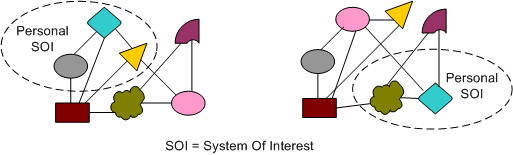
Note that even though we initially agreed on the number and types of objects=people present in our collapsed wave function worlds, the number and nature of the connections between those people are likely to be different for you and me. In the SOI example above, my SOI on the left contains three people and yours on the right only contains two. My SOI on the left doesn’t include the pink ellipse in the “problem” sub-group but yours on the right does. Your SOI doesn’t include an interface ‘tween the gray ellipse and blue diamond but mine does. Thus, our interpretations of what ails us will most likely differ. Add a third, fourth, fifth, etc., SOI to the mix and all kinds of diverging interpretations will emerge.
Now, apply this example to a work environment. If I’m the “boss” and you disagree with my interpretation of the problem situation, but are “afraid” of speaking truth to power because of standard stifling corpo culture norms, then you may just go along with my interpretation even though you’re pretty sure that your interpretation and solution is “right”. Since I’m the boss, all knowing and all powerful, I’m always “right” – even if I’m not. 🙂
Transcend AND Include
Before Newton, religion and superstition were used by most human beings to explain what they saw and felt day-to-day. Depending on what religion you subscribed to, all kinds of wild theories were proposed to explain events and happenings that were not easily understood. Then Newton came along and busted all the myths with his “principia”. Newton’s classical physics was relatively easily understood. Objective experimentation confirmed that it worked admirably in predicting the motions and positions of “macro” objects as a function of the forces acting on them. Classical physics “proved” that all material objects are separate and the only way one object can affect another is by impressing an external force on it. In addition, thanks to Einstein’s brilliance, forces cannot travel faster than the speed of light. Thus, two objects at the ends of the universe are independent of each other and effectively isolated from each other.
Then, along came quantum physics, which, as the picture below shows, was found to transcend and include classical physics. For macro-sized objects on the scale of the things that we experience, the rock solid and experimentally verified maths that underly quantum physics transform into Newton’s equations. Thus, Newton’s equations are not absolute; they are “approximations”. However, at the atomic scale and smaller, quantum physics busts the new, Newton-derived, myths that there even are objects.
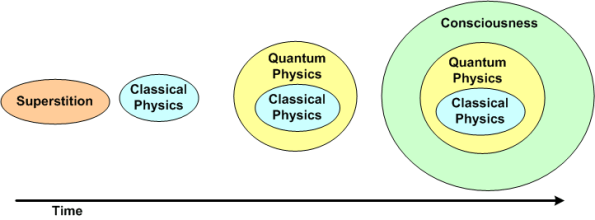
According to Q-physics, everything is a superposition of continuous, non-local, spread out waves until a subjective conscious observation is made. The point at which a conscious observation is made is called the “collapse of the wavefunction”. WTF? In addition, any two “consciously observed” objects (remember, according to Q-physics there are no such things as objects until a conscious observation is made) that ever interacted, remain “entangled” and associated regardless of how far apart they are. An observation on one of them instantaneously affects the other – violating Einstein’s maximum speed-of-light discovery. Again, WTF?
The addition of subjective consciousness into the previously objective world of physics has thrown a huge monkey wrench into the world of science. Consciousness, which is subjective, has collided with science, which (up until now?) is purely objective. So, like Q-physics transcends and includes C-physics, does consciousness transcend and include Q-physics? If so, what will be the next discovery in the world of science?
Quantum Consciousness
In their wonderful book “Quantum Enigma” (I just finished reading it twice in a row, back-to-back), physicists Kuttner and Rosenblum assert that quantum theory is the most battle-tested scientific theory of all time. In its 80 year existence, it has never failed any experimental test hurled at it by the most brilliant academic minds, past and present.
If my understanding is correct, and it might not be because of the nature of the subject matter, quantum theory says that nothing material exists until it is consciously observed. Hmmm, that sounds like the same thing spiritual teachers have been asserting for thousands of years before the development of quantum theory.
On the extremely small scale of sub-atomic sizes, that assertion has been proven many times over by employing the scientific way – experimentation. One classic example is that depending on which experiment you consciously choose to perform, you can prove that light is either a mass-less continuous wave or a stream of discrete and separate particles of mass. The reason why we can’t recreate paradoxical experiments similar to that with large macro-sized objects like people is because the technology needed to do it is not available, yet. Bummer.
Another assertion quantum theory makes is that two entangled objects can instantaneously influence one another, regardless of how far apart they are spaced. This assertion effectively voids Einstein’s proof that no physical entity can travel faster than the speed of light in a vacuum. Einstein called this “spooky action at a distance” and he spent a good deal of time trying to poke holes into quantum assertions like entanglement. Hmmm, sounds like quantum theory says everything is connected with everything else. More spiritual heresy?
The figure below shows a stack that hypothetically connects science to spirituality. It’s an expanded version of the science only, psychology-to-quantum physics stack presented in Kuttner’s and Rosenblum’s book. I subjectively added the non-scientific thoughts, feelings, and behavior layers to the top, and the consciousness, awareness, and no-thing layers to the bottom.
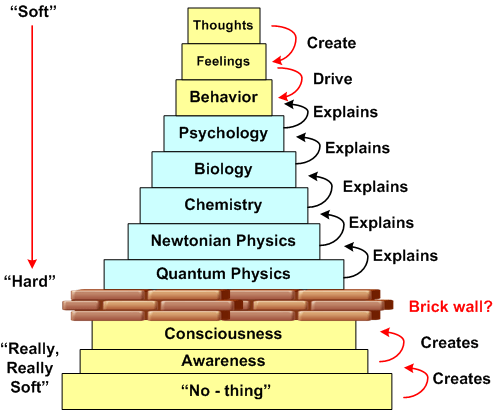
Because quantum theory butts up against consciousness, and they seem to be separated by an unexplainable brick wall, Kuttner and Rosenblum explore the seemingly mysterious connection between them in their book. As they say, “when experts don’t agree, you can pick your own expert to believe in“.
A Shift In Perspective
At birth, everyone is egoless. We are pure awareness, a manifestation of universal consciousness. We have no agenda and no desire to make ourselves look good at the expense of others. We don’t get into zero-sum games and our outer purpose is directly synchronized with our inner purpose. When we get labeled with a name, start accumulating “credentials” and “expertise”, and we begin to internalize the human-made concepts of “I” and “me”, our heads expand in order to accommodate ego growth. As ego expands, consciousness contracts and we lose touch of the infinite source of energy that comprises our inner core. Our behaviors and actions become increasingly dominated by the artificial need to selfishly accumulate “things out there” and consume way more than we need. How do I know this? Because like you, I’m a perfect example of ego-domination. Give “me” more, “I” need more, it’s all about “me”, “I’m” smarter than “you”, “I’m” better looking than “you”, “I” have more and nicer things than “you”, “you” should want to be like “me”, to hell with “you” and to heaven with “me”. Duality and separation settle in.

As the lower graph in the above figure shows, some people may, by an unknown and humanly-uncontrollable act of grace, experience a shift in perspective at some point in their lives. The ego starts to deflate, consciousness starts rising, and the artificial mode of good/bad, dual thinking starts dissolving. For some people, the slope of the ego curve instantaneously flips to negative infinity at the point of transition and an “epiphany” occurs. Jill Bolte Taylor, Eckhart Tolle, Byron Katie, Sydney Banks, and the Buddha come to mind as examples of people who’ve experienced epiphanies.
Becoming aware that one is ego-dominated is not enough to trigger a transformation back to our true nature and a realignment of our outer purpose with our inner purpose. How do I know this? Because I’m aware of the fact that I’m dominated by the constraining, finite, and toxic force of the ego. The ego is brilliant in that it can argue with anything at any time and rationalize any action, no matter how horrendous the end result is.
So here “I” am, recognizing the fact that I’m a slave to “my” ego and hoping that an instantaneous shift in perspective will happen to “me”. Since I don’t have a clue on how to trigger the shift, I’m on a constant intellectual search for enlightenment. However, feverishly accumulating intellectual understanding is not the way to realize and experience “the peace that passeth ALL understanding”. Bummer.
Lost In Thought
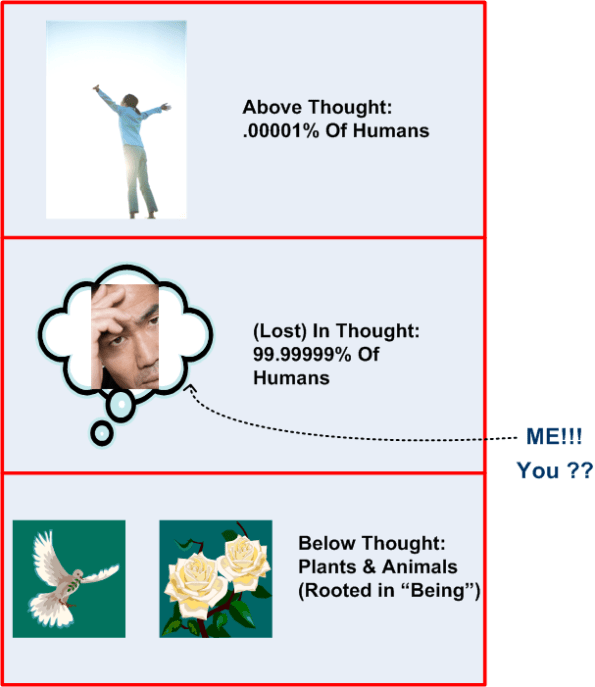

Why am I here?
WTF?
Meh!
D'oh!

My BTC Address



 Bulldozer00's Blog