Archive
Shhhh! Be Quiet
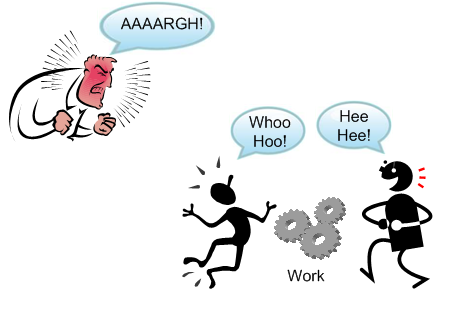
If you’re having fun on a project, don’t let anyone outside of your team know that’s the case. You see, others will become jealous and they’ll start reacting like you’re a lazy ass slacker. The unconscious thinking behind the reaction is that if they’re not having fun, you shouldn’t be having fun either – verboten!
In true FOSTMA fashion, you’re required to be stressed out with your nose to the grindstone at all times. This is especially true for those who don’t understand the work but can never admit to it because they might be perceived as being “fallible” by other more important “infallibles“. D’oh!
To Prevent Asking, Simply Don’t Ask
One of the dudes that I follow on Twitter is Don Harkey. His handle is “LeaderBook“, and he’s got a neat gig going on. When he tweets, it’s always a phrase or sentence from a book on leadership:

If you have a culture where your employees don’t even think about asking for, let alone actually asking for, a projector, a white board, a second computer monitor, a professional membership, a training class, or (heaven forbid) a tool that costs money, you get what you deserve.
So, how do you get a culture of “non-asking“? It’s so easy it comes naturally. There’s no work required – and that’s a good thing for work-averse managers. All ya gotta do is “lead by example” by never asking your employees what they need to do their jobs better. To really discourage the practice of employees from asking for things to help them do their jobs better (because employees can’t be trusted and they’ll take advantage of your goodwill, of course), you can ensure that the acquisition process is an unknowable labyrinth littered with approvals required by bureaucratic little Hitlers. See, I said it was easy.
CORKA, The Killer Whale
In case you were wondering, CORKA stands for CORpo Kiss-Ass. In DYSCOs (frequent disclaimer: not all companies are DYSCOs), the CORKA density is a function of the level one operates in within a corpricracy, no?

Jokingly Funny
A Free Pass
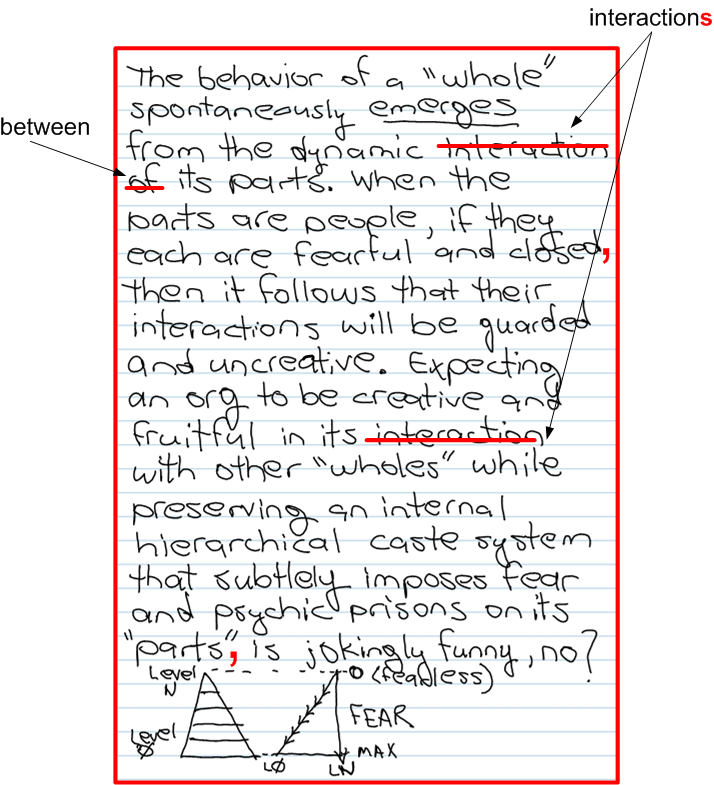
In a culture of blame, and its Siamese twin, fear, any non-manager group member who consistently asks tough questions and points out shoddy, incomplete, ambiguous work becomes a group target for retribution. This defensive peer group behavior is a natural response to redirect attention away from the stank and to squelch criticism. The funny thing is, managers in CCHs are given a free pass to ask tough questions and criticize without fear of retribution. It helps that managers don’t produce any work products that can be scrutinized by DICsters – if they wanted to. Even if managers did pitch in by leading by example, most DICkies wouldn’t point out flaws because of……. fear of downstream retribution.
Ironically, because of the hierarchical mindset ingrained into all members of a DYSCO, and even though bad managers don’t have to worry about being tarred and feathered by the DICforce, most managers at the workface are incapable of asking the tough questions. Watts Humphrey summarizes this managerial shortcoming nicely:
However, as (Peter) Drucker pointed out, managers can’t manage knowledge work. This means that they cannot plan knowledge work, they cannot monitor and track such work, and they cannot determine and report on job status. – Watts Humphrey & James Over
Cultures of blame and fear of retribution go hand in hand with command and control hierarchies like peas and carrots, Jenny and Forrest. To expect otherwise is to be delusional.
Marshal Law
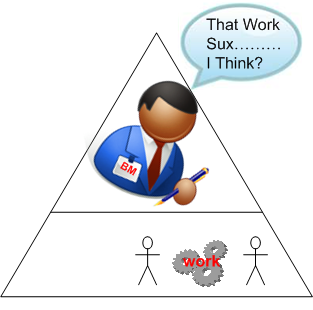
In a time of crisis, some “leadership” experts promote imposing the corpo equivalent of marshal law via the execution of more top-down control and discipline in the form of more frequent, multi-layered, financial reviews and detailed status reporting.
The thinking behind the “more control” approach is that by shining the light more often, and at a higher intensity, on those directly-in-the-soup will cause the crisis to dissolve. Another unquestioned assumption behind the “more control” approach is that the light-shiners will be able to better understand the real problems behind the crisis and offer “helpful” solution idea candidates – inspiring the troops to success.
Sounds great, right? Let’s switch gears, step into the deliciously diabolic role of devil’s advocate, and ask “what’s wrong with this picture?“. Are these thoughts missing:
- those doing the shining may be responsible for the mess in the first place but don’t realize it.
- those doing the shining have been so disconnected from the real world for so long that they are incapable of understanding the problem details well enough to help?
- those being illuminated will batten down the hatches, narrow their thinking, and withhold important information if they think it can be used against them.
Nah, probably not. After all, it’s a no brainer that the best and brightest problem solvers and decision makers sit at the top of the pyramid. If you don’t believe me, simply ask them.
 On the other hand, a different pool of leadership experts promotes the unintuitive loosening of controls and less formality in a time of crisis – to allow more ideas from more people to surface and have a chance of resolving the crisis. Which approach do you think has a better chance of success?
Don’t try to address difficulties by adding more meetings and management. More meetings plus more documentation plus more management does not equal more success. – NASA SW Dev Approach
Judgment, Integrity, Credibility, Honesty, And $53M
The often (but not always) incestuous relationship between hand picked corpo board of directors yes-men and CEOs has come to the fore again: “HP orders probe into Hurd’s departure”. Why would Hewlett Packard, as represented by its board of derelicts, I mean directors, investigate their own handling of Hurd’s dismissal? They’re not doing it because it’s the right thing to do. They’re only doing it because they’re being forced to:
“HP’s plan for an outside investigation follows a lawsuit in San Jose, Calif., by shareholders who allege that the company’s directors wasted money by giving Hurd $53 million in severance.”
Yepp, a gift of $53 million to Mr. Hurd for exhibiting:
A profound lack of judgment. It (Hurd’s dismissal) had to do with integrity, it had to do with credibility and it had to do with honesty.” – Mike Holston, HP’s general counsel
After doling out that kind of dough, can’t the same be said about HP’s board? Well, that’s what we may find out after the dust settles. In the meantime, HP’s board may have gotten what they deserved. Mr. Hurd has Madoff nicely by skidaddling over to one of HP’s biggest competitors, Oracle Inc. He and his buddy, Oracle oracle Larry Ellison, sure do know how to make money.
“Mark did a brilliant job at HP and I expect he’ll do even better at Oracle,” said CEO Larry Ellison in a statement.
The real question is: “How isolated are these types of incidents?“. Just because they get reported in the press doesn’t mean that dishonesty runs rampant in the bozone layers of big business. Nevertheless, it begs the question: “Is the taken-for-granted, rarely-questioned process in which CEOs and boards of directors are chosen broken?“. Boards anoint CEOs (who coincidentally are often the chairman of the board) and CEOs nominate board members for election. What do you think of the process? How can it be made better?

Hostile, Cruel, And Wasteful
From an interview with C++ creator Bjarne Stroustrup, I give you this:
Corporate practices can be directly hostile to individuals with exceptional skills and initiative in technical matters. I consider such management of technical people cruel and wasteful. – Bjarne Stroustrup
I think this may be the main reason why brilliant technical startup companies are born. In an ironically altruistic twist, the unconsciously idiotic ways in which DYSCO SCOLs treat their best human “resources” (sic) hurt themselves while simultaneously benefiting the world.
Culture Shift
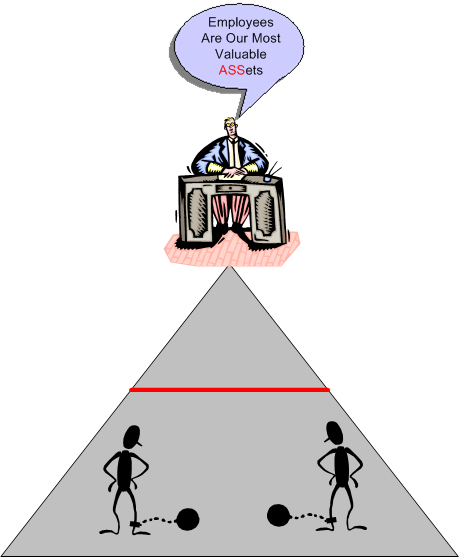
In the video “Hacking Your Organization“, Lloyd Taylor states that low org productivity is often caused by a mismatch between explicit and implicit culture. When the espoused culture doesn’t align with the actual day-to-day operating culture of an org, people (because they’re not dumb asses) get disillusioned and turned off by the hypocrisy. Hence, it’s only natural that many people will “hang up the phone” and “disconnect & distance” themselves from their work and do what little they can to get by. Of course, the BM hypocrites responsible for keeping the implicit and explicit cultures unsynchronized judge these DICs as lazy under-performers. That’s because there’s no way that they, themselves, can be the catalyst of a disillusioned workforce. In their minds, they’re infallible and whatever they say about the culture is auto-magically true.
Mr. Taylor’s model, and he stresses that it’s just a model, partitions corpo cultures into four archetypes: communal, mercenary, networked, and fragmented. The criteria he uses to diagnose a culture are sociability and solidarity:
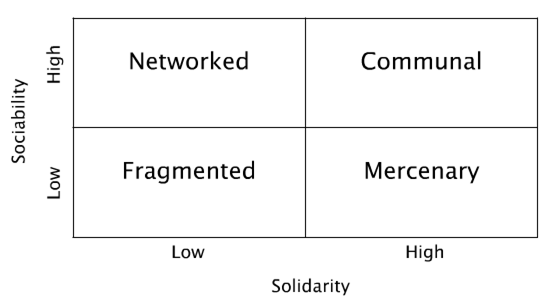 In Lloyd’s view, virtually all startups begin with vibrant communal cultures. As a company grows, because of the physical limitations of the human brain, a cultural shift has to occur at some point:
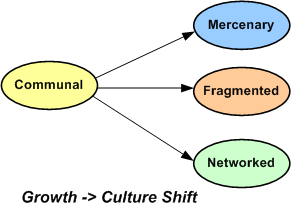
If, during growth, the company’s leaders don’t steer the org toward the culture that they want, or they hard-headedly maintain that their culture is still communal when a shift has occurred, then the implicit-explicit cultural mismatch that triggers low productivity will manifest. Bummer for all involved.
Mr. Taylor stresses that no culture is fully good or bad and that success can be sustained in all four culture types as long as the espoused culture is aligned with the actual culture – especially during cultural shifts. This is possible because each individual will know where they stand and what they need to do to become successful themselves. They can also decide whether they are comfortable operating in the org culture, and when to move on.
The hour long video is highly informative and Mr. Taylor uses all kinds of examples to bolster his theoretical views: Enron, Anderson Consulting, Lehman Brothers, Apple, Zappos.com, Hewlitt Packard, Oracle, etc. Hop on over to InfoQ and check it out if you’re interested in the fascinating topic of group culture.
The BCMT

Print out, copy, distribute, collect, and evaluate. If the results aren’t to your liking, ignore and bury them. Otherwise, toot your horn loudly and frequently.

Why am I here?
WTF?
Meh!
D'oh!

My BTC Address



 Bulldozer00's Blog