Archive
Priority List
In his brilliant and elegant essay, “Capitalism is Dead. Long Live Capitalism“, Gary Hamel laments about the deterioration of capitalism into those other bad, highly inequitable, anti-American “isms”. He says:
So why do fewer than four out of ten consumers in the developed world believe that large corporations make a “somewhat” or “generally” positive contribution to society? Why is it that only 19% of Americans tell pollsters they have “quite a lot” or a “great deal” of confidence in big business?
In Gary’s opinion, the reason is……
… the unwillingness of executives to confront the changing expectations of their stakeholders. In recent years, consumers and citizens have become increasingly disgruntled with the implicit contract that governs the rights and obligations of society’s most powerful economic actors—large corporations. To many, the bargain seems one-sided—it’s worked well for CEOs and shareholders, but not so well for everyone else.
This lead-in dovetails into the idea of a “CEO stakeholder priority list“. The UML class diagram below shows six types of corpo stakeholders. Of course, the six types were arbitrarily picked by me and there may be others on the same level of abstraction that you think are missing. Notice that the “earth” is a passive stakeholder that can’t directly and instantaneously exert pressure on the way corpricracies behave; unlike the other people-type stakeholders.

Now, check out some sample CEO stakeholder priority lists below. With 6 stakeholders types, the number of unique lists is quite a lot: 6! = 6 x 5 x 4 x 3 x 2 = 720. I just semi-randomly concocted these three specific sample lists so that I can continue babbling on while hoping that you’re still reading my drivel.
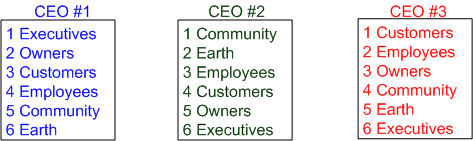
My own unscholarly opinion is that the vast majority of CEOs, their appointed-yes-men VP teams, and their hand picked boards of directors either consciously or unconsciously operate according to the blue list (or any other instance that prioritizes the “executives” stakeholder first). My opinion aligns with Mr. Hamel’s assertion that too many corpo captains are making decisions that materially favor themselves (first) and their shareholders while disproportionately harming the other stakeholder types.
But wait, hasn’t this always been the case with capitalism? If so, why has it suddenly become fashionable for dweebs like me to vilify corpricracies that operate in accordance with the blue list?
In closing, I feel the need to repeat the best quote in Hamel’s blarticle:
There are CEOs who still cling to the belief that a company is first and foremost an economic entity rather than a social one. – Gary Hamel
To those CEOs who still think that the word “social” equates to communism, get over it and move into this century.

Why am I here?
WTF?
Meh!
D'oh!

My BTC Address



 Bulldozer00's Blog