Archive
Viable, Vulnerable, Doomed II
As the title indicates, this blow-sst is an extension of yesterday’s inane blabberfest. While yesterday’s lesson (<— lol!) dealt with the static structure of Viable, Vulnerable, and Doomed (VVD) orgs, today’s BS-fest talks about the dynamic behavior of VVD social groups. Behold that if you’re conscious and you concentrate on observing the world around you, the structure plus behavior of an org will clearly and unambiguously reveal over time what it does. Forget what its so-called leaders say it does, observe for yourself how the stratified monolith is structured, how it behaves, and what it actually produces. If you’re diligent and astute, you’ll discover the principle of POSIWID: the Purpose Of a System Is What It Does (not what it’s leadership says it does).
The UML diagram below shows a state machine model of: the mutually exclusive states of a VVV system, the transitions between the states, and the events that trigger the transitions. But wait…… VVV? What happened to VVD? Well, in a dumbass attempt to inject levity and fruitlessly retain your interest, I changed the name of the “Doomed” state to “”Vucked” so that all states start with the letter “V”. Stupid, no?
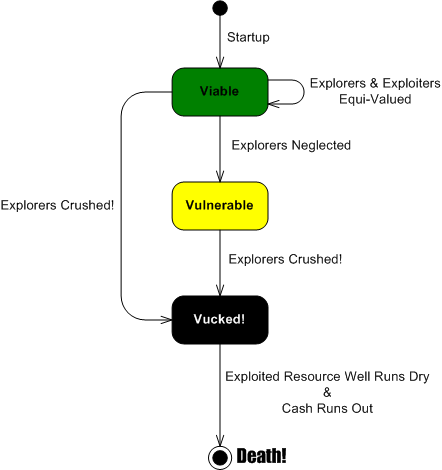
Virtually all startup companies initialize into the viable state. After all, if they didn’t have a product or service that a market didn’t want to consume, they wouldn’t be born as a viable entity, right? Over time, if they neglect their explorers and single mindedly, greedily, milk their product/service to death, eventually they’d become vulnerable to competitors. If the leadership becomes drunk with success and their heads expand too far, they start resenting and rejecting their explorers – they become vucked!
Unless, as the figure below shows, an epiphany in the head shed occurs (and the chances of that occurring in fat headed executives rolling in dough are incredibly slim) it’s death to the org and all its membership – including the innocents who had no hand in the implosion. This ain’t a hollywood story so there’s no happy ending.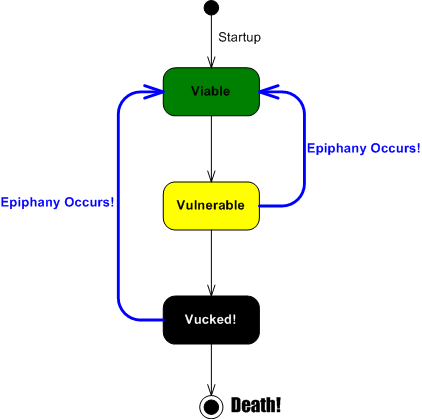
Preserving The Problem
Because I’m a shirker, I love Clay Shirky. Not only does he have a kool name, the guy is an innovative thinker:
“Institutions will try to preserve the problem to which they are the solution.” — Clay Shirky
Like many rich and insightful quotes that I stumble upon, I didn’t quite get this one at first. But after thinking about it, I conjured this one up:
While espousing that they want unity of purpose, collaboration, esprit de corps, teamwork, and yada-yada-yada, the juntas in head sheds everywhere unwittingly (wittingly?) preserve the very same problem they supposedly want solved. In this example, the problem is poor corpo performance caused by fragmentation, isolation, stratification, disengagement, and mis-communication. CCRATS not only preserve the performance problem, I’ll go one better than the Clayster. I’ll assert that CGHs amplify the stank by nurturing and perpetuating their hand made caste system of divisive titles, arbitrary reward systems, and socially disconnected working units/departments/groups. It’s silo city – by design.
So why do head sheds everywhere perpetuate this Alice In Wonderland behavior in spite of the ominously growing evidence that it doesn’t work in an increasingly flat and globally connected world? Because changing the entrenched system they collectively built to take care of themselves would flatten the hierarchy and cause them to come tumbling down from the heavens. Do you think many of the “honorable and infallible” talking heads of our institutions want, or have the will, to give up their elevated personal standing for the greater good of the whole? I suspect not many, but those who can and do will prosper in this age of rapid change.
Rules, Exceptions, Guidelines
Unlike natural laws (on the macroscopic level) which unremorsefully allow no exceptions, I think all human concocted rules should be flexible to exceptions, no? If you believe that, then maybe the word “rule” should be replaced with “guideline”. Doing this can be interpreted as splitting hairs, but I think it may positively affect those who are required to operate by the “rules”. It shows respect and implies that some freedom is allowed to continuously improve things. Since the yearning for freedom is built into the fiber of every human being, those in positions of authority who conjure up the “rules” should take heed.
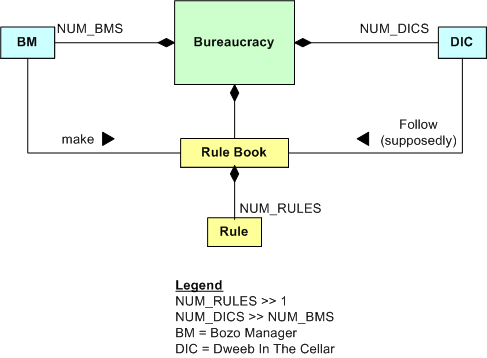
Note: The model above is a UML “class diagram”, which is used to depict the static structure of a system. Other UML diagrams can be used to model the behaviors of a system. The diagram can be interpreted as follows:
- A bureaucracy has NUM_BMS BMs and NUM_DICS DICs and a Rule Book.
- The BMs make the rule book, which has NUM_RULES (usually a boatload) rules.
- The DICs are obliged to follow the rules, written or unwritten (but understood) – or else.
The Commencement Of Husbandry
The figure below was copied over from yesterday’s post. Derived from Joseph Tainter’s “The Collapse of Complex Societies”, it simply illustrates that as the complexity of a social organizational structure necessarily grows to support the group’s own growth and survival needs, the adaptability of the structure decreases. The flat and loosely coupled institutional structures originally created by the group’s elites (with the willing consent of the commoners) start hierarchically rising and coalescing into a rigid, gridlocked monolith incapable of change. At the unknown future point in time where an external unwanted disturbance exceeds the group’s ability to handle it with its existing complex problem solving structures and intellectual wizardry, the whole tower of Babel comes tumbling down since the monolith is incapable of the alternative – adapting to the disturbance via change. Poof!
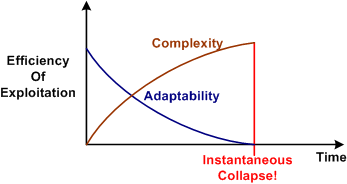
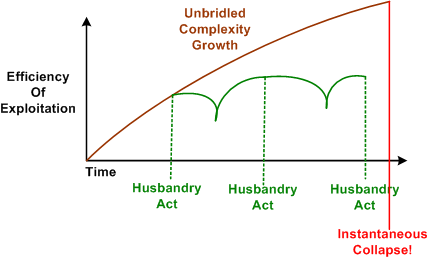
According to Tainter, once the process has started, it is irreversible. But is it? Check out the figure below. In this example, the group leadership not only awakens to the dooms day scenario, it commences the process of husbandry to reverse the process by:
- Re-structuring (not just tinkering and rearranging the chairs) for increased adaptability – by simplifying.
- Scouring the system for, and delicately removing useless, appendix-like substructures.
- Discovering the pockets of fat that keep the system immobile and trimming them away.
- Loosening dependencies between substructures and streamlining the interactions between those substructures by jettisoning bogus processes and procedures.
- Installing effective, low lag time, internal feedback loops and external sensors that allow the system to keep moving forward and probing for harmful external disturbances.

If the execution of husbandry is boldly done right (and it’s a big IF for humongous institutions with a voracious appetite for resources), an effectively self-controlled and adaptable production system will emerge. Over time, and with sustained periodic acts of husbandry to reduce complexity, the system can prosper for the long haul as shown in the figure below.
Services And Outcomes
In an e-mail from friend and mentor Bill Livingston, he said:
If duty is focused on method and practices, there can be no responsibility either for meeting the objective or for any consequences of services. If goal attainment is chosen paramount, there can be no limitations on methodology. Duty for professional services is given by authority. Responsibility for outcomes must be willingly taken by the designer. – William L. Livingston
Think about how obsessed most companies (especially large ones run by fat heads) are with regard to following standard corpo policies, rules, methods, and practices. In other words, red freakin’ tape. In these abominations that have lost their way, if one is a good soldier and loyally follows the unchangeable rules inscribed in stone by the dudes in the head shed, there can be no repercussions for failure to achieve goals. After all, since the corpocrats created the operational rule set and they’re (of course) infallible, that means the rule set is perfect. Hence, if you follow the rules to the letter but cause a disaster, you’re absolved.

Underbid And Overpromise
As usual, I don’t get it. I don’t get the underbid-overpromise epidemic that’s been left untreated for ages. Proposal teams, under persistent pressure from executives to win contracts from customers, and isolated from hearing negative feedback by unintegrated program execution and product development teams, perpetually underbid on price/delivery and over-promise on product features and performance. This unquestioned underbid-overpromise industry worst practice has been entrenched in mediocracies since the dawn of the cover-your-ass, ironclad contract. The undiscussable but real tendency to, uh, “exaggerate” an org’s potential to deliver is baked into the system. That’s because competitors and customers are willing co-conspirators in this cycle of woe. The stalemate ensures that there’s no incentive for changing the busted system. As the saying goes; “if we can’t fix it, it ain’t broke!“. D’oh!

If a company actually could take the high road and submit more realistic proposals to customers, they’d go out of business because non-individual customers (i.e. dysfunctional org bureaucracies where no one takes responsibility for outcomes) choose the lowest bidder 99.99999% of the time. I said “actually could” in the previous sentence because most companies “can’t“. That’s because most are so poorly managed that they don’t know what or where their real costs are. Unrecorded overtime, vague and generic work breakdown structures, inscrutable processes, and wrongly charged time all guarantee that the corpo head sheds don’t have a clue where their major cost sinks are. Bummer.
Wealth And Effort
Any form of “ism” can work if it creates and sustains a large middle class that feels it can make it to the top of the pyramid of privilege by the fruits of their own labor. As soon as the bubble bursts and the middle class feels that the rich keep getting richer without any effort and the poor keep getting poorer regardless of effort, all is lost and a revolution is in the offing. Sure, a powerful police force may temporarily stave off the revolution, but not forever. Over time, the innate human desire for liberty trumps oppression like water dissolves rock.

In the USA, democracy and the right of every person to vote has worked pretty well to stave off the destruction of the middle class. However, when rich elites gain publicly invisible control over all political parties and force the government to allow them to operate unfettered without any oversight, the result is extreme capitalism and the potential fall of the middle class. I don’t know if it’s happening in America, but it sure seems like it. When big fat corpo bureaucracies demand and get capitalism on the way up and socialism (bailouts) on the way down, there’s no risk of consequences to their behavior and they have no reason to change their middle class busting ways. “Too big to fail” and “too little to succeed” sux for the middle class. Let them eat cake.
Line, Dot, Cone
My friend and mentor from afar (if you’ve looked around your local environment, there’s an incredible dearth of mentors from a-near), William L. Livingston, is about to hatch his fourth book: “Design For Prevention“. I’m happy to say that I’ve served as a reviewer and a source of feedback for D4P. I’m sad to say that it won’t become a New York Times bestseller because it’s one of those blasphemous books that goes against the grain and will be rejected/ignored by those it could help the most – institutional leaders.
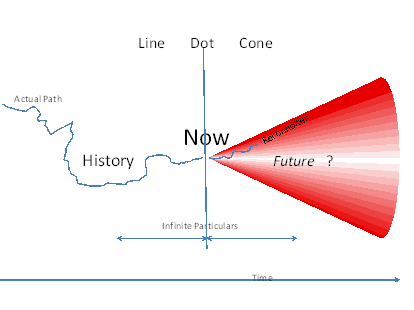
One of the graphics in DfP that I’ve fixated on is the “Line Dot Cone” drawing. As shown below, the path to “now” is not smooth and deterministic. It’s non-linear and quite haphazard. Likewise, the future holds an infinite cone of possibilities. The only way to narrow the cone of future uncertainty is to perform continuous reconnaissance via sensing/probing/simulating and then intelligently acting upon the knowledge gained from the effort, where intelligence = appropriate selection (W. Ross Ashby) and not academic knowlege.
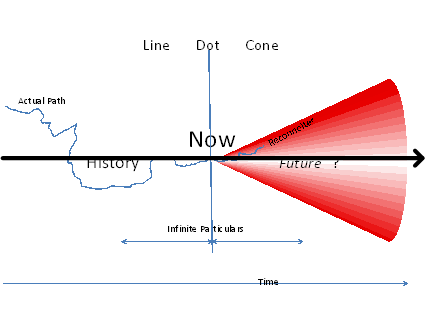
CCH corpocracies don’t acknowledge the existence of the Line-Dot-Cone reality. It would undermine the carefully crafted illusion that the dudes in the penthouse have projected about their ability to make the future happen. In their fat heads, as the overlay below shows, progress always occurs linearly in accordance with their infallible control actions. Thus, no reconnaissance is needed and all will be well for as long as they rule the roost.
Inappropriate
It seems that the word “inappropriate” is in fashion these days. It’s the modern and eloquent replacement for old and tired words like “disrespectful”, “disloyal”, “blasphemy”, “heresy”, and “sacrilege”. Infallible judgers are always on the lookout for impactful, fear-inducing words like these to silence conscientious objectors and concerned citizens. As you might surmise, the word “inappropriate” is directed at me quit frequently :).
Based on my personal experience, I can tell you that the fear effect works, but it’s success is person-specific. In my case, the fear effect usually wears off quickly and I’m back at being “inappropriate” yet again.
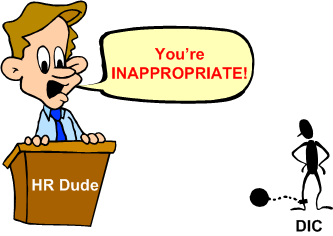
In dysfunctional CCHs, one of the primary functions of HR departments is to police the behavior of the DICforce. Thus, since they’ve been “approved” by the corpocracy to inject fear into non-conformers and rabble rousers, they’re the final arbiter of what’s deemed “inappropriate”. When someone “reports” (a.k.a rats out) someone to HR, the group happily kicks into action to assess the allegation. Unlike the drawn out investigation that occurs when a DIC rats out another DIC, the verdict of “inappropriate” is always certain when a manager rats on a DIC. You see, since HR is an integral member of the management guild and it gets paid by its brethren, it does whatever is best for management – which may not be best for the company as a whole.
Since (as I’ve said several times before) I like to make things up, don’t believe a word I say. If I could, I’d change the name of this blog to “Don’t Read This Blog Because I Like To Make Things Up“.
Ego Appeasement
It’s funny how dysfunctional orgs will demand unquestioned loyalty from the masses in order to help the org grow and develop, but at the same time thwart that goal by appeasing egos to the detriment of the org as a whole. In defiance to what’s best for the community that they lead, top echelon leaders will not merge or disassemble org units if middle managers will have their egos bruised.
For example, if it makes economic sense to tuck or merge an obsolete unit run by a senior VP under a “regular” VP for the betterment of the whole org, the top dogs won’t do it out of “respect” for the titular system of privilege. God forbid that a senior VP report to a regular VP. It’s verboten in CCH-land. Another corpo faux pas is forming an org that may increase profitability but has a VP reporting to a lowly Director. Ain’t gonna happen.
Such is the power of titular hierarchies to thwart their own development.


Why am I here?
WTF?
Meh!
D'oh!

My BTC Address



 Bulldozer00's Blog