Archive
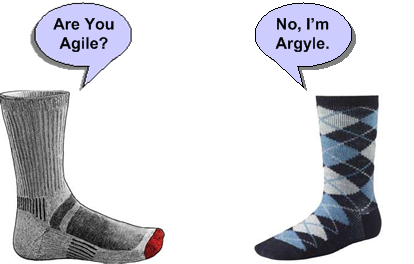
No, I’m Argyle
When something is so over-hyped like, say, “agile“, if you try it out and don’t find it to be effective, the high priests will tell you that you’re doing it wrong. If you don’t try it out because your common sense and experience tell you it won’t work effectively in the context you’re in, then the high priests will call you a Luddite. The high priests of anything over-hyped always have their bases covered, no?
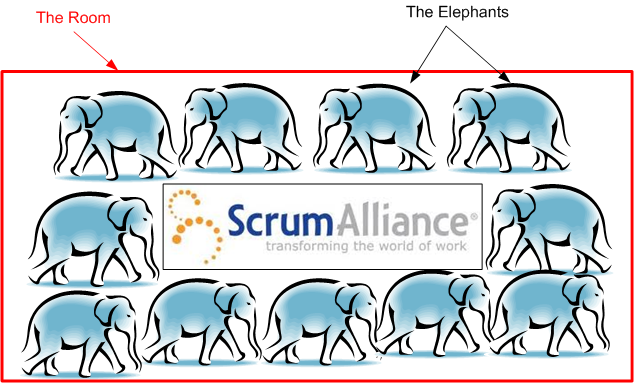
The Elephants In The Room
One of the originators of RUP and the creator of the 4+1 view modeling approach, Phillippe Kruchten, has written a terrific article on the “twenty elephants in the room” that haunt the agile movement. Here’s a subset of his infamous list that resonates with me:
- Commercial interests censoring failures (tell me about the failures).
- Failure to dampen negative behaviours (no analysis of failures).
- Context and contextual applicability of practices (can you say “safety-critical systems“?)
- Anarchism (preventing a more systematic organization of the body of knowledge).
- Elitism (blame failure on the “unenlightened” others)
- Certification (effective tool to assess maturity for individuals and organization, or commercial ploy from trainers and consultants to rake in the dough?)
- Role of architecture and design (they are still often equated to BUFD, and rapidly brushed aside with claims of YAGNI, or “we’ll refactor it later”)
- Scaling naïveté (with a bit of imagination all agile practices scale up, and if this does not work it is because you have not tried hard enough).
- Technical debt (while agile practices could help control technical debt, they are also often at the root, the cause of massive technical debt).
- Effective ways of discovering information without writing source code (uh, can you say “modeling“?).
Of course, because of his involvement in the development of the perceived horrible, heavyweight, RUP process, extreme agilistas will not even listen to Phillippe’s ideas – let alone ponder the validity of any of them.
Requirements Stability
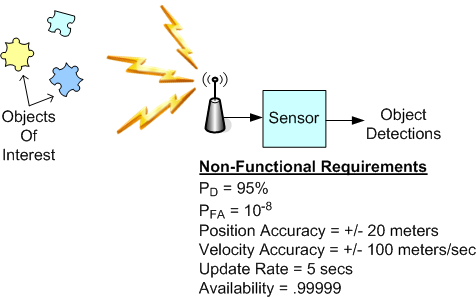
Over the years, I’ve been assigned to the roles of specifier, designer, documenter, writer, and maintainer of source code for radar sensor systems that are used in safety-critical applications. These sensors get deployed in noisy, interference-infested environments and they must perform at high levels of availability and with great fidelity.
The figure below shows a generic sensor system context diagram along with some typical non-functional requirements (with made-up values) that are critical for customer acceptance. My experience has indicated that once these black-box level requirements are specified, they rarely change. Thus, the agile war cry to continuously “embrace requirements change” may not fully apply to the development of this class of systems, no?
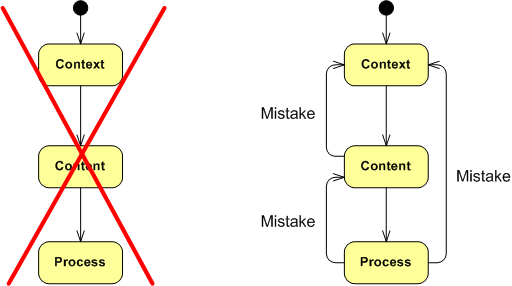
The point I’m trying to make here is to be wary of morphing into a lap-dog zealot for any technique, process, method, or practice – which includes the hallowed “agile” brand. For a long time, my motto (thanks to the work of W. L. Livingston and John Warfield) has been: Context, Content, and then Process (CCP). Synthesize an understanding of the problem context, design the content of the solution (structure and behavior), and only then design the solution construction process – tailored to the context and content. Of course, since mistakes and errors will be made during the journey, backtracking and iterative convergence are expected. Thus, “embrace mistakes, errors, backtracking, and iteration” is my war cry. What’s yours? What’s your org’s?
No Man’s Land
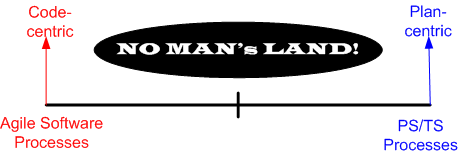
Having recently just read my umpteenth Watts Humphrey book on his PSP/TSP (Personal Software Process/Team Software Process) methodology, I find myself struggling, yet again, to reconcile his right wing thinking with the left wing “Agile” software methodologies that have sprouted up over the last 10 years as a backlash against waterfall-like methodologies. This diagram models the situational tension in my hollow head:

It’s not hard to deduce that prescriptive, plan-centric processes are favored by managers (at least those who understand the business of software) and demonstrative, code-centric processes are favored by developers. Duh!
Advocates of both the right and the left have documented ample evidence that their approach is successful, but neither side (unsurprisingly) willingly publicizes their failures much. When the subject of failure is surfaced, both sides always attribute messes to bad “implementations” – which of course is true. IMHO, given a crack team of developers, project managers, testers, and financial sponsors, ANY disciplined methodology can be successful – those on the left, those on the right, or those toiling in NO MAN’s LAND.
l’ve been the anointed software “lead” on two, < 10 person, software teams in the past. Both as a lead and an induhvidual contributor, the approach I’ve always intuitively taken toward software development can be classified as falling into “no man’s land“. It’s basically an informal, but well-known, Brooksian, architecture-centric, strategy that I’d characterize as slightly right-leaning:
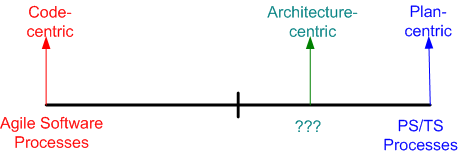
As far as I know, there’s no funky, consensus-backed, label like “semi-agile” or “lean planning” to capture the essence of architecture-centric development. There certainly aren’t any “certification” training courses or famous promoters of the approach. This book, which I discovered and read after I’d been designing/developing in this mundane way for years, sort of covers the process that I repeatedly use.
In my tortured mind (and you definitely don’t want to go there!), architecture-centricity simply means “centered on high level blueprints“. Early on, before the horses are let out of the barn and massive, fragmented, project effort starts churning under continuous pressure from management for “status“, a frantic iterative/sketching/bounding/synthesis activity takes place. With a visible “rev X” architecture in hand (one that enumerates the structural elements, their connectivity, and the macro behavior that the system must manifest) for guidance, people can then be assigned to the sparsely defined, but bounded, system elements so that they can create reasonable “Rev 0” estimates and plans. The keys are that only one or two or three people record the lay of the land. Subsequently, the element assignees produce their own “Rev 0” estimates – prior to igniting the frenetic project activity that is sure to follow.
In a nutshell, what I just described is the front-end of the architecture-centric approach as I practice it; either overtly or covertly. The subsequent construction activities that take place after a reasonably solid, lightweight, “rev X”, architecture (or equivalent design artifact for smaller scale projects) has been recorded and disseminated are just details. Of course, I’m just joking in that last sentence, but unless the macro front end is secured and repeatedly used as the “go to bible” shortly after T==start, all is lost – regardless of the micro-detailed practices (TDD, automated unit tests, continuous integration, continuous delivery, yada yada yada) that will follow. But hey, the content of this post is just Bulldozer00’s uncredentialed and non-expert opinion, so don’t believe a word of it.
A Metafesto
Being a software engineer, I’m always on the hunt for better ways to develop software. In my continuous search for excellence, I’ve recently been bombarded by what seems like an endless stream of manifestos. Here are some of the most “famous” ones:
They’re all so brilliantly elegant and moving that I want to put them on little magnets and display them in my cube right next to the company core values and quality policy magnets.
In response to the manifesto craze, I’ve come up with my own “metafesto”. A manifesto about manifestos.
Enough already! Stop talking about manifesting some ideal behavior and just do it. Manifest what you wrote yourself. No need to get up on a soapbox and pontificate to the masses of little people so that they do things the “right” way. If what you preach works, and people see it and resonate with it, then they’ll manifest what you’re manifesting. I hereby renounce all software-oriented manifestos as self-righteous and dictatorial rules wrapped in elegant and poetic rhetoric.
Do as Ghandi says: ““We must become the change we want to see.” He didn’t say “Talk about the change we want to see” in the world.

Why am I here?
WTF?
Meh!
D'oh!

My BTC Address



 Bulldozer00's Blog