VCID, ACID, SCID
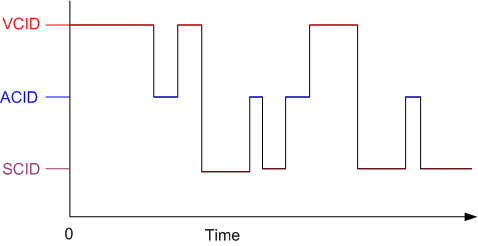
First, we have VCID:
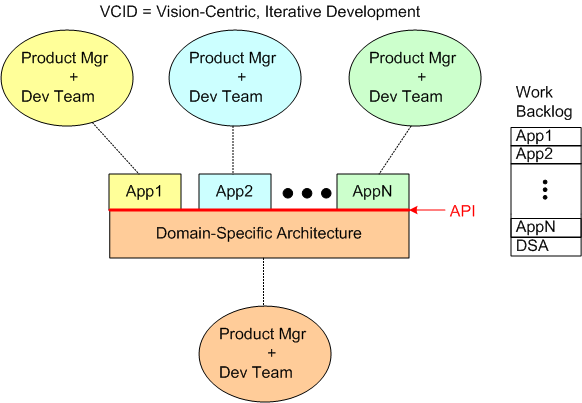
In VCID mode, we iteratively define, at a coarse level of granularity, what the Domain-Specific Architecture (DSA) is and what the revenue-generating portfolio of Apps that we’ll be developing are.
Next up, we have ACID:
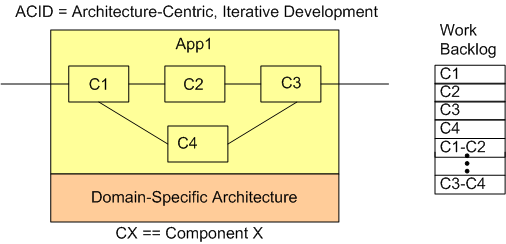
In ACID mode, we’ll iteratively define, at at finer level of detail, what each of our Apps will do for our customers and the components that will comprise each App.
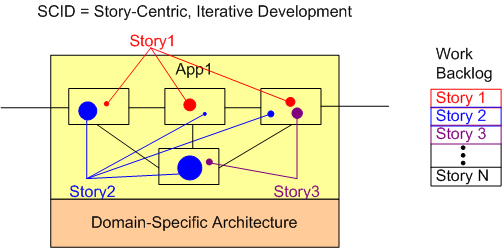
Then, we have SCID, where we iteratively cut real App & DSA code and implement per-App stories/use cases/functions:
But STOP! Unlike the previous paragraphs imply, the “CID”s shouldn’t be managed as a sequential, three step, waterfall execution from the abstract world of concepts to the real world of concrete code. If so, your work is perhaps doomed. The CIDs should inform each other. When work in one CID exposes an error(s) in another CID, a transition into the flawed CID state should be executed to repair the error(s).
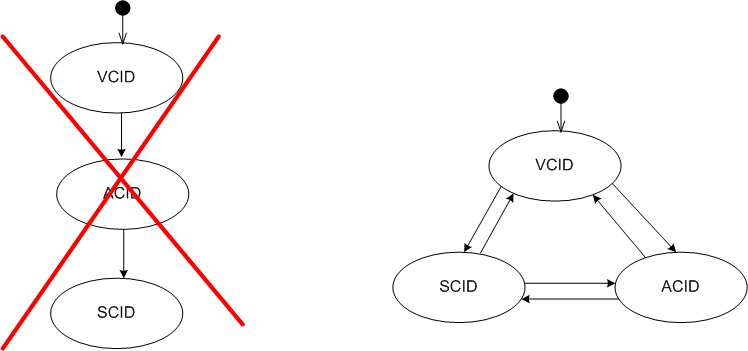
Managed correctly, your product development system becomes a dynamically executing, inter-coupled, set of operating states with error-correcting feedback loops that steer the system toward its goal of providing value to your customers and profits to your coffers.
Nothing Is Unassailable
I recently posted a tidbit on Twitter which I thought was benignly unassailable:
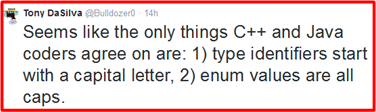
Of course, Twitter being Twitter, I was wrong – and that’s one of the reasons why I love (and hate) Twitter. When your head gets too inflated, Twitter can deflate it as fast as a pin pops a balloon.

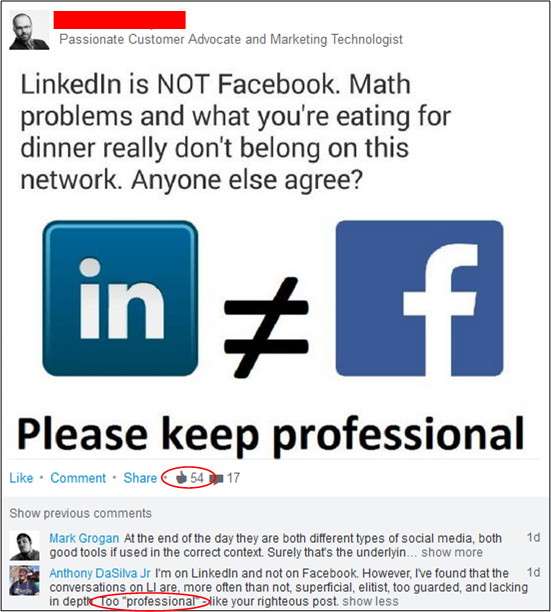
Too “Professional”
This is why I’m not a huge fan of LinkedIn.com:
The Annihilation Of Conceptual Integrity
When a large group or committee is tasked with designing a complex system from scratch, or evolving an existing one, I always think of these timeless quotes from Fred Brooks:
“A design flows from a chief designer, supported by a design team, not partitioned among one.” – Fred Brooks
“The entire system also must have conceptual integrity, and that requires a system architect to design it all, from the top down.” – Fred Brooks
“Who advocates … for the product itself—its conceptual integrity, its efficiency, its economy, its robustness? Often, no one.” – Fred Brooks
“A little retrospection shows that although many fine, useful software systems have been designed by committees and built as part of multi-part projects, those software systems that have excited passionate fans are those that are the products of one or a few designing minds, great designers.” – Fred Brooks
Note Fred’s correlation between “conceptual integrity” and the individual (or small group) for success.
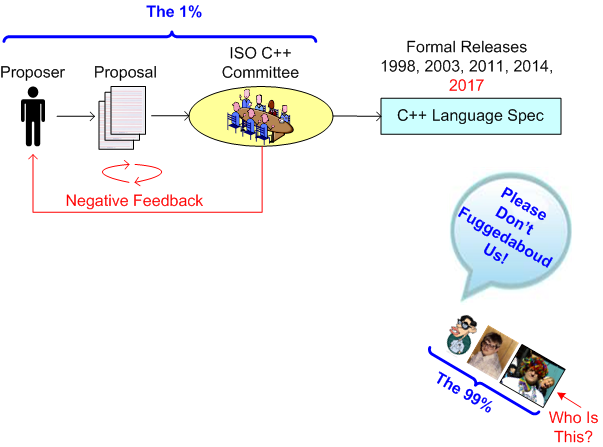
C++ is a large, sprawling, complex, programming language. With the next language specification update due to be ratified by the ISO C++ committee in 2017, Bjarne Stroustrup (the original, one-man, creator and curator of C++) felt the need to publish a passionate plea admonishing the committee to “stop the insanity“: Thoughts About C++17.
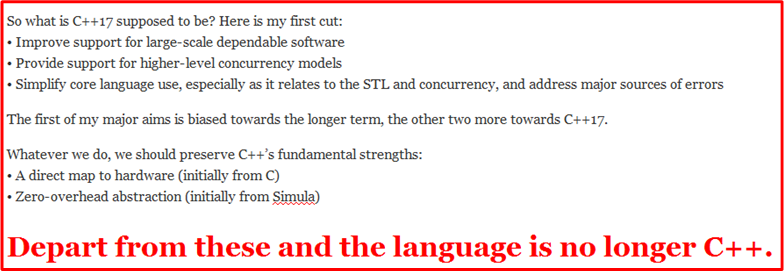
By reminding the committee members of the essence of what uniquely distinguishes C++ from its peers, Bjarne is warning against the danger of annihilating the language’s conceptual integrity. The center must hold!
It seems to be a popular pastime to condemn C++ for being a filthy mess caused by rampant design-by-committee. This has been suggested repeatedly since before the committee was founded, but I feel it is now far worse. Adding a lot of unrelated features and library components will do much to add complexity to the language, making it scarier to both novices and “mainline programmers”. What I do not want to try to do:
• Turn C++ into a radically different language
• Turn parts of C++ into a much higher-level language by providing a segregated sub-language
• Have C++ compete with every other language by adding as many as possible of their features
• Incrementally modify C++ to support a whole new “paradigm”
• Hamper C++’s use for the most demanding systems programming tasks
• Increase the complexity of C++ use for the 99% for the benefit of the 1% (us and our best friends).
Like all the other C++ committee members, Bjarne is a really, really, smart guy. For the decades that I’ve followed his efforts to evolve and improve the language, Bjarne has always expressed empathy for “the little people“; the 99% (of which I am a card-carrying member).
In a world in which the top 1% doesn’t seem to give a shit about the remaining 99%, it’s always refreshing to encounter a 1 percenter who cares deeply about the other 99 percenters. And THAT, my dear reader, is what has always endeared Mr. Bjarne Stroustrup to me.
I am often asked – often by influential and/or famous people – if I am planning a D&E2 (The Design And Evolution Of C++ version 2). I’m not, I’m too busy using and improving C++. However, should I ever find it convenient to semi-retire, D&E2 would be a great project. However, I could do that if and only if I could honestly write it without condemning the language or my friends. We need to ship something we can be proud of and that we can articulate.
W00t! I didn’t know I was influential and/or famous: And In The Beginning.
From Change Management To Change Prevention
Assume that in order to prevent chaos from reigning in your organizational processes, you design and place into operation a change management system.
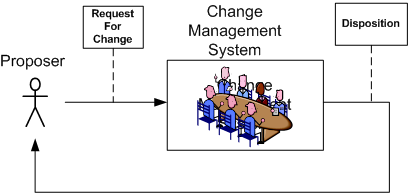
In order for your system to be effective, the turnaround time (i.e. latency), from request to disposition better be low enough so that people will be motivated to participate in the system.

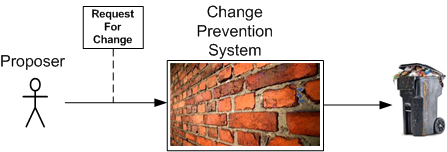
If, over time, you keep adding more and more evaluation rules to your system and imposing more and more pre-conditions (e.g. requiring a formal ROI analysis paper) on your proposers, your system’s latency will keep rising and its effectiveness at managing change (accepting the good and rejecting the bad) will keep decreasing. People will conclude that it’s just not worth their time to traverse your bureaucratic gauntlet. In the extreme case, your system will automagically morph from a change management system into a change prevention system – and you may not even know that it has happened.
Yes, But You Will Know
In recounting his obsession with quality, I recall an interview where Steve Jobs was telling a reporter about painting a fence with his father when he was a young boy. There was a small section in a corner of the yard, behind a shed and fronted by bushes, that was difficult to lay a brush on. Steve asked his dad: “Do I really have to paint that section? Nobody will know that it’s not painted.” His father simply said: “Yes, but you will know.”
It is pretty much a de-facto standard in the C++ (and Java) world that enum type names start with a capital letter and that enumeration values are all capitalized, with underscores placed between multi-word names:

Now, assume you stumble across some sloppy work like this in code that must be formally shared between two different companies:

Irked by the obvious sloppiness, and remembering the Steve Jobs story, you submit the following change request to the formal configuration control board in charge of ensuring consistency, integrity, and quality of all the inter-company interfaces:
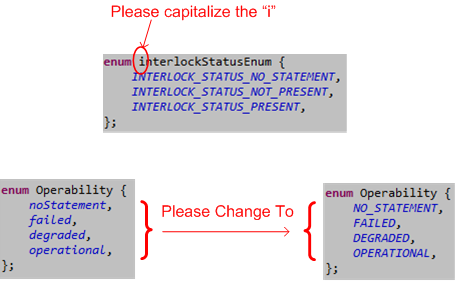
What would you do if your request was met with utter silence – no acknowledgement whatsoever? Pursue it further, or call it quits? Is silence on a small issue like this an indicator of a stinky cultural smell in the air, or is the ROI to effect the change simply not worth it? If the ROI to make the change is indeed negative, could that be an indicator of something awry with the change management process itself?
How hard, and how often, do you poke the beast until you choose to call it quits and move on? Seriously, you surely do poke the beast at least once in a while… err, don’t you?

Additive Vs Multiplicative
You may not believe this, but overall, I like “agile” management and coding practices- where they fit. The most glaring shortcoming that I, and perhaps only I, perceive in the “agile” body of knowledge concerns the dearth of guidance for handling both the social and technical dependencies present in every software development endeavor. The larger the project (or whatever you #noprojects community members want to call it), the more tangled the inter-dependencies. There are, simultaneously: social couplings, technical couplings, and the nastiest type of coupling of all: socio-technical couplings.
The best analogy I can think of to express my thoughts on the agile dependencies black hole is the linear vs multiplicative complexity conundrum as expressed so elegantly by Bertrand Meyer in his book, “Agile!“. But instead of the family friendly linguini and lasagna images Mr. Meyer employs in his book, I, of course, choose to use imagery more in line with the blasphemous theme of this blog:
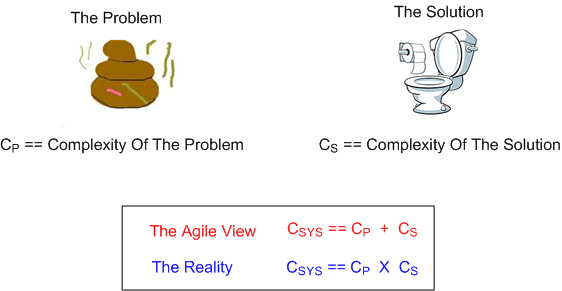
The complexity of the system is at least equal to the product of the problem and solution complexities. At worst, there are exponents associated with one or both multiplicands.
The Missing Role
Quick, quick! What role is missing from the classic Scrum 1.0 team configuration of developers, product owner, and scrum master?

Ooh, ooh, I know what’s missing….

Me thinks version 2.0 of the Scrum guide should include, and formally recognize, the glorious role of Agile Coach, no?
Since the Scrum Master has waaaaaaay to much to do already (running the daily 15 minute meeting and removing all those bazillions of impediments that the whiny developers willingly disclose every day), she can’t possibly fulfill the crucial role of agile coach. In addition to formal recognition, the Scrum Alliance should create a program where aspiring coaches can dole out some $$$$ to get certified.
The Apples To Apples Fallacy
To promote their infallible expertise, fathead consultants love to present apples-to-oranges comparisons as though they were apples-to-apples comparisons. One such prominent consultant (hint: a famous Forbes columnist) recently gushed over the success of music provider Spotify.com; contrasting its success to the team that built the buggy, slow, initial, version of the healthcare.gov web site.
As is almost always the case, these clever dudes leave out the oft-hidden, process-independent, contextual, forces that relentlessly work against success:

To imply that the Healthcare.gov team would have been successful if they simply employed agile practices (like Spotify.com) is to either be naive, disingenuous, or both.
Have you noticed that the press isn’t clamoring over the inadequacy of the healthcare.gov site anymore? Obviously, the development team must have righted the ship by morphing into a high performing juggernaut under the tutelage of a cadre of agile process consultant(s) – regardless of whether they did or they didn’t.

Why am I here?
WTF?
Meh!
D'oh!

My BTC Address



 Bulldozer00's Blog