Move In, Move Out
In many application domains, the Producer-Queue-Consumer pattern is used to transport data from input to output within a multi-threaded program:
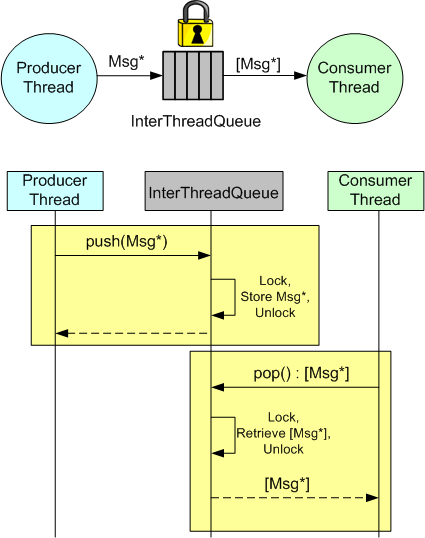
The ProducerThread creates Messages in accordance with the application’s requirements and pushes pointers to them into a lock-protected queue. The ConsumerThread, running asynchronous to the ProducerThread, pops sequences of Message pointers from the queue and processes them accordingly. The ConsumerThread may be notified by the ProducerThread when one or more Messages are available for processing or it can periodically poll the queue.
Instead of passing Message pointers, Message copies can be passed between the threads. However, copying the content can be expensive for large messages.
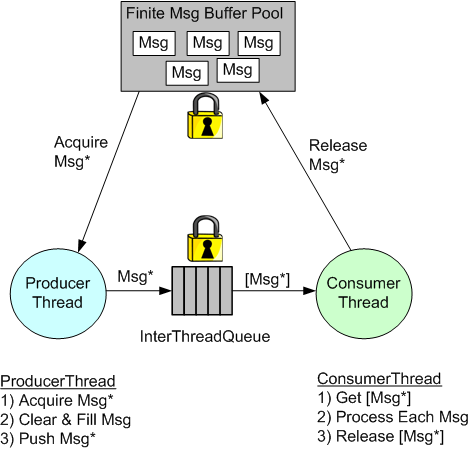
When using pointers to pass messages between threads, the memory to hold the data content must come from somewhere. One way to provide this memory is to use a Message buffer pool allocated on startup.
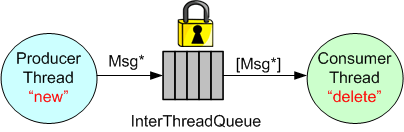
Another, simpler way that avoids the complexity of managing a Message buffer pool, is to manually “new” up the memory in the ProducerThread and then manually “delete” memory in the ConsumerThread.
Since the introduction of smart pointers in C++11, a third way of communicating messages between threads is to “move” std::unique_ptrs into and out of the InterThreadQueue:

The advantage of using smart pointers is that no “deletes” need to be manually written in the ConsumerThread code.
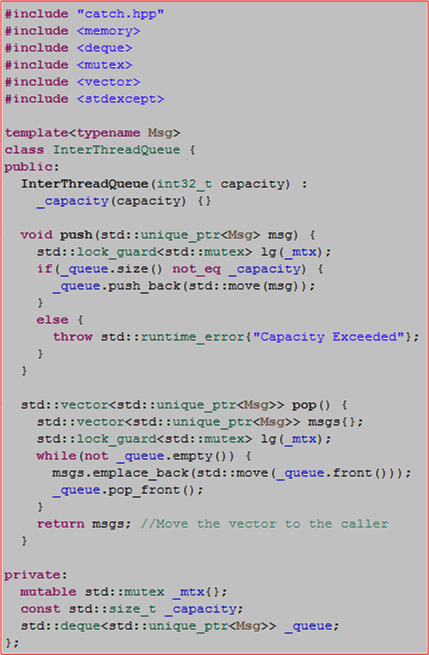
The following code shows the implementation and usage of a simple InterThreadQueue that moves std::unique_ptrs into and out of a lock protected std::deque.

#include "catch.hpp"
#include <memory>
#include <deque>
#include <mutex>
#include <vector>
#include <stdexcept>

template<typename Msg>
class InterThreadQueue {
public:
  InterThreadQueue(int32_t capacity) :
    _capacity(capacity) {}

  void push(std::unique_ptr<Msg> msg) {
    std::lock_guard<std::mutex> lg(_mtx);
    if(_queue.size() not_eq _capacity) {
      _queue.push_back(std::move(msg));
    }
    else {
      throw std::runtime_error{"Capacity Exceeded"};
    }
  }

  std::vector<std::unique_ptr<Msg>> pop() {
    std::vector<std::unique_ptr<Msg>> msgs{};
    std::lock_guard<std::mutex> lg(_mtx);
    while(not _queue.empty()) {
      msgs.emplace_back(std::move(_queue.front()));
      _queue.pop_front();
    }
    return msgs; //Move the vector to the caller
  }

private:
  mutable std::mutex _mtx{};
  const std::size_t _capacity;
  std::deque<std::unique_ptr<Msg>> _queue;
};

TEST_CASE( "InterThreadQueue" ) {
  //Create our object under test
  InterThreadQueue<int32_t> itq{2};

  //Note: my compiler version doesn't have std::make_unique<T>()
  std::unique_ptr<int32_t> dataIn{new int32_t{5}};
  itq.push(std::move(dataIn));
  dataIn = std::unique_ptr<int32_t>{new int32_t{10}};
  itq.push(std::move(dataIn));

  dataIn = std::unique_ptr<int32_t>{new int32_t{15}};
  //Queue capacity is only 2
  REQUIRE_THROWS(itq.push(std::move(dataIn)));

  auto dataOut = itq.pop();
  REQUIRE(2 == dataOut.size());
  REQUIRE(5 == *dataOut[0]);
  REQUIRE(10 == *dataOut[1]);

  REQUIRE(0 == itq.pop().size());
}
Generating NaNs

While converting serialized double precision floating point numbers received in a datagram over a UDP socket into a native C++ double type, I kept getting NaN values (Not a Number) whenever I used the deserialized version of the number in a numeric computation. Of course, the problem turned out to be the well-known “Endian” issue where one machine represents numbers internally in Big Endian format and the other uses Little Endian format.
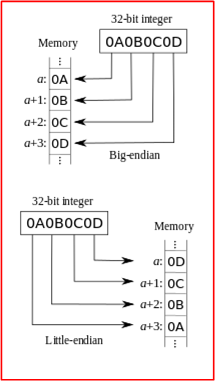
One way of creating a NaN is by taking the square root of a negative number. Another way is to jumble up the bytes in a float or double such that an illegal bit pattern is produced. Uncompensated Endian mismatches between machines can easily produce illegal bit patterns that create NaNs. Note that NaNs are only an issue in the floating point types because every conceivable bit pattern stored in an integral type is always legal.
To prove just how easy it is to produce a NaN by jumbling up the bytes in a double, I wrote this little program that I’d like to share:
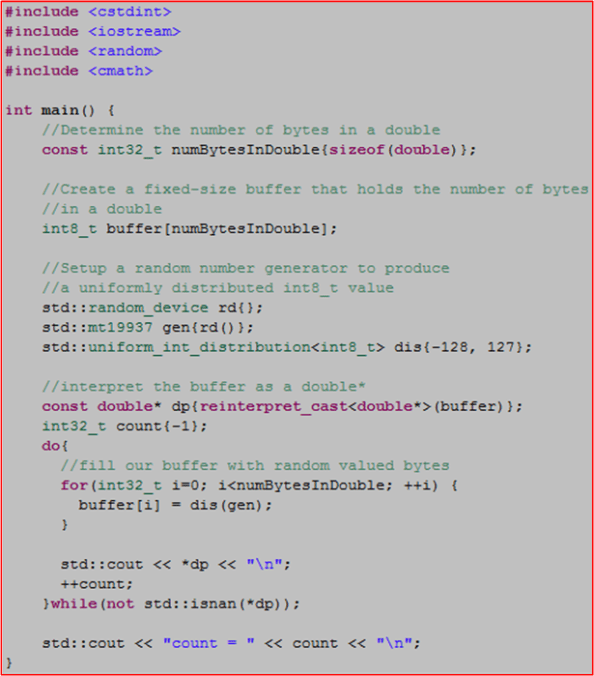
Here is a fragment of the output from a typical program run:
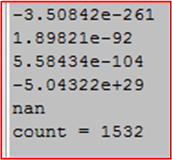
I was a little surprised at the low number of iterations it typically takes to produce a NaN, but that’s a good thing. If it takes millions of iterations, it may be hard to trace a bug back to a NaN problem.
For those who would try this program out, here is a copy-paste version of the code:
#include <cstdint>
#include <iostream>
#include <random>
#include <cmath>

int main() {
    //Determine the number of bytes in a double
	const int32_t numBytesInDouble{sizeof(double)};

	//Create a fixed-size buffer that holds the number of bytes
	//in a double
	int8_t buffer[numBytesInDouble];

    //Setup a random number generator to produce
    //a uniformly distributed int8_t value
    std::random_device rd{};
    std::mt19937 gen{rd()};
    std::uniform_int_distribution<int8_t> dis{-128, 127};

    //interpret the buffer as a double*
    const double* dp{reinterpret_cast<double*>(buffer)};
    int32_t count{-1};
    do{
      //fill our buffer with random valued bytes
      for(int32_t i=0; i<numBytesInDouble; ++i) {
        buffer[i] = dis(gen);
      }

      std::cout << *dp << "\n";
      ++count;
    }while(not std::isnan(*dp));

    std::cout << "count = " << count << "\n";
}

Perfect And Real
In the perfect Scrum world, software is developed over time in fixed-size (ΔT) time boxes where all the work planned for the sprint is completed within the timebox. Typically ΔT is chosen to be 2 or 4 weeks.
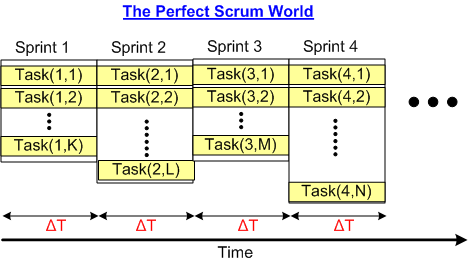
If all the tasks allocated to a sprint during the planning meeting are accurately estimated (which never happens), and all the tasks are independent (which never happens), and any developer can perform any task at the same efficiency as any other developer (which never happens), then bingo – we have a perfect Scrum world.
However, in the real world (Scrum or non-Scrum), some (most?) tasks are interdependent, some tasks are underestimated, and some tasks are overestimated:
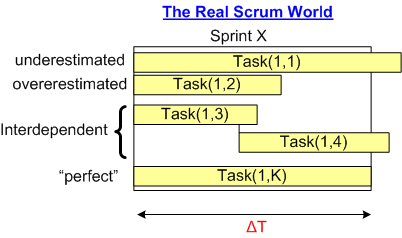
Thus, specifying a fixed ΔT timebox size for every single sprint throughout the effort may not be a wise decision. Or is it?
To The Moon Alice!
Using the information below as a reference point,

let’s do some rounding and truncating and assume the following:
- The total market capitalization of gold is $10T
- The total market capitalization of negative interest bonds is $10T
With 15M BTC in circulation, the current market capitalization of Bitcoin is around $10B. If (when?) Bitcoin eventually manages to steal just 10% of the market capitalization from each of those two assets, its market cap would balloon to $2T, resulting in a gain of 200X. Yepp, that’s “X” and not “%”.
Bitcoin’s current price per USD is around $750. Multiplying this price by 200 yields a new price of $150,000 per BTC.
Of course, the BTC price could collapse to $0 at any point in time. However, since its launch in 2009, it has been declared “dead” by various experts over 106 times – and still counting.

If you’ve got $750 of play money laying around, fuggedaboud searching for the next Amazon/Apple/Google/Netflix to invest in and hoping that the esteemed management of your new investment doesn’t fuck up for a decade. Consider doing the following instead:
- Opening an account on a reputable Bitcoin exchange (I use coinbase.com (USD-to-BTC exchange fee of 1%)).
- Buying 1 Bitcoin
- Becoming your own bank and immediately moving your 1 BTC out of your online exchange wallet and into your own PC-based wallet (I use Electrum), or mobile phone-based wallet (I use Blockchain), or hardware-based wallet (I use Trezor).
If BTC collapses or (more likely) you screw up taking full personal control over your BTC, your maximum loss will be $750. However, your upside is “to the moon Alice!“.

A New Alternative
Humor me for a moment and assume that you knew your country’s fiat currency was going to collapse soon.

The traditional response to such an impending calamity would be to exchange all your fiat currency for a precious metal, especially gold.
An alternative way to preserve your wealth in an apocalyptic world would be to exchange your fiat currency for a cryptocurrency, of which Bitcoin is king. If you didn’t take any action whatsoever, your accumulated wealth would disappear in a hyperinflationaty crisis – either slowly or instantaneously. Just ask the citizens of Nigeria, Venezuela, Brazil, Argentina, Zimbabwe or any other country with incompetent, corrupt governments that rack up huge debts and continuously devalue their currency.
The problems with holding physical gold bars are: storing them, transporting them, defending them against theft, and accurately dividing them up to pay others for food/services.
With Bitcoin and other cryptocurrencies, these problems are almost non-existent. You can store the majority of your cryptocoins in a tiny, easy to hide, encrypted and password protected, hardware wallet (Trezor, Ledger, Keepkey, etc). You can periodically transfer small mounts to your cell phone wallet to pay for food and other daily expenses.

So, what would YOU do if you knew for certain that your national currency was about to go poof? Isn’t it about time you started learning about the future of money, cryptocurrencies? I suggest you start with YouTube. There are tons of introductory Bitcoin videos to watch.
Front And Back
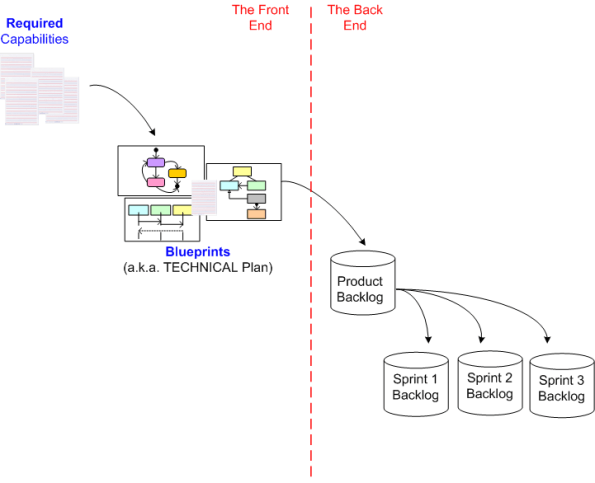
In response to my previous post, Glen Alleman pointed out that for large system development projects, the technical plan must be preceded by a higher level, coarser, activity. Glen is right.
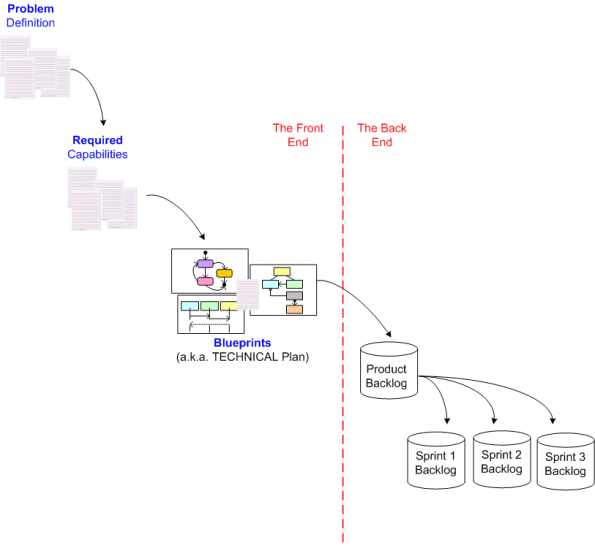
Senior analysts and architects don’t just sit down and start designing the technical plan from scratch. They work with experienced, knowledgeable customers to develop, define, and document the capabilities that the system must satisfy in order to solve their problem. Thus, I’ve augmented my diagram to show this important activity:
We’re not done yet. There is still (at least) one more front end activity missing from the diagram: the problem definition phase:
So, what precedes the problem definition phase? The pain of problem discovery….
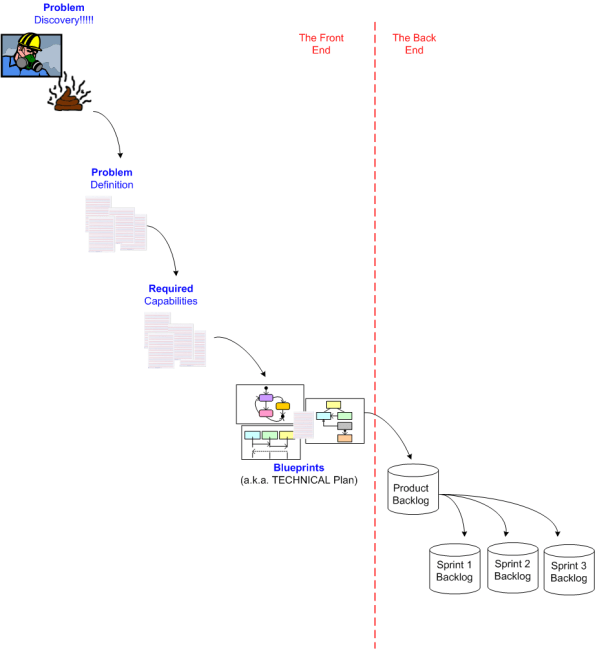
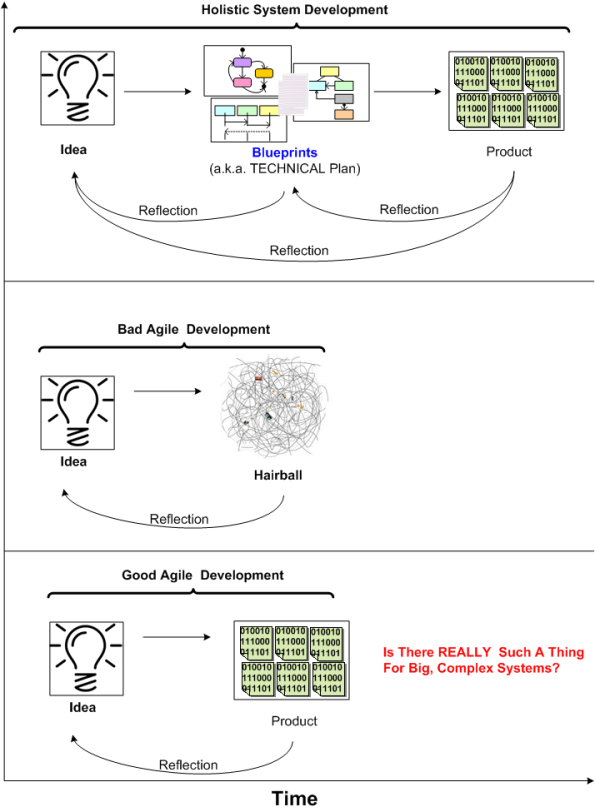
The Agile community does a great job of defining how the back end should be managed for cost-effective product development, but IMO they are mostly silent on the much-more-important, fuzzy, front end.
What Happened Before The First Product Backlog?
Some people like to ask: “What happened before the big bang?“. Being a geeko-nerd, I like to ask: “What happened before the first product backlog?”.
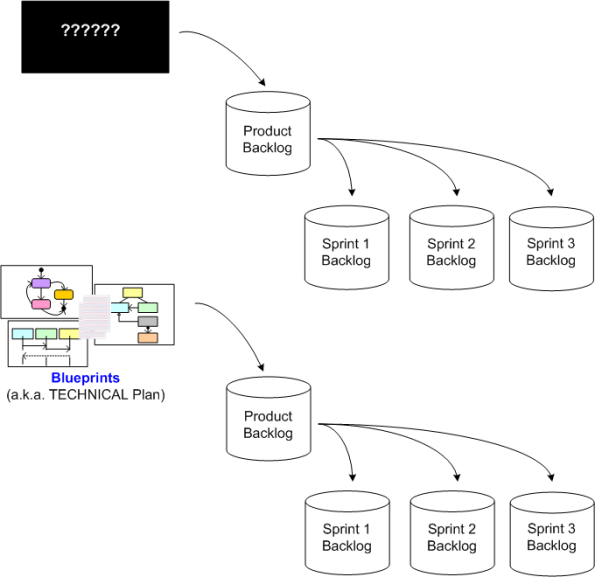
Regarding agile framework definitions, IMO, Scrum has the most well-documented and coherent definition of the bunch. However, since it remains silent on the issue, I still wonder: “WTF happens before the first product backlog?”.
For innately complex systems requiring a large amount of coordinated effort, here’s what I think should happen:
- A small group of senior domain analysts and system architects should spend a fair amount of un-pressured time to develop and document the high level, technical blueprints (structures + behaviors) for what needs to be built.
- The authoring group should disseminate and educate the rest of the development team on the technical vision.
- The team should populate and iterate on the first version of the product backlog.
- The team should decide on, and put in place, the development toolset and infrastructure that will be used to develop and test the system throughout the effort.
- The team, including the technical authors, should start incrementally and iteratively building the system – revisiting/updating the plans/product backlog frequently when new knowledge is discovered as the project moves forward.
What do YOU think should happen before the first product backlog?
Is There REALLY Such A Thing?
A Loss Of Heart
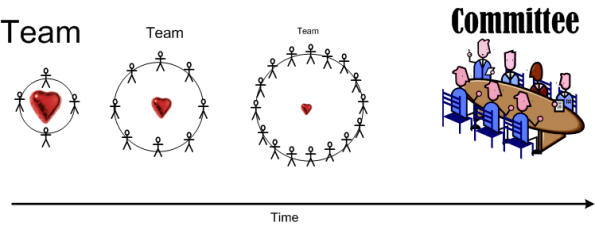
With team scaling, comes a loss of heart – but not always?

Why am I here?
WTF?
Meh!
D'oh!

My BTC Address



 Bulldozer00's Blog