The Bitcoin Guitar
Tatiana Moroz is a “Bitcoin singer”. As you can see in the photo below, she is curiously sporting a Bitcoin QR code sticker right on her guitar.

In appreciation of Tatiana’s singing a sweet Bitcoin jingle, I decided to tip her $1.00 worth of Bitcoin. To do so, I launched my iphone Coinbase wallet app, selected the “send bitcoin” feature, and focused the phone camera on the QR code in the picture. The wallet app then translated the QR code into the bitcoin address it represents and setup the transaction for me:
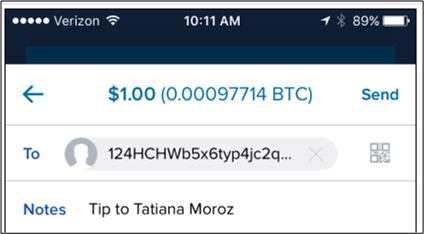
I then clicked send, and voila, she received the BTC tip from me!
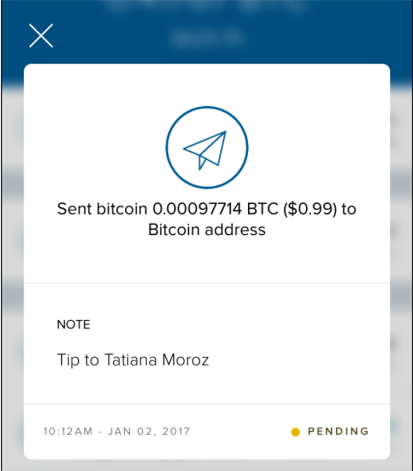
Assuming I wanted to tip Tatiana, and Bitcoin didn’t exist, how convenient would the other currently available dinosaur payment options be to me?
The 118th Obituary
Every once in awhile I scope out the wonderful 99bitcoins.com site to have a good chuckle. The site continuously finds and posts the latest and greatest “Bitcoin Obituaries” penned by financial elitists.
The 118th Bitcoin obituary is a doozy. On December 8th, the multi-titled hot shot with a highly esteemed MIT degree, Jiri Kram, looked into his crystal ball and predicted Bitcoin’s demise on December 12th. Well, it’s December 30th and Bitcoin’s price has risen from $771 (when he made his proclamation) to $957 as I wrote this post.

Here are some snippets from his propaganda piece (that promotes a centralized, proprietary, cryptocurrency named ForceCoin) that clearly illustrate how ignorant and uninformed Mr. Kram is regarding Bitcoin.
Bitcoin is a fundamentally flawed virtual currency that is inherently volatile and unstable.
Bitcoin is a bubble that like Tulip, South Sea, Dot.com or Subprime will burst.
Bitcoin is not an asset class that can serve as a store of wealth.
Bitcoin is not a secure global virtual currency.
Being the insufferable troll that I am when it comes to elites with inflated craniums, I slipped this turd into Mr. Kram’s punch bowl:

Stunted Growth
More and more of the world’s population is becoming aware of Bitcoin’s blockbuster potential to liberate them from those fiat currencies that are being manipulated and debased by governments and central banks. As a result, more and more people have been entering the Bitcoin ecosystem to employ the virtual currency for any or all of the following use cases:
- Use as a domestic commerce payment tool
- Use as an international remittance tool
- Use as a temporary store of value
The rise in Bitcoin popularity has caused the per-block transaction occupancy to increase and bump up against the 1 MB ceiling arbitrarily burned into the protocol by Satoshi Nakamoto since its inception in 2009…

As more and more transactions contend for entry into each block, the minimum transaction fee that miners will accept for block admittance is increasing….
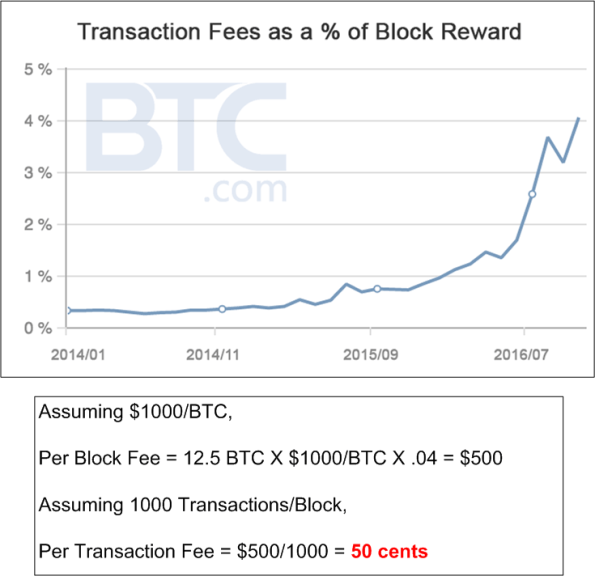
Assuming an average cost of 50 cents per transaction, then buying a cup of coffee for $2.50 would result in a 20% Bitcoin network tax!
As fees keep rising due to the constrained maximum transaction block size, the case for using Bitcoin as a domestic commerce tool is becoming more and more uneconomical. In the worst case, bitcoin growth can come to a screeching halt and usage can get stuck in use cases 2) and 3) as listed above.
The dynamic system diagram below models the negative feedback loop that is currently in operation in the Bitcoin ecosystem. Working around the loop clockwise, here is what happens:
- As more people use bitcoin, the blocks become more saturated (+).
- As the blocks become more saturated, the transaction fees rise (+).
- As the transaction fees rise, the transaction confirmation times rise from low proposed-fee transactions being rejected by the miners or from transactions being admitted to blocks long after they’ve been initially submitted by the user. (+)
- As the fees and transaction times rise, the number of people using Bitcoin decrease. (-)(-)
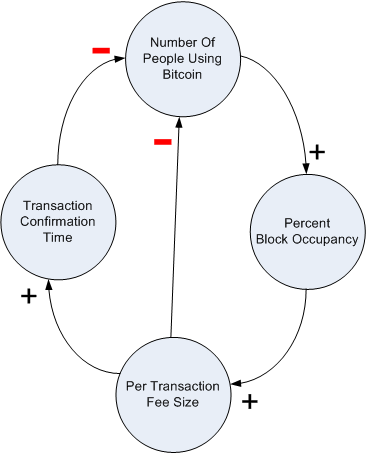
The good thing about negative feedback loop systems is that they tend toward stability. A second time around the loop shows the flip in signs:
- As fewer people use bitcoin, the blocks become less saturated (-).
- As the blocks become less saturated, the transaction fees decrease (-).
- As the transaction fees decrease, the transaction confirmation times decrease from all transactions immediately being included by the miners in the very next block to be mined. (-)
- As the fees and transaction times decrease, the number of people using Bitcoin increase. (+)(+)
The key to stable Bitcoin system growth is to untether the maximum block size and allow it to grow in step with the growth in the user community so that the strength of the two negating influences in the model (fee size and confirmation time) do not drive the new number of users down to zero. The capped 1 MB maximum block size is currently stunting Bitcoin’s growth.

The $900 Breach
Just three days ago I posted “The $800 Breach“. Well, today we have the $900 breach:

The news I’m reading implies that the price rise is due to heavy trading in China as investors flee from the yuan and utilize bitcoin as a convenient “store of value” (as opposed to gold). Expect more capital controls from the Chinese government as they attempt to staunch the flow.
When Bitcoin breached the $800 barrier, I thought a modest price pullback would soon follow. I have the same sentiment in mind now that the $900 threshold has been crossed. But hey, in the wild and wacky world of bitcoin you never know what the hell is gonna happen.
Could we soon see the price of BTC eclipsing the $1136 per-ounce value of gold, or could we see an epic crash looming? With so many governments deep in debt and central banks screwing up their economies, I think the former is more likely than the latter. What do you think?
The $800 Breach
Bitcoin has breached the $800/BTC price point for the first time in a long time. With failing nation states all over the world recklessly debasing their fiat currencies, imposing negative interest rates, and outlawing the possession of cash, people are increasingly wising up to the financial liberty that the king of cryptocurrency brings to the table.

It’s never too late to buy a Bitcoin or two, or three. Consider investing 1% of your savings in the best hedge ever invented against fiat currency calamity.
How Agile Are You?
Follow this scientifically proven method to measure how “agile” your organization really is:
- Printout a boatload of copies of the Agile checklist below and hand them out to all the engineers, managers, and executives in your organization
- Tally the results
- Report your findings back here

My speculative guess is that the results you get from the management/executive group will not align with the results you tally from the engineering group. However, I’ll never know if I’m on the right track if you don’t communicate your results back to me.
For the newly initiated, here’s how the Agile Checklist (patent pending!) was meticulously developed:
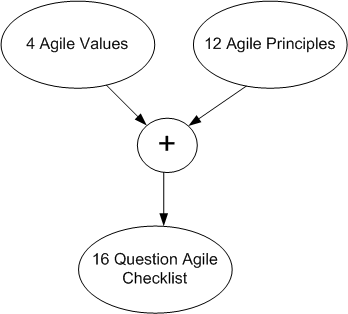
A Hijacked Vision
If you dive into Satoshi Nakamoto’s writings like I have, you’ll quickly discover that his (their?) original vision for Bitcoin was that the network be available as a permission-less, peer-to-peer payment system intended for anyone, anywhere, anytime. And yes, that includes billions of disenfranchised people currently without the ability or opportunity to open a bank account.
In order for Bitcoin to scale to accommodate billions of daily users, the maximum block size currently burned into the network protocol must be increased from the paltry 1 megabyte size that’s been in effect since the birth of bitcoin way back in 2009.
Before disappearing into the ether, Satoshi foresaw the potential growth of bitcoin and had these words to say about the maximum block size:

The bitcoin core software development team, most of whom are employed by the for-profit company Blockstream, have hijacked Satoshi’s vision by steadfastly refusing to increase the bitcoin on-chain maximum block size beyond 1 megabyte.
Assuming 200 bytes per transaction, each 1 MB bitcoin block can hold a up to 5000 transactions. Since blocks are validated at 10 minute intervals, that means the network capacity is currently capped at a measly 8 transactions per second (versus Visa/PayPal capacities of hundreds of thousands of transactions/sec).
A quick glance at the home page of Blockchain.info shows that every block is full and confirmations are taking much longer than 10 minutes.

With more and more transactions competing to be added to each block, the per transaction miner’s fee, which originally amounted to pennies, is increasing at such at rate that only large transactions will make economic sense in the near future. In the worse case, people might as well quit trying to enter the Bitcoin ecosystem and revert back to using dinosaur remittance providers like Western Union at 20% per transaction.
As new individual users and businesses attempt to experiment with bitcoin, many of them are not only being turned off by larger and larger transaction fees, they’re increasingly getting annoyed by long confirmation delays – even to the point of having their transactions dropped from the network altogether because of overcapacity at peak usage times.
Of course, the bitcoin core development team (which may as well be called Adam Bach’s Blockstream Inc. team) has a billion technical excuses for keeping the max block size at 1MB, all of which have been debunked by the pro-increase-in-block-size technical community. Everyone knows the real motivation behind core’s uncompromising position: Blockstream’s plan to profit from the side chain products they are developing.

Speaking of the pro-increase-in-block-size technical community, they are on their third valiant try at attempting to put Bitcoin back on track with Satoshi’s original vision:

To hell with the Bitcoin core development team’s self-serving roadmap for Bitcoin, I support Bitcoin Unlimited. So should you.
Subtle And Quirky, But Still Lovable
I’m a long time C++ programmer who’s going to expose something embarrassing about myself. As a starting point, please take a look at the code below:
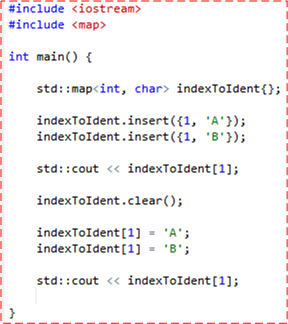
The first std::cout statement prints out the letter A and the second one prints out B. Here comes the embarrassing part… I erroneously thought that both the map::insert() and map::operator[] functions expressed the same semantics:
If the map object already contains an entry for the key being supplied by the user in the function call, the value supplied by the user will not be copied into the map.
Applied to the specific example above, before running the program I thought both std::cout statements would print the letter A.
Of course, as any experienced C++ programmer knows (or, in my case, should know), this behavior is only true for the map::insert() function. The map::operator[] function combined with the assignment operator will always copy the value into the map – regardless of whether or not an entry for the key is already present in the map. It makes sense that the two functions behave differently because sometimes you want an unconditional copy and sometimes you don’t.
The reason I wrote this post is because I very recently got burned by my incorrect assumption. To make a long story short, there was a bug in my large program that eventually was traced, with the help of the simple code example above, to the bad line of code that I wrote using map::operator[]. A simple change to map::insert() fixed the bug. It was critical to the application that an existing value in the map not be overwritten.
One of the dings against C++ is that it contains a lot of subtle, quirky semantics that are difficult for mere humans to remember. Despite agreeing with this, I still love the ole language that keeps on chugging forward like the little train that could (direct mapping to the hardware and zero overhead abstraction), despite the chagrin of many in the software industry:
I consider C++ the most significant technical hazard to the survival of your project and do so without apologies – Alistair Cockburn
The War On Cash
Let’s see:
- The U.S. government may be considering taking the $100 bill out of circulation.
- The E.U. is scrapping the $500 euro note.
- India is recalling the 500 and 1000 rupee notes.
- Greece is stealthily going cashless to appease the EU.
- 900 of Sweden’s 1,600 bank branches no longer keep cash on hand or take cash deposits.
The war on cash is in full swing and while the banks are, as usual, winning, the citizenry is losing money and privacy. As physical transactions with cash decrease, electronic transactions with plastic increase, which means that more transaction fees get collected and the banks get richer. In addition, since every transaction is electronically recorded, your privacy can get hacked by criminals and/or your “friendly” government.
The only way I know of for the average Joe Schmoe to fight back is for him to buy, and personally take possession of, precious metals and cryptocurrencies like bitcoin. Taking physical possession of your property is crucial because any asset that you own which resides in an entry on a centralized institutional ledger can be confiscated or frozen by your government in times of a crisis of their own making – even if you are a hard-working, law-abiding, citizen.
Regarding the precious metals and cryptocurrencies, taking possession of, and storing, a physical precious metal is much more costly/risky than doing the same for a virtual cryptocurrency. The larger the amount, the more costly/risky it is….

Ah yes, one more thing about precious metals, specifically gold. The government can unconditionally ban the possession of physical gold and demand its return to the US government. It actually has done this before. In 1933, F. D. R. issued executive order 6102, which forbade:
“….the hoarding of gold coin, gold bullion, and gold certificates within the continental United States.”
Notice the use of the word “hoarding” – as if trying to protect your hard earned property from seizure is a bad, immoral, thing.
In the future, governments can forbid the “hoarding” of cryptocurrencies. However, since decentralized networks cannot be shutdown and private keys can be stored on tiny devices, large scale enforcement would be next to impossible.

Why am I here?
WTF?
Meh!
D'oh!

My BTC Address



 Bulldozer00's Blog