Archive
SysML Resources
Unlike the UML, the SysML has relatively few books and articles from which to learn the language in depth. The two (and maybe only?) SysML books that I’ve read are:
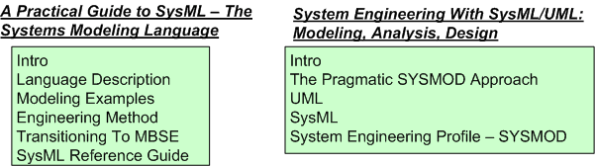
System Engineering With SysML/UML: Modeling, Analysis, Design – Tim Weilkiens
A Practical Guide to SysMLThe Systems Modeling Language – Sanford Friedenthal; Alan Moore; Rick Steiner
IMHO, they are both terrific tools for learning the SysML and they’re both well worth the investment. Thus, I heartily recommend them both for anyone who’s interested in the language.
The books’ authors take different approaches to teaching the SysML. Even though the word “practical” is embedded in Friedenthal’s title, I think that Weilkiens book is less academic and more down to earth. Friendenthal takes a method-independent path toward communicating the SysML’s notation, syntax and semantics, while Weilkiens introduces his own pragmatic SYSMOD methodology as the primary teaching vehicle. Weilkiens examples seem less “dense” and more imbibable (higher drinkability :-)) than Friedenthal’s, but Friedenthal has examples from more electro-mechanical system “types”.
What I liked best about Weilkiens’s book is that in addition to the “what”, he does a splendid job explaining the “why” behind a lot of the SysML notation and symbology. You will easily conclude that he’s passionate about the subject and that he’s eager to teach you how to understand and use the SysML. Friedenthal’s book has an excellent and thorough SysML reference in an appendix. It’s great for looking up something you need to use but you forgot the details.
The Venerable Context Diagram
Since the method was developed before object-oriented analysis, I was weaned on structured analysis for system development. One of the structured analysis tools that I found most useful was (and still is) the context diagram. Developing a context diagram is the first step at bounding a problem and clearly delineating what is my responsibility and what isn’t. A context diagram publicly and visibly communicates what needs to be developed and what merely needs to be “connected to” – what’s external and what’s internal.
After learning how to apply object-oriented analysis, I was surprised and dismayed to discover that the context diagram was not included in the UML (or even more surprisingly, the SysML) as one of its explicitly defined diagrams. It’s been replaced by the Use Case Diagram. However, after reading Tim Weilkiens’s Systems Engineering With SysML/UML: Modeling, Analysis, Design, I think that he solved the exclusion mystery.
….it wasn’t really fitting for a purely object-oriented notation like UML to support techniques from the procedural world. Fortunately the times when the procedural world and the object-oriented world were enemies and excluded each other are mostly overcome. Today, proven techniques from the procedural world are not rejected in object orientation, but further developed and integrated in the paradigm.
Isn’t it funny how the exclusive “either or” mindset dominates the inclusive “both and” mindset in the engineering world? When a new method or tool or language comes along, the older method gets totally rejected. The baby gets thrown out with the bathwater as a result of ego and dualistic “good-bad” thinking.
“Nothing is good or bad, thinking makes it so.” – William Shakespeare


Why am I here?
WTF?
Meh!
D'oh!

My BTC Address



 Bulldozer00's Blog