Archive
Spiritual UML
Because he is the chosen one, the universe spaketh to BD00 last night: “Go forth my son, and employ the UML to teach the masses the true nature of the mind!“. Fearful of being annihilated if he didn’t comply, BD00 sat down and waited for an infusion of cosmic power to infiltrate his being (to catalyze the process, BD00 primed the pump with a three olive dirty ‘tini and hoped the universe didn’t notice).
With mouse in trembling hand and an empty Visio canvas in front of him, BD00 waited…. and waited… and waited. Then suddenly, in mysterious Ouja board fashion, the mouse started moving and clicking away. Click, click, click, click.
After exactly 666 seconds, “revision 0” was 90% done. The secrets of the metaphysical that have eluded the best and brightest over the ages were captured and revealed in the realm of the physical! Lo and behold….. the ultimate UML class diagram:
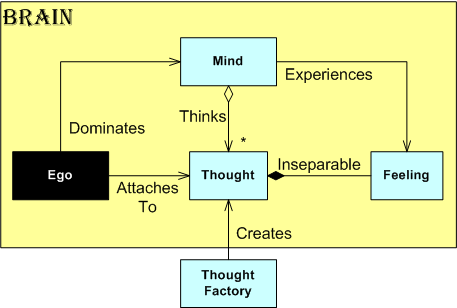
Of course, the “Thought Factory” class is located in China. It efficiently and continuously creates (at rock bottom labor costs) every thought that comes/stays/goes through each of the 7 billion living brains on earth.
Monkey Mind
For ego-dominated people like me, “I-thoughts” run rampant through the mind. Buddhists call this malady the “monkey mind“, with thoughts jumping randomly to and fro in chaotic happenstance.
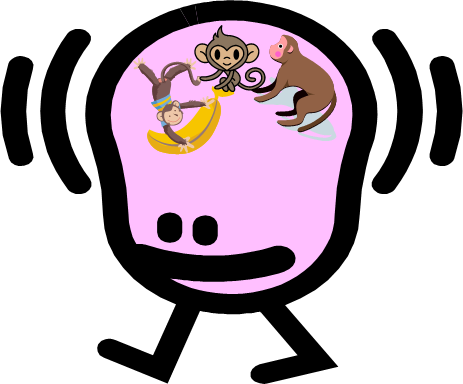
Psychological discord arises because, as one wise man has said, “we can’t bear to sit still with ourselves for one minute“.
Stress Particles
In a terrific duo of videos, George Pransky makes the observation that most people believe unequivocally that stress is objectively “out there“. He makes an analogy with fictional “stress particles“. Ya gotta stay away from places and events that are infested with stress particles, lest your physical health, mental health, and quality of life deteriorate as a result of becoming contaminated.
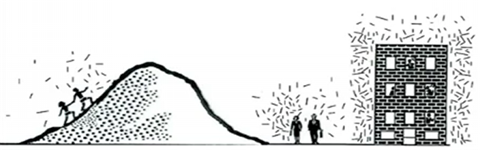
The fact of the matter is that all stress is man-made. To be more specific, all stress is self-made. Granted, it’s hard to argue that events such as job loss, divorce, moving, and the death of a loved one aren’t stressful, but the intensity of suffering one experiences is person-specific, no?
I think the amount of stress one manufactures for oneself is a function of one’s perceived control over situations and the degree with which one expects to have control. Control freaks who are in environments where they can’t or aren’t allowed to exercise control create more stress for themselves than non-control freaks. Control freak or not, environments where an individual can control his/her activities and influence the environment are perceived as less stressful.
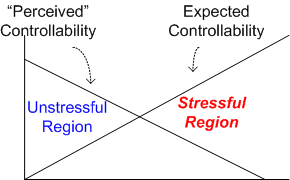
As can be inferred from the diagram, there are at least two ways to increase one’s “unstressful” region while decreasing one’s “stressful” region. Reduce expectations or increase perceived controllability. A better way is to realize the truth of the matter – there is no controllability, there’s only the ability to influence.
Renunciation
I was listening to an Eckhart Tolle talk the other day (via an mp3 file deposited on a USB stick plugged into my new Subaru WRX audio system). He started talking about the key to inner peace. In order to prepare his audience for the bombshell he was about to launch, he asked them to “please don’t be shocked“. Eckhart then said, in his characteristically slow, deliberate, and relaxed tone, that the key to awakening and inner peace is….. the renunciation of thought. D’oh, and WTF?
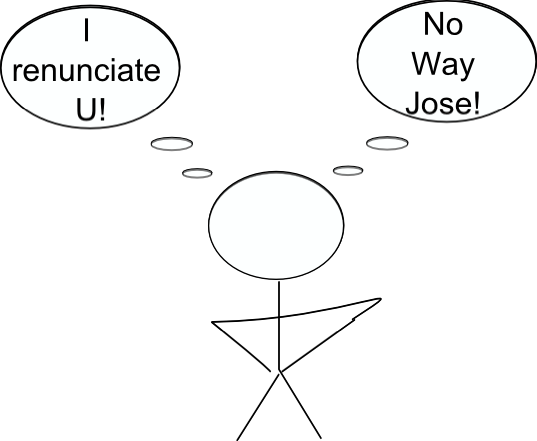
Years ago, when I was more lost than I am today, I would have thought that Mr. Tolle was a charlatan on the level of Jimmy Swaggart and Jim Bakker. Today, knowing what I know, but can’t express in words, I think he is wise. How about you? What do you think?
Note: I usually use Microsft Visio to generate the dorky diagrams on this blog. The pic in this post is my first one using the freely downloadable Inkscape package.
Childlike Humility
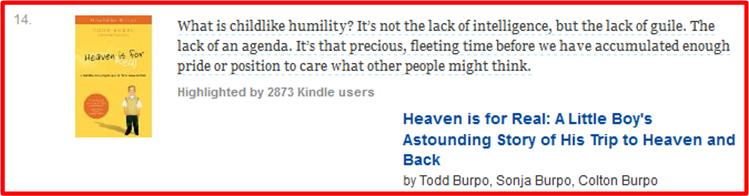
This quote from Amazon Kindle: Most Highlighted Passages of All Time really socked me in the jaw. Does it do anything for you?
Tainted Observations
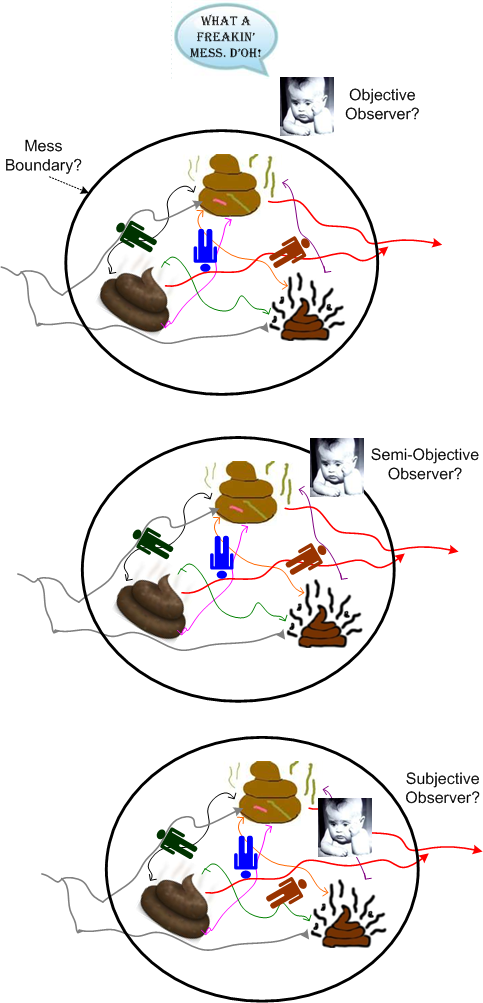
Based on his rudimentary understanding of quantum physics, BD00 thinks there is no such thing as a truly objective observer. Every observation is tainted by the instantaneous and unconscious coupling of personal (a.k.a subjective) beliefs, desires, and fears to the observed. The closer one is to a perceived “mess“, the more the taint.
Coffee And Ice Cream
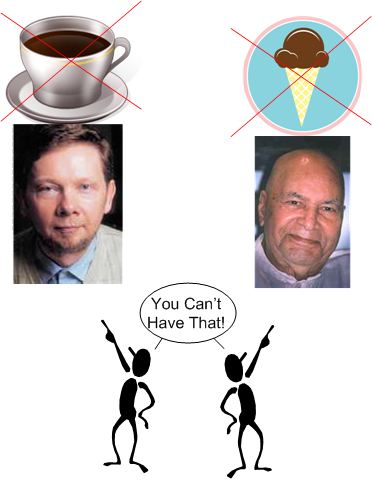
I was listening to an Eckhart Tolle mp3 audio the other day and he started talking about the innate tendency of people to auto-label “others” with a concept and then to expect 100% behavior compliance with that label. In his case, he was told that “you’re a spiritual teacher – you shouldn’t be drinking coffee!“. Jokingly, he said that he now wears sunglasses and a baseball cap whenever he goes to Starbucks. D’oh!
Similarly, spiritual guru “poonjaji” said that he was scolded for liking and eating ice cream. I can’t remember exactly how he handled the situation, but I’m positive that he disarmed the fault-finder with grace and wisdom.
How about you, how do you handle being labeled by someone or, more ominously, by some group(s)? I used to, and still often do, get defensive and fire a retaliatory label right back at the source. In those wonderful moments where I serendipitously catch myself fuming up, I say “thanks for your opinion“.
Insecurity And Anxiety
How’s this for a book title?

LOL! Seriously though, Alan Watts was a prolific Zen Buddhist teacher, speaker, and writer. Many moons ago I read Alan’s book: “The Book: On The Taboo Against Knowing Who You Are“. From what I remember, it was before “I got” what spiritual advancement was all about, so I didn’t get much out of it. It didn’t help that hard-core Zen Buddhism is full of terse, paradoxical, and mind twisting sayings.
Although Mr. Watts is not on the top of my “spiritual guru” list, I just may snatch up this book. Hell, an Amazon.com bot recommended it to me so that must mean something. Plus, it seems to be prophetical in that it was written in 1968 when the world was simpler and much less hectic. However, since the book is not available on the kindle (which is puzzling to me), I just may pass it up.
Of course, like you, I’m not insecure or anxious. I just love the book’s title. 🙂
No Going Back
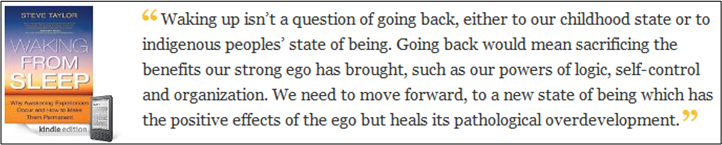
So, what does Steve Taylor mean by “pathological over development of the ego“? I think he means the obsessive desire for power, status, and material wealth regardless of its cost to other people and nature. What do you think he means? Do you even agree with his assessment that the world’s collective psyche needs to transition to a new, enlightened state?
Steve recommends practicing meditation and it’s sibling, mindfulness, as the best means of quieting the mind and loosening the iron grip of the ego. Too bad I suck at both of them and, for some strange reason, I choose not to make the time to practice them. I’m too occupied with searching for, and hoarding, intellectual knowledge to complete myself – even though I know that the effort won’t pay off.
Required Pretentiousness
“We grow up being afraid of our own ignorance and terrified that our ignorance may show. Over time, we’re conditioned to appear as “knowledgeable” as we can, while carefully concealing the limits of our understanding.”
Does the above quote, snipped from Peter Ralston’s “The Book Of Not Knowing“, ring as true for you as it does for me? I think it’s one of the top reasons why I spend a lot of time trying to keep abreast of developments in my field and advancing my programming and design skills.
You see, I often feel uncomfortable when someone starts talking about a topic that I’m ignorant of. I used to (and still do, but much less frequently) “pretend” that I understood what was being said so that I wouldn’t appear “stupid“. Now, I rarely hesitate to say sentences like “you lost me in the dust” or “I have no idea what you’re talking about” – regardless of the social consequences. I’ve realized that “not knowing” is the natural state of being – which means that we can’t avoid dwelling in it no matter how hard we try. Trying to fight spending one second in the state of not knowing is as ludicrous as a bird trying not to fly or a fish trying not to swim. Fighting one’s natural state of being always has a cost; psychological, physical, or both.
“Pretending to know” is a full time activity in hierarchically structured organizations that work with, and create, non-physical knowledge. Since knowledge is king, the higher one moves up in a hierarchy, the more pressure one feels to delude oneself into omniscience (e.g. when was the last time you asked a question that a superior didn’t whip out an answer to?). This unnatural behavior is exacerbated by the fact that all members in a hierarchy are either conscious or unconscious co-conspirators in the comedy.
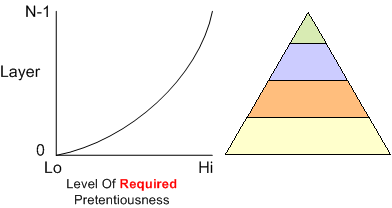
I’m a conscious and willing co-conspirator. How about you?

Why am I here?
WTF?
Meh!
D'oh!

My BTC Address



 Bulldozer00's Blog