Archive
Self-Assessment
“I’m just an ordinary average guy….. Pick up the dog doo, hope that it’s hard (woof woof).” – Joe Walsh
Okee Dokee. Today is my birthday and it’s self-assessment time. Time to step back and guess who I am and where I stand……
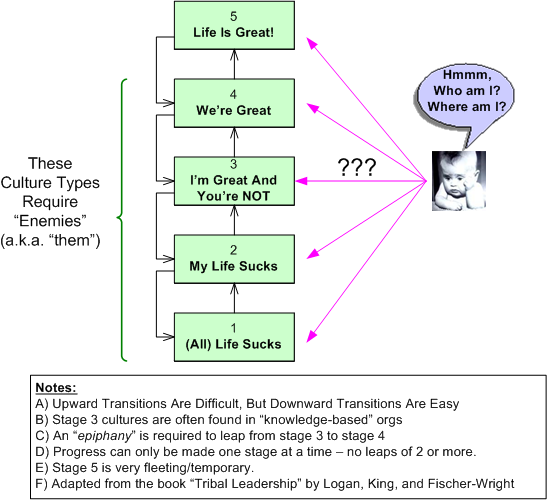
At the present time, I’m a dude with a stage 3 mindset working in a stage 3 benevolent patriarchy. My situation may not be as nirvana-ish as being a stage 5 dude working in a stage 5 DEPAM, but it sure beats being a stage 1 dude imprisoned in a stage 1 malevolent patriarchy, no?
How about you? What’s your self-assessment, today? Awe come on, don’t be shy.
From Consumer To Participant
As I’ve stated before, I love Clay Shirky. The guy is phenomenally perceptive and insightful in detecting subtle changes in global trends and patterns of behavior. In “Cognitive Surplus”, Mr. Shirky recounts the rut of one-way consumerism that most of us were in, and many of us are still in, until relatively recently. The figure below shows the “old days” model, which is still “these days” for a boatload of people – especially institutional SCOLs.
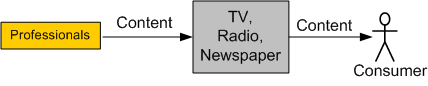
In the “old days” model, content was concocted by “professional” content concocters and spoon fed to us through the (yawn) standard one-way media outlets of TV, radio and newspaper. The media creators and the media communication infrastructure owners had full say over what we heard and saw through the limited, one way-media outlets. We were (and most still are) passive consumers sitting in our lazy boys and scarfing up the input provided to us.
With the advent of social networks, the situation has changed drastically. As the figure below illustrates, the “old days”, one- way system of forced feeding has been supplemented by a parallel, “new days”, two-way system in which you and I have the opportunity to participate and create. The meteoric rise of social networks has allowed previously shackled DORKs like you and me to actively create and share content while simultaneously allowing a much greater variety of choice over what we consume. Ain’t life grand?
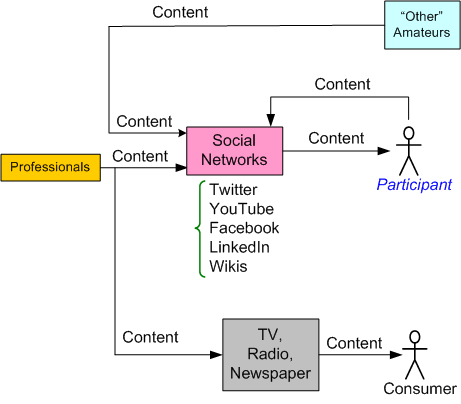
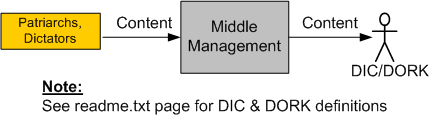
Of course, the emergence of this brave new world has triggered great angst and fear in those old school power mongers who can’t or won’t morph with the times. As far as most corpricracies go, they’re still stuck in the mindset of “we’ll control the crap and we’ll control the distribution of the crap of what you see and hear. As you know, we’re better and smarter than you and your fellow amateurs, so it’s in your best interest if you forgo the opportunity to participate.”
What’s Up With Featured Blogs?
WordPress.com provides the capability for users to browse blog posts by clicking on a subject tag. After clicking on a tag of interest, the results page displays a bunch of blog posts that authors have marked with that tag. As the (egotistical and self-serving) screen snippet below illustrates, the first listed blog post at the top of the page is somehow designated as the “featured blog“.

Out of curiosity (which is judged as a sin inside of most religious and corpo institutions), I briefly searched for the criteria/algorithm that wordpress.com uses to select the “featured blog” of the day, but I couldn’t find it. However, I did find a bunch of vain, self-congratulatory posts just like this yawner.
Rude, Unsophisticated, Uncouth
Via “11 True Stories Behind Tech’s Top Names“:
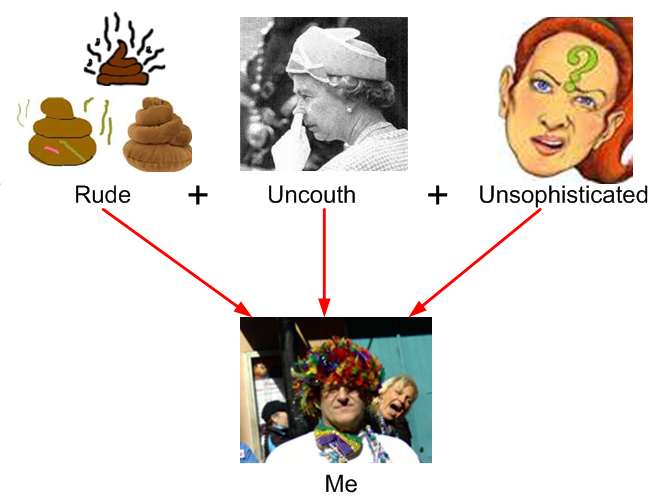
Yahoo is actually an acronym for “Yet Another Hierarchical Officious Oracle.” But according to the company, the team chose the name for its definition: “rude, unsophisticated, uncouth.”
Rude, Unsophisticated, Uncouth (RUU). I love it cuz I resemble that acronym (but not you, of course)! I gotta send a resume to Yahoo!. On second thought, nah. The vibrant and RUU-full Yahoo! no longer exists. From what I’ve seen and heard, I think it may have transformed into woeful Yahoo! I wish new CEO Marissa Mayer the best of luck in her effort to restore the company’s RUU-fulness.
Me And My Stuff
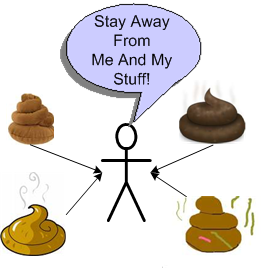
Because it stirred up some internal energy, I intuitively navigated into this link from a recent, Mr. Creative Class, Richard Florida tweet (Pod People < PopMatters). The quote that opens the piece:
The problem in our culture is not so much that there is too much stuff but that we are afflicted with insatiable egocentricity, which the stuff merely reflects. – Rob Horning,
really zinged me. Reading that quote triggered a Vulcan mind-meld (Bzzzzzt!) in my head with a recent quote that I saw from someone else (whom I don’t remember, but wish I did): “when the last tree is gone and the last drop of water is undrinkable, maybe we’ll finally realize that we can’t eat money“.
Alright, alright. Call me a self-righteous, hippocritical-institutional-paycheck-eating, (blah, blah, blah), tree-hugger if you’d like, but that’s the way I felt in the moment; even if that’s the way I wasn’t supposed to feel – according to you.
Dissed By Someone “Important”
The impeccably credentialed and self-revered Ian Mitroff dissed me out of the blue via a private message on LinkedIn:
“You are an absolute relativist which is not very interesting or relevant.”
Based on the following quote, Mr. Mitroff might label Shakespeare as an uninteresting, absolute relativist too:
There is nothing either good or bad, but thinking makes it so. – William Shakespeare
Damn it Willie, nothing is relative! It’s not good or bad, it’s one or the other. Since my judgment is infallible, it’s whichever I say it is.
Feeling compelled to reply to the self-anointed “father of crisis management“, my bruised and battered ego retorted with:
“I’m sorry, oh exalted professor. Thanks for your irrelevant opinion.”
Me thinks that Ian may be one of those professors that Ken Robinson says: “solely uses his body to transport his head around“. I hate to prematurely judge people, but it sure feels good to be bad.
“A conscience is what feels bad when everything else feels so good.” – Steven Wright

Strategic And Cautious
At nights and on weekends we cry out for human rights and freedom of speech, and then we go to work and become strategic and cautious about our every word for fear we will be seen as disloyal or uncommitted. – Peter Block
The above quote reminds me of many meetings that I’ve attended. In one of these watch-out-what-you-say-or you’ll-be-in-deep-shit group fear fests, the topic of a long time dedicated and highly productive employee leaving the company popped up. The frustrating and sad thing about the experience was that even though virtually everyone knew who the person was, no one spoke his name – including wimpy me. It was like an unwritten taboo, as hinted by Block’s quote above. At the time, I thought of getting up and yelling:
“Damn it! His name is XXXX. Why can’t anyone freakin’ speak it? Even though I think most of you know who we’re talking about, what harm would befall us if we spoke his name to the ones who don’t know? Why so much fear and secrecy?”
Of course, I only thought the thought and I didn’t say squat….. preferring to remain strategic and cautious.

Ray Of Light
Ray Leggiero was a great friend and work colleague of mine. Ray would stop by my cube every other day early in the morning to talk, joke, and commiserate for a few minutes about a variety of subjects. Ray was one of only two regular commenters on this ridiculous blog. Ray often challenged my views and beliefs and made me think twice about what the hell I was saying. Ray was a Yankee fan and I’m a Red Sox fan. Ray was a Republican and I am a pseudo-Democrat. Ray was passionate about all aspects of software development and so am I.
 After not hearing from, or seeing the ever-smiling Ray, trucking around the office for a week, I walked over to his cube to find out why. His cubie mate told me that Ray was sick and wouldn’t be back for awhile, so I called his house. His wife, Pat, came right out and shocked me with “Ray has cancer“. She said that he was too tired and sick to come to the phone.
A week later, I learned that Ray was gravely ill and in the intensive care unit of a local hospital. The same day we heard this stunning news, a couple of other work friends and I went to the hospital to see Ray during lunch break. We were floored and deeply disheartened when we saw the state he was in. We were so rattled and shaken by what we had seen, that instead of going back to work, we went to a bar and guzzled a few beers to calm our nerves. Ray died the next morning.
The suddenness of it all was incredibly jolting and earth shattering to many people, especially Pat and his three young boys: Anthony, Matthew, and Brandon. In the span of only one month, gentle Ray went from being a vibrant, positive, conscientious, helpful person to a very sick individual engulfed by cancer. I, and scores of other people, will deeply miss Ray’s luminescent presence in our lives.
So long my dear, dear friend.
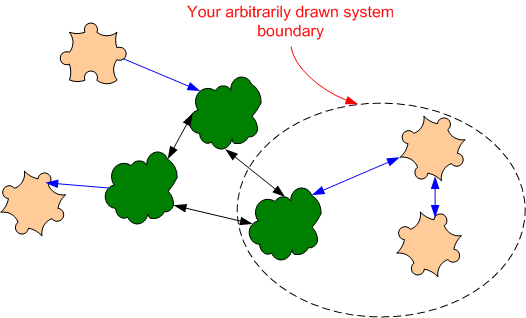
Arbitrary Boundaries
The Generic Template

My Arbitrarily Defined Boundary

Your Arbitrarily Defined Boundary
Crucial Skills: Choking Up
I’ve talked about the Vital Smarts dudes before, and they continue to impress. In this post, Crucial Skills: Choking Up, Vital Smarts principal Al Switzler gives some sound advice to a client regarding the phenomenon of unexpected and unwanted emotional seizure during a Crucial Conversation (CC).
When a conversation flips from”normal” to crucial, either or both participants will experience one or more of these symptoms:
1 Some people’s faces turn red.
2 Some people can feel their pulse—often in their temples.
3 Some people’s breathing changes—it speeds up, or lengthens.
4 People’s voices can increase or decrease in volume.
5 There may be churning in the gut or butterflies in the stomach.
In my case, numbers 3 and 4 rear their ugly heads when I find myself in the midst of an unexpected CC (how about you?). When the 3-4 duo instantaneously appears, I’ve learned to detect the change immediately. However, since I think “control” is overrated, over sought, and often an excuse to obscure truth, I often choose to let the truth, as I see it, fly via an unacceptable emotional rant 🙂 .
“Never apologize for showing feeling. When you do so, you apologize for the truth.” – Benjamin Disraeli
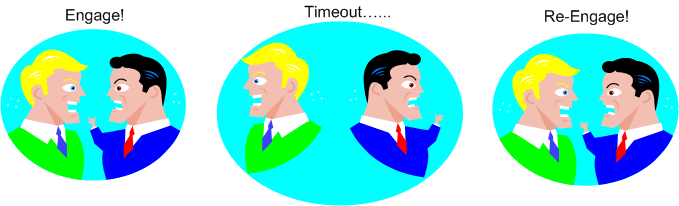
On the flip side, Al makes a lot of sense when he recommends switching over to proven CC skills upon detection of your changed physical state. When one succeeds at this, it defuses the situation and facilitates an exchange of understanding ‘tween the CC participants. First, he advises you to “step out of the content and rebuild safety” by calling a time out. Then, when the symptoms dissipate, re-enter the content and have a frank exchange of views. You do this by “starting with heart”, of course, to establish a collaborative and nurturing environment for progressing forward.

Why am I here?
WTF?
Meh!
D'oh!

My BTC Address



 Bulldozer00's Blog