Archive
Huge Cajones
According to “No Managers Required: How Zappos Ditched The Old Corporate Structure For Something New”, by the end of 2014, Zappos.com will have dismantled their corpo pyramid. Under the stewardship of maverick CEO Tony Hsieh, the 1500 employee company will be transitioned into a “holacracy” of 400, self-governing circles.

Talk about having huge cajones. Just think of the disruptive risk to business performance of making such a daring structural/operational change to a billion dollar enterprise.
Although I look forward to watching how the transformation plays out, I’m a bit skeptical that Mr. Hsieh can pull it off. After visiting the site of the “consultant” that will be advising the company during the transition (holacracy.org) and browsing through the ungodly long, complicated, formal Holacracy Constitution, the first thought that came to mind was “D’oh!“.
Twitter friend and guest blogger @serialmom sums up the situation with this insightful tweet:

Goalodicy
Goalodicy – the pursuit of idiotic goals
The last book I read was Scott Adams’ “How to Fail at Almost Everything and Still Win Big: Kind of the Story of My Life“. The current book I’m reading is Oliver Burkeman‘s “The Antidote: Happiness for People Who Can’t Stand Positive Thinking“. Coincidentally, and unbeknownst to me before I began reading the books, both authors trash the dogma that setting specific goals is a worthwhile idea. Burkeman has this (and much, much more) to say on goal pursuit:
A business goal would be set, announced, and generally greeted with enthusiasm. But then evidence would begin to emerge that it had been an unwise one – and goalodicy would kick in as a response. The negative evidence would be reinterpreted as a reason to invest more effort and resources in pursuit of the goal. And so things would, not surprisingly, go even more wrong…. There is a good case to be made that many of us, and many of the organisations for which we work, would do better to spend less time on goal-setting, and, more generally, to focus with less intensity on planning for how we would like the future to turn out. – Oliver Burkeman
Scott Adams is even more critical of the “best practice” of goal-setting than Burkeman:
Throughout my career I’ve had my antennae up, looking for examples of people who use systems as opposed to goals. In most cases, as far as I can tell, the people who use systems do better. The systems-driven people have found a way to look at the familiar in new and more useful ways. To put it bluntly, goals are for losers. That’s literally true most of the time. For example, if your goal is to lose ten pounds, you will spend every moment until you reach the goal—if you reach it at all—feeling as if you were short of your goal. In other words, goal-oriented people exist in a state of nearly continuous failure that they hope will be temporary. That feeling wears on you. In time, it becomes heavy and uncomfortable… Goal-oriented people exist in a state of continuous pre-success failure at best, and permanent failure at worst if things never work out. – Scott Adams
If you’re a laser-focused, SMART goal-oriented person, you might want to revisit some of the foundational bricks in your worldview in light of what Burkeman and Adams have to say. But then again, neither Burkeman nor Adams are absolutists. They don’t emphatically advise against all goal-setting. They simply suggest considering alternative, less psychically destructive methods of attempting to better our lives (devise/use a system; envision a qualitatively desirable future and move toward it).
You might say every system has a goal, however vague. And that would be true to some extent. And you could say that everyone who pursues a goal has some sort of system to get there, whether it is expressed or not. You could word-glue goals and systems together if you chose. All I’m suggesting is that thinking of goals and systems as very different concepts has power. – Scott Adams
There is plenty of very real research testifying to the fact that the practice (of goal-setting) can be useful. Interpreted sufficiently broadly, setting goals and carrying out plans to achieve them is how many of us spend most of our waking hours. – Oliver Burkeman

Manage-ification By Growth
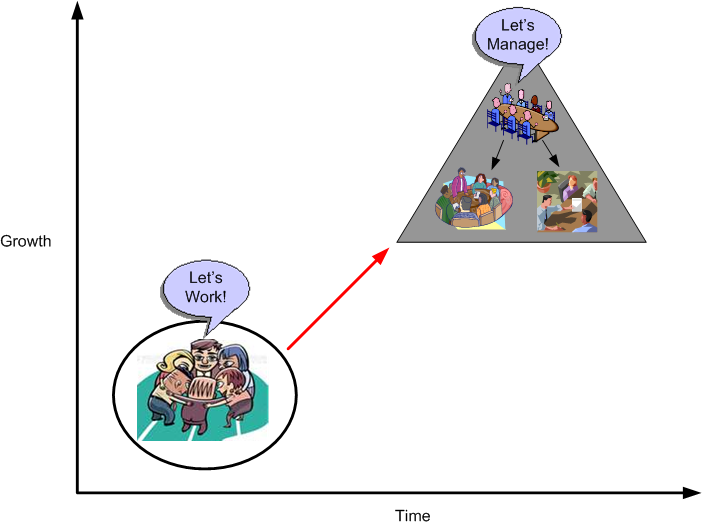
Somewhere on the road from small startup sensation to huge institutional borgdom, the oft-repeated process of “manage-ification by growth” fires up and kicks into high gear. It’s inevitable, or is it?
The Creation Of A New Class
In the context of complex decisions with uncertain outcomes and no obvious right answer, the managerial mind inevitably longs for some handrails to grasp amid the smoke and flames. Strategic planning offers that consolation— or illusion— of a sure path to the future – Stewart, Matthew
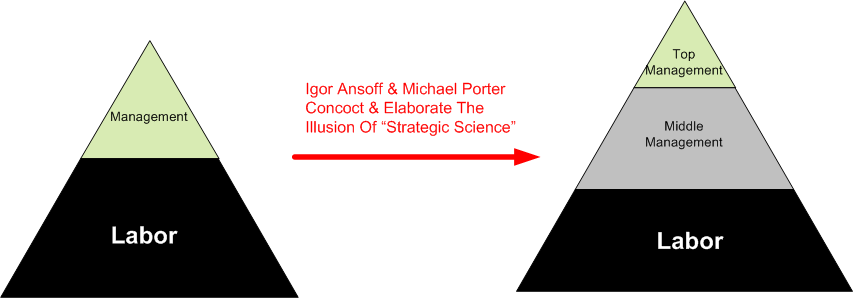
In “The Management Myth“, Matthew Stewart researches how the business of “Business Strategy” got started and how it evolved over the decades. He (dis)credits Igor Ansoff with starting the phantom fad founded on “nonfalsifiable tautologies, generic reminders, and pompous maxims“. Mr. Stewart also credits mainstream strategy guru Michael Porter with growing the beast in the nineties into the mega-business it is today.
Perhaps the most interesting outcome from the rise of the business of strategy was the stratification of “management” into two classes, top management and middle management:
Top management takes responsibility for deciding on the mix of businesses a corporation ought to pursue and for judging the performance of business unit managers. Middle management is said to be responsible for the execution of activities within specific lines of business. This division within management has created a new and problematic social reality. In earlier times, there was one management and there was one labor, and telling the two apart was a fairly simple matter of looking at the clothes they wore. The rise of middle management has resulted in the emergence of a large group of individuals who technically count as managers and sartorially look the part but nonetheless live very far down the elevator shaft from the people who actually have power – Stewart, Matthew
I always wondered how the delineation between “top” and “middle” management came about. Now I know why.
The March Of The Gurus
All self-credentialed management gurus base their sage “advice” on some sort of underlying pseudo-science. To keep the gravy train a rollin’, they gotta keep up with the science du jour; and today’s fresh produce seems to be the highly acclaimed field of neuroscience. But beware….
Studying neurobiology to understand humans is like studying ink to understand literature – Nassim Taleb
So, what preceded neuroscience as the rack du jour for the guru aristocracy to hang their collection baskets on? BD00 is delighted you asked! He’ll not only give you the answer to that question, he’ll gift you the entire history of the march of the gurus:
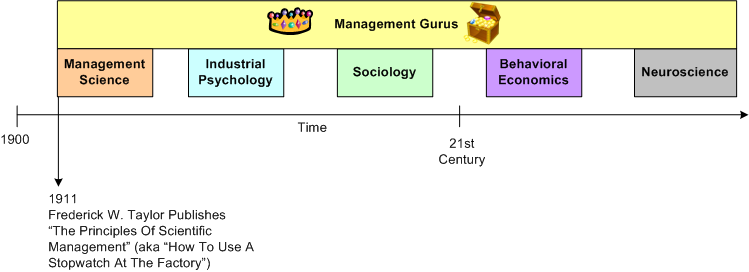
As you might guess, the research effort that went into the development of this guru-march graphic required many staff hours distributed over dozens of sprints from a highly effective, self-organized, horizontally-scaled, agile team facilitated by a Scrum Alliance certified Scrum Master.
Bundles Of Emotions
Without a doubt, the most impactful (and depressing) management book I’ve read over the past few decades is Matthew Stewart’s “The Management Myth“. In his unforgettable masterpiece, Mr. Stewart interweaves his personal rise-and-fall story as a highly paid management consultant with the story of the development of management “science” during the 20th century. Both tracts are highly engaging, thought-provoking, and as I said, depressing reads.
At the end of this post, I’m gonna present a passage from Matt’s book that compares the Winslow and Mayo approaches to “scientific” management. But before I do, I feel the need to provide some context on the slots occupied by Winslow and Mayo in the annals of management “science“.
The Taylor Way
Frederick Winslow Taylor is considered by most to be the father of “scientific” management. In his management model, there are two classes of people, the thinkers (managers) and the doers (workers). Thinkers are elites and workers are dumbasses. By increasing piece/hour pay, Taylor’s model can be used to mechanistically increase efficiency, although it doesn’t come for free. Executed “scientifically“, the increase in labor cost is dwarfed by the increase in profits.
The Mayo Way
Elton Mayo, although not nearly as famous as Doug MacGregor (the eloquent theory X and X guy who I liked very much before reading this obscene book), is considered to be one of the top “scientists“, and perhaps creator of, the human relations branch of management (pseudo)science. In Mayo’s management model, there are also two classes of people, the thinkers (managers) and the feelers (workers). Thinkers are also elites, but workers are bundles of emotions. By manipulating emotions, Mayo’s model can be used to “humanely” increase efficiency. But unlike the reviled, inhumane, Taylor model, the efficiency gains from Mayo’s “nice” model are totally free. A double win! Productivity gains in an ethical manner with no additionally incurred financial cost to the dudes in the head shed. Management is happy and the workery is a happy, self-realized community. W00t!
The Quote
OK, now with the context in place, here’s the passage I promised:
Mayo’s drive for control makes Taylor look like a placard-waving champion of the workingman. The father of scientific management may have referred to his workers as “drays” and “oxen,” but with his incentive-based piece-rate systems he nonetheless took for granted that these beasts of burden had the capacity to make economic decisions for themselves on the basis of their material self-interest. In Mayo’s world, however, the workers of the world lack this basic rational capacity to act in their own self-interest. – Stewart, Matthew (2009-08-10). The Management Myth: Why the Experts Keep Getting it Wrong (p. 135). W. W. Norton & Company. Kindle Edition.
When I first read that passage, it sent an uncomfortable shiver down my spine. Was it as good for you as it was for me?
Shoving all the preceding BD00 drama aside, I’d rather be happy (and duped?) making $XXXX than be miserable making the same amount. I just wish that badass Matt didn’t throw his turd in my damn punchbowl! 🙂
 In case you’ve been wondering why I’ve been relentlessly railing lately against the guild of agile coaches on Twitter, this post exposes my main motivational force. From what I’ve seen, the coaching community rarely, if ever, thinks or speaks or writes about where the fruits of their so-called 400% efficiency improvements end up. They either auto-assume that the tropical delights are doled out fairly, or the topic is taboo; undiscussable (RIP Chris Argyris).
Take A Guess
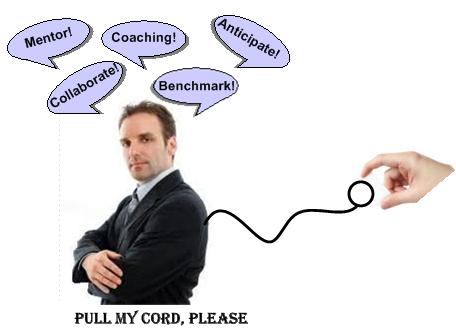
Take a guess at which CEO recently made all these inspirational statements:
- “Overall I am very pleased with the progress we have made, but we still have a lot of work to do to drive consistent execution and navigate a rapidly shifting marketplace.”
- “We saw improved sales in our mainstream XXXXX business, but we need to improve our pricing discipline and profitability,”
- “We saw improved sales execution, a strong hyper-scale quarter, and stabilization in XXXXX complimented by revenue growth in YYYYYYY”
- “We improved our share position in all three regions”
- “We continue to manage the end-to-end cost structure of our XXXXX business with profitability very much in mind.”
- “Looking forward we will stay committed to smart capital allocation and profitable growth.”
- “As we said at our security analyst meeting last month, we believe we can grow both margin and share over the longer term. We’ll continue to be aggressive in targeted cases, but we have more opportunity to improve our profitability”
If you’re expecting an answer from BD00, then fuggedaboud it. You can pick any CEO because the vast majority of C-execs speak in this same tongue. But ya know what? Despite the standard BD00 sarcasm oozing from this post, the “system” demands that somebody do it; and I’m thankful that those who do it, do do it. I wouldn’t want to do it. In addition to not fitting into the physical and psychological profiles required by the C-level community, it’s not my cup of tea.
Pick Your Theory: X, Y, Or T
If you’re a student (or self-proclaimed/credentialed “expert“) of institutional behavior, there’s no doubt that you’ve heard of Doug MacGregor‘s famous Theory X and Theory Y worldviews regarding social attitudes within organizations. And, if you’re a manager who is not into political suicide, you at least publicly espouse allegiance to the more ethically pleasing Theory Y view.
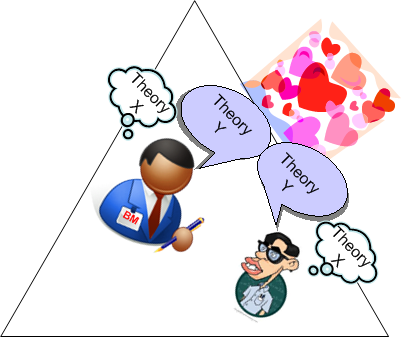
Well, in “The Management Myth: Why the Experts Keep Getting it Wrong“, philosopher-turned-business-consultant-returned-philosopher Matt Stewart concocts an interesting, but perhaps more pragmatic, Theory T:
Theory T (for tragic): Some degree of conflict is inherent in all forms of social organization. Sometimes the self is at odds with the community, sometimes the community is at odds with itself, and sometimes, as Thomas Hobbes pointed out, it’s a war of all against all. – Matt Stewart
Perhaps shockingly, but not totally out of the realm of possibility, Matt concludes:
It (Theory Y) is an attempt to trick our ethical intuitions— that is, to make workers believe that they are being well treated when in fact they are being exploited.
In this unsettling but thought-tickling view, Mr. Stewart asserts that the aim of both the bad-X and good-Y theories is to ultimately exploit the workery, but only Theory X is transparently upfront about it.

Who’s Left Standing?
First W. E. Deming, then Russell Ackoff, and now Chris Argyris. They’re all gone. Bummer.
 When I first encountered the work of each of these three original thinkers, it blew me away. Their insights on organizational and management behaviors were like a breath of fresh air compared to the C-suite pandering, jargonized junk that business schools spew and pop business icons like Tom Peters promulgate (no offense Tom, I like some of your ideas).
Managers who are skilled communicators may also be good at covering up real problems – Chris Argyris
AFAIK, there’s nobody like this trio of intellectual giants left standing (maybe they’ve won?). There are, however, a handful of second string, accessible, truth-tellers out there. Henry Mintzberg, Sam Culbert, and Steve Denning come to mind. Who can you add to this list?
Almost Yearly Apology
Every once in a blue moon, BD00’s conscience compels him to apologize to the guild of 20th century management for his non-compliant, “unacceptable“, online behavior . Here’s this year’s mild BD00 apology:

I’m really glad my conscience periodically crashes the Ackoff-Deming-Argyris-Senge-Hamel-Semler-Nayar-Hsieh anti-management party that rocks on in my brain. It gives the non-BD00 half of me the comfort of knowing that he’s not an apathetic, tunnel-visioned psychopath… errr does it?


Why am I here?
WTF?
Meh!
D'oh!

My BTC Address



 Bulldozer00's Blog