Archive
Solutions, Not Problems!
My absolute favorite leadership quote of all time comes from philosopher Karl Popper:
“The day soldiers stop bringing you their problems is the day you have stopped leading them. They have either lost confidence that you can help or concluded that you don’t care. Either case is a failure of leadership.” – Karl Popper
IMO, no other leadership quote comes close to hitting the nail on the head as Mr. Popper’s. Do you wanna know why? Because over my long and un-illustrious career, I’ve heard some anointed leaders say the equivalent of this:
“Don’t bring me problems, bring me solutions!”
I’ve heard that at least three times, and all three times I’ve thought:
If you’re not here to help solve your soldier’s problems problems too, then what do you do here besides watch numbers, approve/disapprove actions, reduce costs, and strut around; why are you even here at all?
Anyone with half of a brain in their head knows that saying shit like “don’t bring me your problems” drives important problems underground. And under the surface, they fester, grow, and morph into downstream crises that eat into the treasury from which these “keep your problems to yourselves” leaders draw their personal sustenance.
Great leaders encourage their troops to bring their problems forth into the light. Then they roll up their sleeves, jump into the tar pit, and help as much as they can, where they can. Paradoxically, this style is called “servant leadership“, and Theory-X managers just don’t get it. They never have, and never will.  In case you’re wondering why the nerd in the cartoon is just thinking the word “Clueless” instead of saying it out loud, it’s because:
To learn who rules over you, simply find out who you are not allowed to criticize. ~ Voltaire
Satirical Substitution
Here’s how a Theory-X indoctrinated manager interprets the definition of the Daily Scrum as written in the official Scrum Guide:
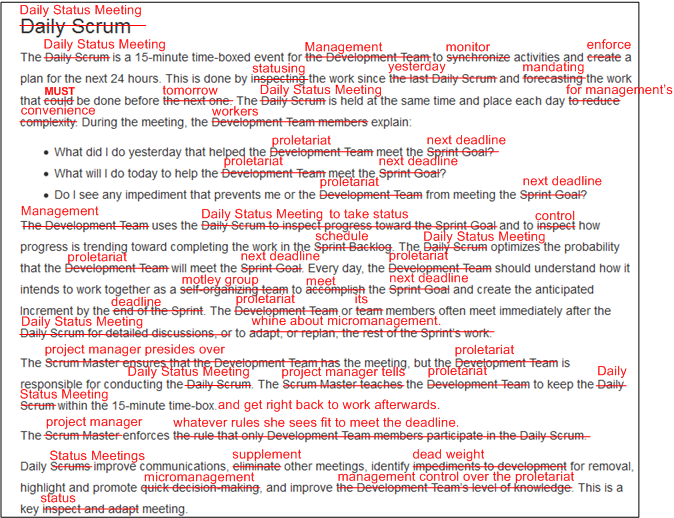
A No Go For Me
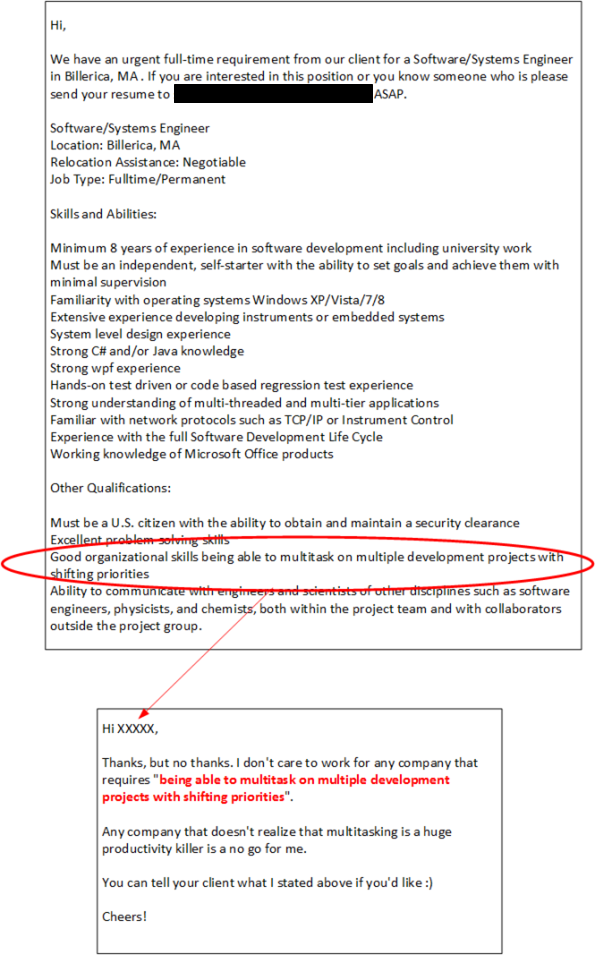
Of course, if I was unemployed, or actively looking for a new job, I would have replied differently to the solicitation. Wouldn’t you have?
The Same Script, A Different Actor
A huge, lumbering dinosaur wakes up, looks in the mirror and sez: “WTF! Look how ugly and immobile I am!“. After pondering its predicament for a few moments, Mr. Dino has an epiphany: “All I gotta do is go on a diet and get a makeover!“.  It’s the same old, same old, script:
- A large company’s performance deteriorates over time because of increasing bureaucracy, apathy, and inertia.
- Wall St. goes nutz, pressuring the company to take action.
- A new, know-it-all, executive with a successful track record is hired on to improve performance.
- The nouveau executive mandates sweeping, across-the-board, changes in the way people work without consulting the people who do the work.
- The exec makes the rounds in the press, espousing how he’s gonna make the company great again.
- After all the hoopla is gone, the massive change effort flounders and all is forgotten – it’s back to the status quo.
The latest incarnation of this well worn tale seems to describe what’s happening in the IT department at longtime IT stalwart, IBM: IBM CIO Designs New IT Workflow for Tech Giant Under Pressure. We’ve heard this all before (Nokia, Research In Motion, Sun, etc):
The mission is to have innovation and the speed of small companies .. and see if we can do that at scale – IBM Corp. CIO Jeff Smith
I’ll give you one guess at to what Mr. Smith’s turnaround strategy is…
Give up? It’s, of course, “Large Scale, Distributed, Agile Development“.
I can see all the LeSS (Large Scale Scrum) and SAFe (Scaled Agile Framework) consultants salivating over all the moolah they can suck out of IBM. Gotta give ’em credit for anticipating the new market for “scaling Agile” and setting up shop to reap the rewards from struggling, deep-pocketed, behemoths like IBM.
It’s ironic that IBM wants to go Agile, yet a part of their business is (was?) to provide Agile consulting expertise to other companies. In fact, one of their former Agile consultant employees, Scott Ambler, invented his own Agile processes: Agile Unified Process (AUP) and Disciplined Agile Delivery (DAD). On top of that, look who wrote this:
Obviously, not all massive turnaround efforts fail. In fact, IBM did an about face once before under the leadership of, unbelievably, a former Nabisco cookie executive named Lou Gerstner. I like IBM. I hope they deviate from the script and return to greatness once again.
From Change Management To Change Prevention
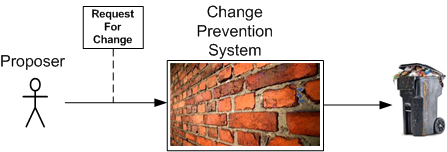
Assume that in order to prevent chaos from reigning in your organizational processes, you design and place into operation a change management system.
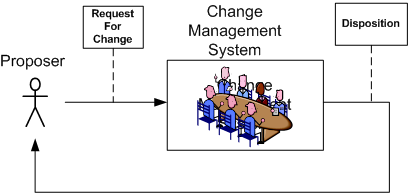
In order for your system to be effective, the turnaround time (i.e. latency), from request to disposition better be low enough so that people will be motivated to participate in the system.

If, over time, you keep adding more and more evaluation rules to your system and imposing more and more pre-conditions (e.g. requiring a formal ROI analysis paper) on your proposers, your system’s latency will keep rising and its effectiveness at managing change (accepting the good and rejecting the bad) will keep decreasing. People will conclude that it’s just not worth their time to traverse your bureaucratic gauntlet. In the extreme case, your system will automagically morph from a change management system into a change prevention system – and you may not even know that it has happened.
The Missing Role
Quick, quick! What role is missing from the classic Scrum 1.0 team configuration of developers, product owner, and scrum master?

Ooh, ooh, I know what’s missing….

Me thinks version 2.0 of the Scrum guide should include, and formally recognize, the glorious role of Agile Coach, no?
Since the Scrum Master has waaaaaaay to much to do already (running the daily 15 minute meeting and removing all those bazillions of impediments that the whiny developers willingly disclose every day), she can’t possibly fulfill the crucial role of agile coach. In addition to formal recognition, the Scrum Alliance should create a program where aspiring coaches can dole out some $$$$ to get certified.
The Apples To Apples Fallacy
To promote their infallible expertise, fathead consultants love to present apples-to-oranges comparisons as though they were apples-to-apples comparisons. One such prominent consultant (hint: a famous Forbes columnist) recently gushed over the success of music provider Spotify.com; contrasting its success to the team that built the buggy, slow, initial, version of the healthcare.gov web site.
As is almost always the case, these clever dudes leave out the oft-hidden, process-independent, contextual, forces that relentlessly work against success:

To imply that the Healthcare.gov team would have been successful if they simply employed agile practices (like Spotify.com) is to either be naive, disingenuous, or both.
Have you noticed that the press isn’t clamoring over the inadequacy of the healthcare.gov site anymore? Obviously, the development team must have righted the ship by morphing into a high performing juggernaut under the tutelage of a cadre of agile process consultant(s) – regardless of whether they did or they didn’t.
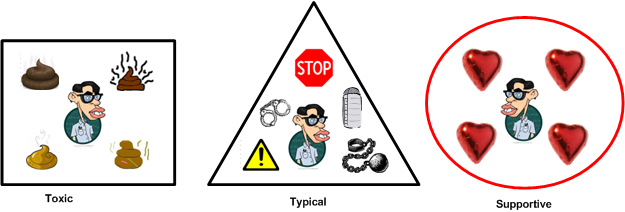
Toxic, Typical, Supportive

How To Run A Company With (Almost) No Rules
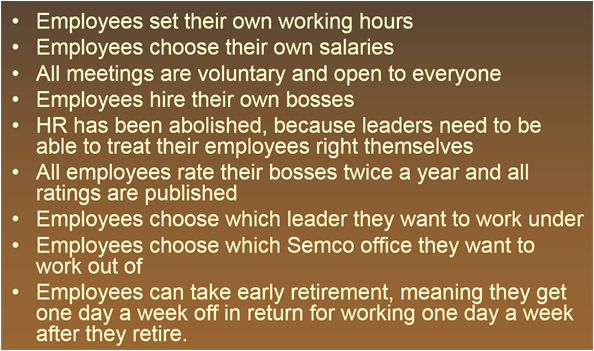
- Set your own salary
- Vote your leaders in/out
- Come and go when you please
- Take vacation whenever you want
- If you finish your work by Wednesday, go to the beach and come back on Monday
- If you have to give back, you’ve taken too much
- Ask “why” three times and then stop
- Design for wisdom
A brilliant and emotionally moving talk from my favorite CEO of all time, Mr. Ricardo Semler.
Please, please, watch it. I guarantee that some, if not all, parts of the talk will fill your heart with joy! Well, maybe it will. If you’re an average, run-of-the-mill, anointed, business leader, it will either piss you off or strike fear into your bones.
If you want some more seminal Semler to whet your appetite, check out these two MIT-sponsored videos:
Make no mistake about it, Mr. Semler’s radical ideas are not a mess of pie-in-the-sky, Utopian psychobabblings. They’re the real deal, and they’ve been in play… in the real world… for over 20+ years at Semco.
Taking The Low Road
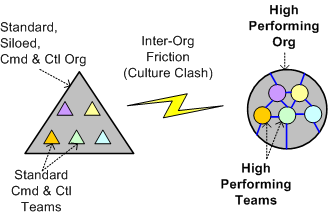
In the pic below, I prefer taking the low road over the high road.
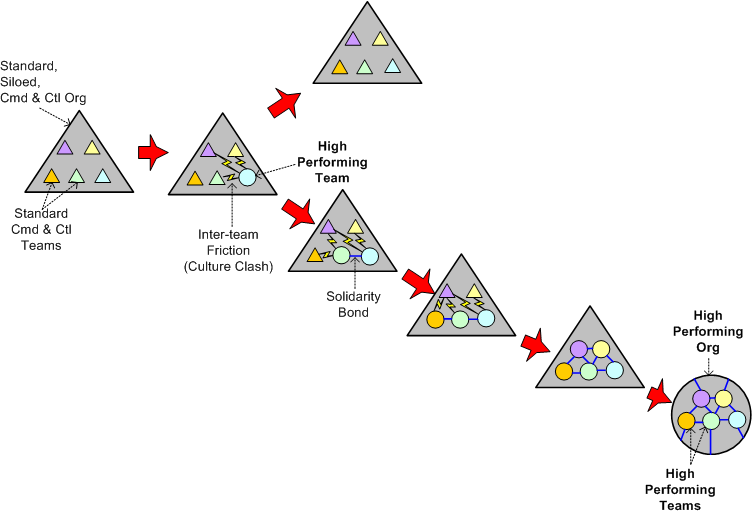
So, now that you and your accomplices have labored long and hard to transform your standard org into a high performing org, you’re happy as a clam. Whoo Hoo!
But wait! What happens when you inevitably team up to do business with a standard org? D’oh! I hate when that happens.

Why am I here?
WTF?
Meh!
D'oh!

My BTC Address



 Bulldozer00's Blog