Archive
Leaders, Followers, Standers
Everybody knows what leaders and followers are, but what about “standers“? A stander is not a slacker. It’s a capable person who is content to stay within his/her comfort zone doing the same thing over and over again.

BD00 thinks that all people are capable and they innately want to “move” forward either as a leader or a follower. It’s a social system’s culture that molds “standers” out of capable people.
In cultures where mistakes of commission are penalized and mistakes of omission go undetected and unacknowledged, the optimum strategy, courtesy of Russell Ackoff, is simply to do as little as needed to elude ex-communication. It’s stagnation city with a burgeoning population of standers; sad for the people and sad for the org.
Under Or Over?

In general, humans suck at estimating. In specific, (without historical data,) software engineers suck at estimating both the size and effort to build a product – a double whammy. Thus, the bard is wrong. The real thought worth pondering is:
To underestimate or overestimate, that is the question.
In “Software Estimation: Demystifying the Black Art“, Steve McConnell boldly answers the question with this graph:
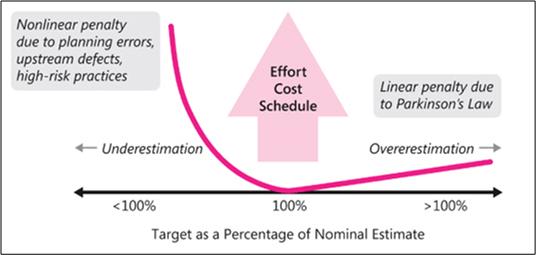
As you can see, the fiscal penalty for underestimation rockets out of control much quicker than the penalty for overestimation. In summary, once a project gets into “late” status, project teams engage in numerous activities that they don’t need to engage in if they overestimated the effort: more status meetings with execs, apologies, triaging of requirements, fixing bugs from quick-dirty workarounds implemented under schedule duress, postponing demos, pulling out of trade shows, more casual overtime, etc.
So, now that the under/over question has been settled, what question should follow? How about this scintillating selection:
Why do so many orgs shoot themselves in the foot by perpetuating a culture where underestimation is the norm and disappointing schedule/cost performance reigns supreme?
Of course, BD00 has an answer for it (cuz he’s got an answer for everything):
Via the x-ray power of POSIWID, it’s simply what hierarchical command and control social orgs do; and you can’t ask such an org to be what it ain’t.
Preposterously Unacceptable
Unless they’re cosmetic tweaks, all proposed alternatives to the unassailable and revered Annual Performance Review (APR) will always be auto-stamped as preposterously unacceptable by the powers that be. It has to be that way, cuz expecting the wolf who’s guarding the hen house to voluntarily give up his post is a slam dunk losing proposition. Nevertheless, let’s look at one of these preposterously unacceptable alternatives just for fun.
Sam Culbert, in “Get Rid Of The Performance Review“, proposes deep-sixing the laughable APR ritual and replacing the stinker with the (crappily named) “performance preview” (PP). The first major feature of the PP is that salary actions are severed from the process. They’re independently determined according to a more objective set of criteria (perhaps like how Joel Spolsky does it at Fog Creek Software). Removing the salary sledgehammer from the hand of the formerly omnipotent manager increases the chance that a straight-talking, two-way conversation regarding individual and organizational improvement will occur.
Mr. Culbert’s face-to-face PP, which can be called into being whenever either side “feels” it should happen, is predicated on both sides answering simple questions like these:
- What have I been doing recently that helps you and the organization perform better?
- What have I been doing recently that isn’t working for you and the organization?
- What can I do in the near future to help you and the organization improve?
Notice that thesw are questions to be answered by both sides – as opposed to one way, judgmental assertions made by the boss “on behalf of the borg” to the subordinate. There are also no formal forms or checklists to be signed and squirreled away in Hoover files to be brandished later for compliance coercion.
This blog post barely scratches the surface of Mr. Culbert’s PP process, but hopefully it’ll spur you to buy his book and learn more about this HR anti-christ. On second thought, don’t do it. If you’re a DICkster, it might bum you out since you’ll vividly realize that you’re helpless and you can’t “fight city hall“. If you’re in the hallowed guild of management (especially the unconsciously evil HR echelon), because of its preposterous unacceptability, it might send shivers up your spine and/or piss you off.
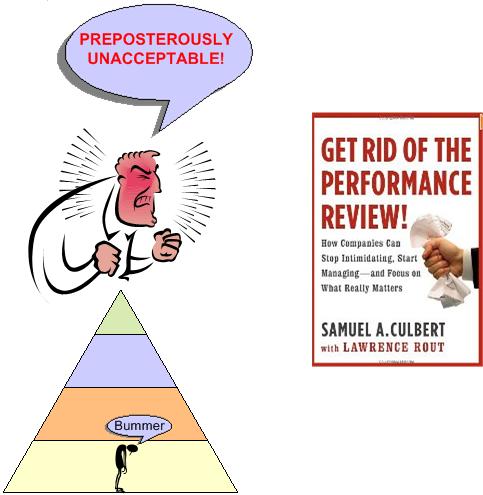
Note: Instead of “Performance Preview” (PP), BD00 would’ve called it something like “I Help, You Help” (IHYH).
Be Thankful
In “Abolishing Performance Appraisals“, Coens and Jenkins state:
One study found that 98% of people saw themselves in the top half of all performers. Another study showed that 80% of people saw themselves in the top quarter of all performers. Other research indicates that 59% of workers across a variety of jobs disagreed or strongly disagreed with any rating that was not the highest on the scale.
Now, assume that your in-Human Resources (iHR) department, under the condoning eyes of the C-suite, enforces the standard bell curve rating system on the DICforce to keep operating costs in check and to implement the industry’s most sacred “best practice“. Of course, the ratings are doled out at the beloved Annual Performance Review (APR) ritual along with subjective lists of personal faults that need “improvement” and 2% raises – a brilliant triple punch combo to the psyche. To make things more interesting, assume that all the reviews are given at the same time each year.
Given the information above, the cyclical morale curve below was scientifically developed by BD00 using one of his patented social system algorithms.
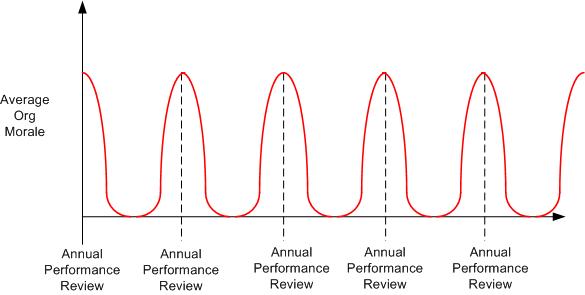
The curve shows that the average “system-wide” morale peaks just prior to the APR; and then it takes a nose dive after most of those optimistic DICs get a dose of reality from their supervisors (whose morale also takes a nose dive from being forced by iHR to administer the deflating news). Subsequent to the nadir, the system morale slowly recovers and rises back to its peak – until boom, the next iHR sponsored APR takes place. Whoo hoo! Dontcha just luv rollercoaster rides?
Just think of the lost productivity and sub-quality work performed during the annual dips. The next time you see an iHR group member, don’t fugget to thank him/her for the wonderful APR system his/her group presides over. Uh, on second thought, don’t do it. Nothing of substance is likely to change and you may be perceived as difficult, disrespectful, and disloyal – three more items to tack onto next year’s personal fault list. Plus, these types of things are undiscussable and they’re not within your tiny silo of expertise.
The Accumulation Of Rules
According to that dumbass BD00, in any given level in an institutional hierarsy, the number of internal org rules a member of that level is required to follow is a function of the number of levels above. Each level makes some rules for the levels below. Relatively speaking, the dudes in the head shed have to follow zero rules and they concoct the “high level” rules for the levels below them.
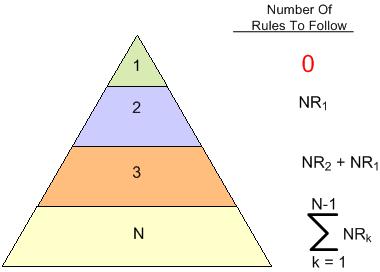
As one travels down a dysfunctional hierarsy, the number of rules to be obeyed is cumulative. By the time you’re down in the bilge room, the number of written and (especially) unwritten rules to follow is essentially infinite. The irony is that while the unfettered infallibles at the top keep piling on the handcuffs, they’re also simultaneously professing their love for empowerment, taking-initiative, dedication, trust, loyalty, yada-yada-yada.
T’is what it is, just another paycheck-for-repression tradeoff. You can’t have your cake and eat it too, so suck it up soldier!
A Double Success Story
I really enjoy reading accounts of how companies overcome a minefield of obstacles to achieve both financial and social success. It’s much easier to achieve financial success at the top in exchange for social freedom at the bottom than it is to achieve success in both areas at the same time (hint: HR groups are the greatest impediment to dual success). For confirmation of this assertion, simply look at the coupling between profit margins and social misery at any third world sweatshop.
One such double financial + social success story is told in the Fast Company article:” How Target’s CEO Inspires Teamwork At A Massive Scale”. However, BD00, the saucy and skeptical bloke that he is, always consumes such anecdotes with a grain of salt when the narrator is a single soul from the C-level suite. In the Target story, the telltaler is the CEO himself, Mr. Gregg Steinhafel.
The good news is that Gregg wasn’t appointed from without. He rose through the ranks:
“A veteran of Target’s rank and file, Steinhafel joined the company back in 1979, worked his way up over the next two decades to become president, and eventually took the corner office in 2008.“
The bad news is that when you traverse the article and pluck out his quotes, they are the same old, same old:
“We are the coaching staff that help design the playbook, but implement it at the same time.”
“At Target, nothing happens without a large, collaborative effort.”
“Everyone is a mentor and mentee. It is one of the fun and exciting parts of [any] job.”
“It’s our responsibility to act and continue to support the teams.”
“All the senior leaders like to sit down and forward think, and anticipate where the puck is going.”
“We benchmark against the world’s best to develop ideas for future growth.”
“We are constantly checking in.”
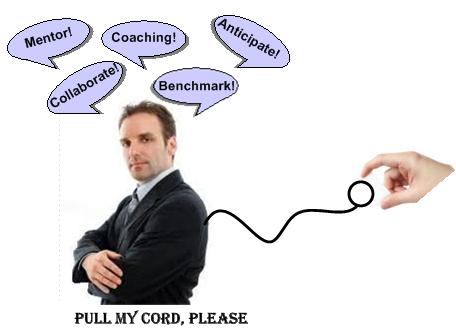
Direct quotes and disrespectfully snarky graphic aside, the double success story at Target seems genuine and I’m thrilled that the company has leveraged social media tools to improve its performance through networked collaboration. I just wish that some lower level employees were asked to contribute to its telling – anonymously, of course.
For sure, you’ll easily find a ton of one-sided, C-suite-sourced stories like this Target tale in the mainstream press and best-selling business book section at Amazon.com. However, you won’t find any in the works of Ackoff, Argyris, Deming, Block, Culbert, Cohen, Livingston, and other dirty rotten scoundrels. The stories they tell are the stories I find fascinating and mind-changing.
Note: I’ve had a vague and notional image of the pull-cord executive doll in my contaminated mind for several months now. I finally conjured up a BS post to host it. Whoo Hoo!
Not Arbiters, Nor Catalysts
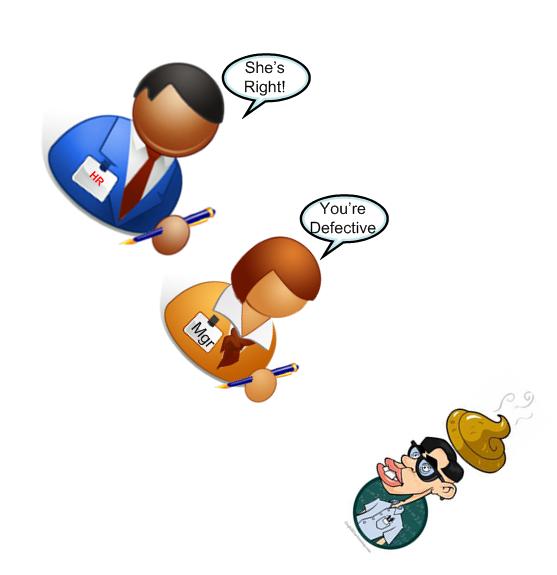
When I was young and naive (as opposed to my current state: old and misinformed), I entered the werkfarce thinking that HR departments were supposed to be compassionate arbiters of disputes and employee development catalysts – until I discovered what they actually did:
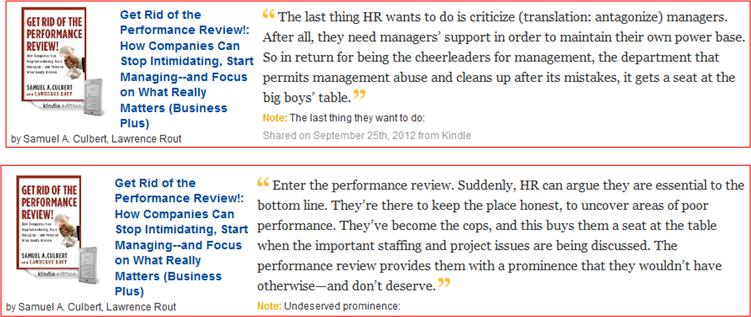
HR groups are bright shining examples of POSIWID. “The Purpose Of a System Is What It Does” – not what it says it does. Alas, BD00 doesn’t think that most HR departments are maliciously evil, they’re just so indoctrinated and immersed in Tayloresque, Theory-X thinking that “they know not what they do“. How about you? Besides thinking that BD00 knows not what he does, what do you think?
It’s The Relationships, Stupid
If you read Sam Culbert’s book rant against the taken-for-granted and unassailable “annual performance review” process, you’d think he is an anti-hierarchy revolutionary deserving to be crushed. But the dude is not:
Hierarchical structure, in the form of an organization chart, serves many constructive purposes. By showing the chain of command, it allows everyone to see who is responsible for what, how organization units are being deployed, and, most importantly, who should be accountable for bottom-line results. In contrast, I can’t think of a single constructive purpose served by hierarchical relationships— that is, those in which the boss gets to dominate all conversations.
Culbert, Samuel A. (2010-04-01). Get Rid of the Performance Review!: How Companies Can Stop Intimidating, Start Managing–and Focus on What Really Matters (Business Plus) (pp. 128-129). Hachette Book Group. Kindle Edition. – Sam Culbert
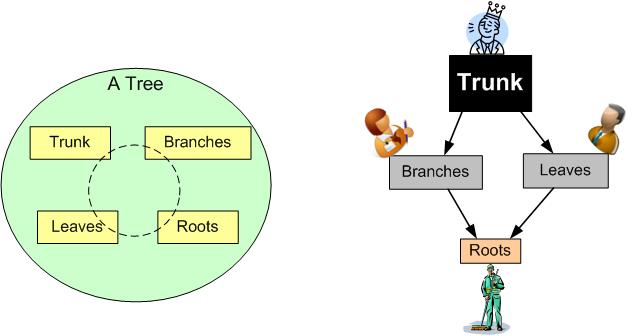
In a man-made conceptual hierarchical breakdown of a tree’s “parts“, the relationships between the parts have nothing to do whatsoever with their “position” in the hierarchy. A tree’s components miraculously work together in synchronous harmony to manifest and share its beauty as a whole with all of nature – including us (perhaps undeserving) humans. Leaves aren’t pitted against leaves for the purpose of gaining more hierarchical status in the “minds” of the other tree parts. The trunk doesn’t perceive itself as “more important and deserving” than the “lowly” branches. The roots don’t talk about the topmost branches in a derogatory manner, nor vice versa.
Related articles
- He Said, He Thought, He Said, He Thought (bulldozer00.com)
Industry Best Practice
When we got the idea for this book, we expected to surely find dozens of other books with the same theme… To our surprise, however, we found no other books devoted to abolishing (the annual performance) appraisal and exploring fresh approaches to the functions of appraisal. – Coens/Jenkins (Abolishing Performance Appraisals)
Since the thought of replacing the sacred “annual performance review” is so shockingly unthinkable, any proposed alternative doesn’t have a snowball’s chance in hell of being embraced. The undiscussability of this “industry best practice” is so palpable, that not many souls even make an attempt to concoct any alternatives, let alone expose them for scrutiny. Alas, such is the power of entrenched 20th century management thinking to keep the status quo on corpo-social issues that really matter, in-situ.
 Related articles
- Behind One’s Back (bulldozer00.com)
- He Said, He Thought, He Said, He Thought (bulldozer00.com)
The Real Customer
In “12 ‘best practices’ IT should avoid at all costs”, InfoWorld‘s Bob Lewis asserts:

I enjoy Bob’s books and columns, but I have to side with the likes of Russell Ackoff and Vineet Nayar on this one. All of an org’s “enabling” functions: HR, QA, Finance, Purchasing, IT, etc; should indeed serve the direct revenue-generating business functions and treat them as paying customers. Otherwise, the natural tendency of these groups in hierarchical orgs is to turn into obstacle-inserting, unresponsive, monopolistic dictatorships. Of course, in the “real world” this rarely happens because rational adults are in charge – and Bob is right. What is your opinion?

Why am I here?
WTF?
Meh!
D'oh!

My BTC Address



 Bulldozer00's Blog