Archive
The FAE
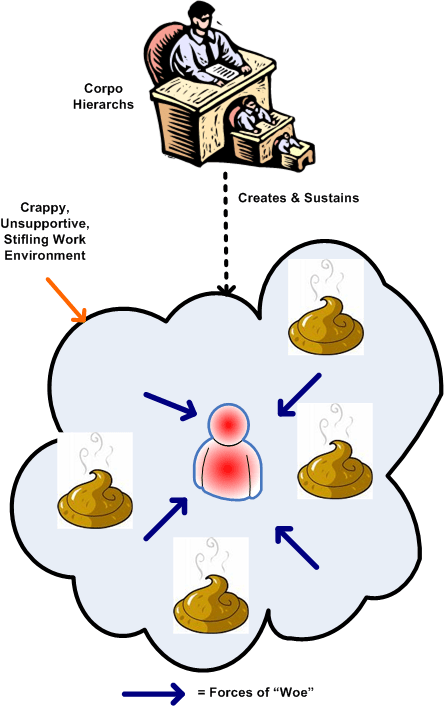
Over the years, I’ve read quite a few books and articles on managing the soft side of an organization. In many of these info sources, I’ve seen the term FAE = Fundamental Attribution Error mentioned. The FAE represents the tendency of a manager to instinctively and unthinkingly blame a person’s character and/or work ethic for under-performance. The real cause, which cannot possibly be true in a corpo manager’s conditioned mind, is likely that his/her inability to create, nurture, and continuously sustain a helpful, supportive, learning work environment is killing productivity and creating under-performers.
Of course, the FAE cannot account for all under-performance in an absolute sense. There are self-made underperformers (like BD00) in every org, regardless of the quality of the surrounding work environment.
Contrasting Cultures
Because it’s a numerically unquantifiable and highly spiritual topic, I’ve always been fascinated by the subject of “company culture”. Leaders can’t directly create and control the cultural behavior they want in their org. At best, they can try to put an environment and set of incentives in place so that the culture they want spontaneously emerges.
IMHO, the most effective method for catalyzing the formation of a desired culture is to lead by example. As Ghandi once said, “be the change you’d like to see in the world”. When executives behave in contradiction to the culture they want, they deserve what they get – an apathetic, mistrusting, and disengaged workforce. Blech, and meh.
Here’s a great and short article that compares four radically different, but financially successful, company cultures: four cultures. Since they’re all deemed successful , there is no one perfect culture that an org can strive for.
Which cultural environment would you like to work in?
Prioritized Value
Obviously, everyone who contributes to a business’ success is important. However, because of compensation discrepancies and obvious differences in the way various groups of people are treated, management clearly has a prioritized list of what it thinks is more important – regardless of what is espoused.
Since everyone has their own agenda and subjective reasons for perceiving what and who is most important for a successful business, here’s my list, in order of decreasing priority:
- The products the company sells (well duhhhh!)
- The people who design, build, test, deliver, install, and maintain the product portfolio.
- The people who train the customers and serve as the front line customer interface when problems occur.
- The people who sell the products.
- The business overhead groups
- Management
My list is driven by the perception that the direct, hands-on creation and sustenance of value for customers is king. Everything else is secondary. A second (maybe the first?) driver is the fact that I’m a product designer, builder, and maintainer. See, I told you that everyone has their own agenda 🙂
Based on my observations over the years, the managements of all mediocre, follow-the-herd, companies have a a prioritized list that is the exact inverse of mine. Because of this clash of core values, I don’t have much professional respect (which is not the same as personal respect for individuals) for the guild of management.
What’s on your list?
Bozo Planning
Why is it that big government and big industry continue to cling to an archaic planning method that clearly doesn’t work. History has repeatedly shown that the Big, One Time Planning (BOTP) method is rapidly becoming more obsolete as the pace of change accelerates. The top half of the figure below shows what has been, and continues to be done for Big, Complex, Multi-technology, Product (BCMP) development jobs.

By definition, BCMPs are hairballs that no one fully understands at the outset. As time ticks forward and the effort progresses, learning naturally occurs and new knowledge is discovered and accumulated. This new found knowledge validates the invalidity of the golden BOTP plan. Strangely but surely, as THEE plan becomes more disconnected from reality, no one says or does anything until the mismatch gets in your face. Driven by fear, no one wants to be the first one to step up and announce that the emperor needs a new wardrobe. Eventually, shoddy work and buggy, failure prone components become visible and impossible to ignore. Finger pointing and defensiveness take over. It’s sick city until the crap gets delivered or the whole shebang is canceled in a highly publicized hatefest.
The bottom of the figure shows an alternative to the toxic BOTP method. It’s called: Planning To Continuously Replan (PTCR). In this method, everyone develops a shared understanding at the outset that PTCR will be used to increase (but not guarantee) the chance of project success. In PTCR, replanning is done at necessary points in the effort. How does a project manager know when one of these necessary points in time has occurred? By rolling up his/her sleeves, getting close to the team and, most importantly, personally monitoring the intermediate work products that are being created in real-time. Trust but verify. There’s no distancing and disconnecting from the project like the bozo executors of the BOTP technique do.
It’s my guess that BOTP will continue to be used by vendors and purchasers of BCMPs in the future. Because of the fear of change and the importance of maintaining (a false) image of infallibility, the comfort of the same-old same-old is always preferred to the uncomfort of the new. This, in spite of the ineffectiveness of the same-old same-old. As Mark Twain said: “I love progress, it’s change that I hate”.
Contrasting Customers
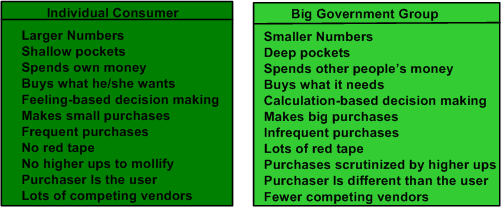
Much of the sage advice given by modern day business gurus like Tom Peters, Gary Hamel, Seth Godin, et al, is targeted at companies that sell to individual consumers. If you sell big, expensive, complex, and long-lived products to government groups, then much of their advice is not applicable.
The graphic below shows just some of the enormous contrasts between these two customer classes. Obviously, the number of individual consumers dwarfs the number of potential government groups. I think that this discrepancy is the major reason why the modern day business experts don’t try too hard at dispensing advice geared toward big system vendors.
One thing that both customer classes have in common is this:
If your product portfolio sux, you are in big trouble.
It doesn’t matter how skilled and talented your marketeers and business development people are. You’re doomed if your product doesn’t perform as expected. At best, your business will muddle along forever amongst the ranks of the mediocre. You will be boring, irrelevant, and uninspiring to all the stakeholders involved in your enterprise. Purgatory city. At worst, crisis management is the order of the day and bankruptcy is just a step or two away.
Can you think of other contrasting attributes between these two vastly different customer categories?
Problems, Growth, And Serious Shrinkage
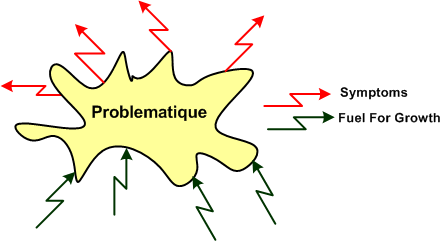
I first encountered the word “problematique” in John Warfield’s book “An Introduction To Systems Science“. A big problem isn’t singular in nature. It is comprised of an intertwined mess of pseudo-individual problems. This hairball produces painful symptoms that are greater than the sum of its parts. Hence, the word “problematique” seems to better convey the seriousness of a big problem.
The figure below shows a general model of a problematique along with its accompanying set of causes and symptoms. Assume that the size of the problematique is not static. Fueled by the unchecked amplification of its set of causes, it grows uncontrollably over time . New symptoms appear and existing symptoms get worse. It’s bummer city.
As an example, assume that some of the nasty symptoms of a hypothetical organization’s problematique are as follows:
-
Dissatisfied customers,
-
Disengaged employees, and
-
Low quality products
Also assume that the problematique’s true (but usually undiscussable) underlying causes are:
-
Shoddy workmanship,
-
Schedule pressure,
-
Management and worker incompetence,
-
Unscalabe and stifling work processes,
-
Useless and unhelpful documentation (a.k.a. camouflage)
Now, assume that in a sincere attempt to control and ameliorate its problematique, the organization designs and implements what it thinks is a problem control system but is really a symptom control system.

Assume that the symptom control system provides the following capabilities:
-
Frequent damage control trips by executives to customer sites to medicate customers.
-
Free upgrade offers,
-
Lower product maintenance prices,
-
Increased schedule pressure on the work force,
-
The imposition of more constraining processes on the work force,
-
The addition of more self-medicating status meetings,
-
The generation of more useless documentation (a.k.a. camouflage squared).
The symptom control system may work for a while, but since the fuel sources haven’t been cut off, the problematique’s growth soooner or later overwhelms the system’s capability to keep the symptoms in check. The chains break and the symptoms reappear. As the problematique continues to grow, new symptoms appear in the form of decreased demand for the organization’s products, decreased revenue, and decreased profits because of rising internal costs.
Next, assume that by the grace of God, the organization awakens and becomes conscious of the true fuel sources that facilitate the problematique’s uncontrolled growth. The organization then designs an effective problematique control system that severs the fuel source connections to the problematique. In order to pull this miracle off, the control system executes the following unconventional behaviors:
-
Increases work force competence through real mentoring and meaningful continuous training.
-
Recognizes and rewards high quality work over heroic crisis response. Merit over conformance.
-
Relieves schedule pressure
-
Streamlines work processes and eliminates obsolete and useless processes.
-
Calls fewer status meetings.
-
Oversees the creation of less, but more useful/helpful, documentation.
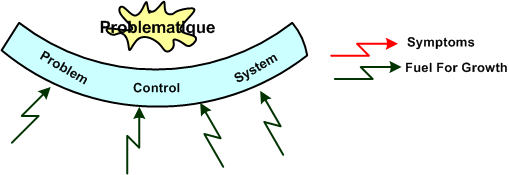
Due to the effectiveness of the integrated control system, the problematique experiences “serious shrinkage”. The symptoms are attenuated, or eliminated entirely, and the organization’s health gradually improves.
Sadly, the effort required to design and implement a symptom control system is much easier than the effort required to design and implement a problematique control system.
Rappers And Cabbies
Look around you. How many people in your organization are Reviewers And aPprovers (RAPpers)? How many people are Creators And Builders (CABbies)? Which types of members are more valued by your organization?
Since managers (especially the higher up you go in the hierarchy) are most likely to be RAPpers, the odds are high that rappers are perceived to be more valuable than cabbies in your organization. Typically, the bigger the org, the more valued the rappers.
Rappers rarely have good ideas. If a rapper comes up with the occasional good idea, they usually keep it to themselves, especially if it’s too different from the norm. The risk is too high for rejection and rappers can’t have that. Rappers are too concerned about looking infallible. They have an image to uphold.
Cabbies, on the other hand, come up with all kinds of ideas, both good and bad. They are less inhibited by the need to look infallible. However, in a rapper dominated environment, most cabbies have a tough time externalizing their ideas for fear of rejection too. After all, they’re human.
When a business is created from scratch, most, if not all, the founding members are both rappers and cabbies. Because good ideas are plentiful and flow freely, the business thrives and grows for a while. However, over time, the usual consequence of growth is that more and more members transform into rappers. The conventional MBA thinking is that rappers are needed to weed out bad ideas and control growth. Fewer ideas get generated and the business starts stagnating. In the extreme, the rappers grow to vastly outnumber the cabbies and voila, a stifling and static bureaucracy is created.
The sad thing is that every human being who walks the face of the earth is born with the innate ability to become a cabbie. However, since western societies value rappers over cabbies, most people ignore and suppress their cabbie talent. To the detriment of all, they unconsciously strive to become rappers.

Adjacent Customers
One way to grow and expand a business is to probe and explore the needs and wants of adjacent customers. Assume that the vast majority of your customers are behemoth national governments who have the ability to generate their own revenue streams via the power of taxation. Unlike individual consumers, who are fickle and tighter with the dollar because they actually earn their money through (hopefully) honest work, revenue streams sourced from national governments are much larger and easier to tap into for big product manufacturers.
So what are some potential adjacent customers for a big and complex system manufacturer? The figure below shows some ideas.

Regarding new customers for your company, it seems reasonable to rule out individual consumers, not-for-profit organizations, and small private organizations. Even though the numbers of customers in those categories are huge, they either don’t have the deep pockets that can sustain your business, or they have no need for your big system products .
One could think of smaller, more numerous local governments as adjacent customer markets. It may be a further stretch, but big publicly held Fortune 500 companies may also be considered as potential adjacent customers. However, you may need to invest in, and development, smaller and less expensive adjacent products to serve these new markets.
Here’s the catch. Without allocating and directing any Business Development (BD) or Internal Research and Development (IR&D) resources to the task of probing, sensing, and exploring the needs and wants of these adjacent customer groups, there’s virtually no chance that you’re going to acquire new customers in these adjacent markets. They’re not just gonna show up out of nowhere at your doorstep with a bundle of money asking for your products. Duhhhh!
Not Of This Earth
Did you ever hear of a company named SEMCO? If not, then you’re missing out on one of the greatest corporate success stories on the planet. The CEO, Ricardo Semler, is perhaps the smartest and most courageous executive to ever lead a for-proft company. Semco and Semler are so different and “out there” that they may not be of this earth.
Check out these snippets (followed by my snarky comments) from the SEMCO Survival Manual:
“Only people who have respect for their followers can be leaders.“
Amen. How does SEMCO determine which people can become, and remain, a leader in their organization? Read on.
“There is no space at the Semco Group for formalities. The doors are always open and people should say what they really think, without worries or inhibitions.”
Unlike the vast majority of corpos that are clones of each other, there’s no “checking your personality at the door” at Semco.
“Unions are an important method of protecting workers. Unionization is free within the company. The Semco Group believes that constant relationships with unions are healthy for the company and the employees. The presence of union members at the company is always welcome.“
Rather than taking the standard corpo “unions are enemies” stance, SEMCO treats unions as partners. Wow, what a concept.
“Based on the fact that everyone can say what they think, rumors and gossip should not be stimulated. Any attempt to harm another person is looked on very seriously. Take part and speak openly of what you are thinking in order to improve things.“
Wow, more weird concepts, “saying what you think” and “speaking openly“. How uncorpo and disrespectful of the SEMCO leadership for promoting such lunacy in writing.
“Every six months you will fill in a questionnaire and say what you really think about your immediate superior.”
Cool rule, eh? Every six months you get to say how you feel about your “leader“. If he/she isn’t measuring up, they get demoted.
“Have an opinion, put yourself forward as a candidate, always say what you think – do not be just another cog in the wheel. State your opinion about everything that interests you, even if you weren’t asked for it. Be active about your feelings.”
OMG! Stating your opinion even when you aren’t asked for it? Arrrrgh! More blasphemy that should be punishable by death. Feelings in the workplace? There’s no place for expressing feelings in the workplace. Feelings are for the weak and un-promotable.
“We want everybody to participate; opinions will always be welcome and should be spontaneous.”
Spontaneous espousal of opinions? More sacrilege that is unacceptable at 99% of all corpo clones. In the land of the clones, before publicly stating your opinion, you must always think it over carefully and ensure that your words won’t offend a single soul – especially one with a big title and high stature. If the words will offend anyone, then keep your piehole shut.
“Watch the results closely and ask any questions you want – there are no issues that cannot be discussed. “
OMG again! There are no “undiscussable topics” at SEMCO? That can’t be. They’re lying through their teeth. It’s obvious that this policy can’t be applied in practice.
After reading all the above lies, I’m convinced that SEMCO doesn’t exist. No company can do all that, make money, and stay in business. No freakin’ way. If SEMCO-styled companies do exist in the good ole USA, they must be found out and closed down at all costs. It’s unacceptable to “us” real capitalists to operate a company in such an unpatriotic way. Quick, someone mobilize the corpo SWAT team. We’re goin’ on a kill mission to snuff out this abomination.
Pile On The Rules

Why am I here?
WTF?
Meh!
D'oh!

My BTC Address



 Bulldozer00's Blog