Archive
MITRE
I work in the aerospace and defense industry. This industry is typically slow moving and not known for bleeding edge innovation. Thus, I was intrigued when I discovered that the MITRE corporation came in at number 30 in Fast Company magazine’s 2010 list of the 50 most innovative companies in the world. I scanned the list for other companies in the industry, but I (unsurprisingly) didn’t find any more industry stalwarts among the innovative elite.
In addition to the world class innovators, Fast Company also lists the top 10 innovative companies in a slew of industries, including the the defense business. Here is their list of innovators, subjectively decided by someone, or some group, at Fast Company.
- Mitre
- DARPA
- iRobot
- QinetiQ
- Northrup Grumman
- Raytheon
- Lockheed Martin
- Boeing
- Aurora Flight Services
- ATK
After reading the summary for each company, it appears that most money and brainpower are being invested in unmanned moving, sensor packed products like robots and aerial vehicles. For companies looking to branch out and explore new business opportunities, they may do well to invest in these areas and see if anything emerges.

Wealth And Effort
Any form of “ism” can work if it creates and sustains a large middle class that feels it can make it to the top of the pyramid of privilege by the fruits of their own labor. As soon as the bubble bursts and the middle class feels that the rich keep getting richer without any effort and the poor keep getting poorer regardless of effort, all is lost and a revolution is in the offing. Sure, a powerful police force may temporarily stave off the revolution, but not forever. Over time, the innate human desire for liberty trumps oppression like water dissolves rock.

In the USA, democracy and the right of every person to vote has worked pretty well to stave off the destruction of the middle class. However, when rich elites gain publicly invisible control over all political parties and force the government to allow them to operate unfettered without any oversight, the result is extreme capitalism and the potential fall of the middle class. I don’t know if it’s happening in America, but it sure seems like it. When big fat corpo bureaucracies demand and get capitalism on the way up and socialism (bailouts) on the way down, there’s no risk of consequences to their behavior and they have no reason to change their middle class busting ways. “Too big to fail” and “too little to succeed” sux for the middle class. Let them eat cake.
Unlike In Love
Unlike in love, in business “absence does not make the heart grow fonder“. When there are long stretches of silence between supervisor-to-supervisee, vendor-to-customer, and/or supplier-to-vendor communications, the receiving party in each case will sooner or later start thinking that the transmitting party doesn’t care about them. Worse, if communication solely occurs when the transmitter “wants something” from the receiver, the relationship deteriorates further. Trust and respect, difficult to acquire but ridiculously easy to lose, go right down the tubes and mutually beneficial collaboration comes to a stand still.
So, is all lost when the transmit-receive communication channel is intact but the transmitter stops transmitting? Hell no, but it takes awareness, sincerity, persistence, initiative and, most importantly, willingness on the transmitter’s part to repair the damage. Why should the transmitter be the lead in re-establishing communication? Because the transmitter is the source of information that the receiver needs to perform its function. No transmission, no information. No information, no mutually beneficial results.

Engage Me, Please
Since many people spend a large amount of time at work, or thinking about work, I’ve been on a perpetual search for the keys to developing, and more importantly, sustaining an inspirational culture that brings daily joy to all. I’m keenly interested in the topic because an inspiring company culture, like quality, is ephemeral, hard to quantify, and hard to bring to fruition.
In this blog post, “The Hole In The Soul Of Business“, Gary Hamel laments the fact that so many business leaders come up empty when it comes to the creation and sustainment of an engaging company culture.
In my last post, I cited a survey that found that only 20% of employees are truly engaged in their work — heart and soul. As a student of management, I’m depressed by the fact that so many people find work depressing. In the study, respondents laid much of the blame for their lassitude on uncommunicative and egocentric managers…
Why is it that managers are so willing to acknowledge the idea of a company dedicated to timeless human values and yet so unwilling to become practical advocates for those values within their own organizations? I have a hunch. I think corporate life is so manifestly inhuman—so mechanical, mundane and materialistic—that any attempt to inject a spiritual note into the overtly secular proceedings just feels wildly out of place—the workplace equivalent of reading a Bible in a brothel.
The first step toward getting rid of a bad habit is admitting that you have a problem in the first place. Alas, uncommunicative and egocentric managers never admit that there is a problem. That’s because they’re infallible, of course.

Hey Nicky, Please Pass The Culture Sauce
This Inc. Magazine piece, Lessons From a Blue-Collar Millionaire, tells the story of CEO Nick Sarillo and Nick’s Pizza & Pub. Like Tony Hsieh of Zappos.com , Jim Goodnight of the SAS Institute, and Ricardo Semler of Semco, Nick knows that the real key to business success is building a people-centric culture and relentlessly husbanding it so that the second law of thermodynamics doesn’t slowly but surely destroy it.
Here are some snippets from the article followed by comments from the peanut gallery.
In an industry in which annual employee turnover of 200 percent is considered normal, Sarillo’s restaurants lose and replace just 20 percent of their staff members every year. Net operating profit in the industry averages 6.6 percent; Sarillo’s runs about 14 percent and has gone as high as 18 percent. Meanwhile, the 14-year-old company does more volume on a per-unit basis (an average of $3.5 million over the past three years) than nearly all independent pizza restaurants. And customers, it seems, adore the service: On three occasions, waitresses have received tips of $1,000.
The above results clearly show that what Nick’s doing works, no?
Sarillo has built his company’s culture by using a form of management best characterized as “trust and track.” It involves educating employees about what it takes for the company to be successful, then trusting them to act accordingly. The company’s training program is elaborate, rigorous, and ongoing. The alternative is command and control, wherein success is the boss’s responsibility and employees do what the boss says.”Managers trained in command and control think it’s their responsibility to tell people what to do,” Sarillo says. “They like having that power. It gives them their sense of self-worth. But when you manage that way, people see it, and they start waiting for you to tell them what to do. You wind up with too much on your plate, and things fall through the cracks. It’s not efficient or effective. We want all the team members to feel responsible for the company’s success.”
There’s not much to add to the above snippet. I, and countless others much smarter and more eloquent than me, have ranted about the toxicity of dysfunctional CCH corpocracies to no avail. CCHs litter the landscape anf they will continue to do so because of Nick’s quote: “They like having that power. It gives them their sense of self-worth.”
They had someone else put in the numbers, and when the numbers came out wrong, they didn’t dig deeper to discover why. Because they didn’t know the ‘why,’ they couldn’t share it with the team members. When you know the ‘why,’ it’s really easy to figure out what to do, but sharing that kind of information wasn’t how they’d been trained to manage.”
In the above snippet, Nick relates his experience when he mistakenly hired managers with the old “I’m the boss and I don’t do details – I’m better than that” 1920’s mindset.
People who inquire about a job receive a handout detailing the company’s purpose and values. Candidates need four yes votes from three managers to receive an offer. Just one of every 12 applicants to Nick’s gets hired. “I was really surprised by the process,” she says. “You get interviewed twice, and you take a personality test.”
Like other culture-obsessed companies, the interviewing process is key to separating the wheat from the chaff.
- 1 Feel your community’s pain; share its joy
- 2 Hire only A+ players
- 3 Learn, grow, compensate
- 4 Systems are for building trust
- 5 Coach in the moment, not after the fact
- 6 A consultant can be more helpful than you think
- 7 Turn negatives into positives by making talk safe
- 8 “Why” is more important than “what” or “how”
- 9 “Trust” without “track” is an invitation to trouble
- 10 Beware of growing before you — and the company — are ready
The above list represents the 10 key ingredients that Nick uses to drive his business. My faves are numbers 4, 7, 8, and 9. What are yours?

SAS Still Rocks
Everyone loves to be number one. According to Fortune mag, SAS is the Best Company to Work For in 2010. This rare gem of a company has been on my list of faves for many years and it amazingly continues to thrive in a rapidly moving industry that’s under constant pressure from competitors like Google, IBM, Microsoft, and open source software organizations.
SAS (pronounced sass) has been on Fortune’s list of Best Companies to Work For every one of the 13 years we’ve been keeping score. But this is the first time SAS is in the No. 1 slot.
CEO Jim Goodnight’s motives aren’t charitable but entirely utilitarian, even a bit Machiavellian. The average tenure at SAS is 10 years; 300 employees have worked 25 or more. Annual turnover was 2% in 2009, compared with the average in the software industry of about 22%. Women make up 45% of its U.S. workforce, which has an average age of 45.
Goodnight says the “wonder” isn’t that his company is so generous, but why other presumably rational corporations are not. Academicians confirm that his policies augment creativity, reduce distraction, and foster intense loyalty — even though SAS isn’t known for paying the highest salaries in its field and even though there are no stock options.
The notion of easy living frustrates those on the inside. “Some may think that because SAS is family-friendly and has great benefits that we don’t work hard,” says Bev Brown, who’s in external communications. “But people do work hard here, because they’re motivated to take care of a company that takes care of them.”
With a “billion dollars in the bank” and another big building going up on campus, Goodnight is continuing to invest. In a company of elite quantitative analysts, he devotes more than a fifth of revenue to R&D. For 33 straight years, SAS’s revenues have gone up — reaching $2.3 billion in 2009, nearly doubling in seven years.
The company that I work for, Sensis Inc., is pretty damn good to its employees too. Just because I’m on a diet doesn’t mean I can’t look at the menu.

Layers Of Value Streams
An organization of people assembled for a purpose runs on all cylinders when every layer in its control structure creates a value stream that puts more into the org than it takes out. The higher you go up the pyramid of privilege, the less visible the added value, but the more the impact. In dysfunctional orgs, the upper layers don’t create any value and their impact is damaging to the whole. Like leeches, they suck the blood out of the org without contributing anything of substance.

It’s the responsibility (or, it should be) of each upper layer to sample the value stream produced by the lower layer(s) to ensure continuous excellence and improvement. Except for the DICforce (at rock bottom of course), each upper level can sample and measure any/all of the value streams below them.
In screwed up and inefficient corpocracies where the upper layers are too lazy or incompetent to sample the lower layer value streams, the only value stream samplers are the customers. This means that if crap makes it out the door, they’re the ones who discover and report it. At worst, they don’t report it and they silently blow off the org. They never buy anything from it again, and they tell all their peers to stay away from the crap factory. Meanwhile, everyone back at doo-doo ranch is asking each other; “Lucy, whuh hah-penned?”.
Ya Can’t Put The Cat Back In The Bag
Check out this snippet from “Can Larger Companies Still be Passionate and Quirky?“:
Writing for The New York Times, Adam Bryant conducted an interview with Tony Hsieh, the chief executive of Zappos.com. Part of the interview that intrigued me was Hsieh’s explanation of why he and his roommate sold their company LinkExchange to Microsoft in 1998.
Part of it was the money, he admits. But, mostly, it was because the passion and excitement that permeated the company in the beginning was gone, and he’d grown to dislike its culture:
“When it was starting out, when it was just 5 or 10 of us, it was like your typical dot-com. We were all really excited, working around the clock, sleeping under our desks, had no idea what day of the week it was. But we didn’t know any better and didn’t pay attention to company culture. By the time we got to 100 people, even though we hired people with the right skill sets and experiences, I just dreaded getting out of bed in the morning and was hitting that snooze button over and over again.”
To avoid this happening with Zappos, Hsieh says he formalized the definition of the Zappos culture into 10 core values; core values that they would be willing to hire and fire people based on. Read the interview with Hsieh for details on how they went about this.
With LinkExchange, Tony was wise enough to know that it was fruitless to try and restore the company’s original esprit de corps culture. Once the cat gets out of the bag, it’s pretty much a done deal that you won’t get it back in.
What’s mind boggling to me is that leaders of startups that grow and “mature” over time don’t even have a clue that the vibrant culture of community/comraderie that they originally created has petered out. They get disconnected and buffered from the day to day culture by adding layer upon layer of pyramidal stratification and they delude themselves into thinking the culture has been maintained “for free” over the duration. Those dudes deserve what they get; a transformation from a communal meritocracy into a corpo mediocracy just like the rest of the moo-herd.

Nested Bureaucracies
By definition, ineffective bureaucracies (are there any effective ones?) consume more resources than they produce in equivalent value to their users/consumers. According to Russell Ackoff, the only way an ineffective bureaucracy can remain in place is by external subsidization that is totally disconnected with its performance. In other words, bureaucracies rely on clueless sugar daddies supplying them with operating budgets without regard to whether they are contributing more to “the whole” than they are withdrawing. Unchecked growth of internal bureaucracies siphons off profits and it can, like a cancer, kill the hosting org.
The figure below shows a simplistic bird’s eye view of an American economic system dominated by CCH bureaucracies. The irony in this situation is that even though the Corpo Granite Heads (CGH) in charge of the CCHs are staunch supporters of the distributed free market model which rewards value creation and punishes under-performance, they run their own orgs like the old Soviet Union. Ala GM and most huge government departments, they operate as centralized, nested bureaucracies where the sloth at the top trickles money down to the mini-bureaucracies below – without regard to value produced.
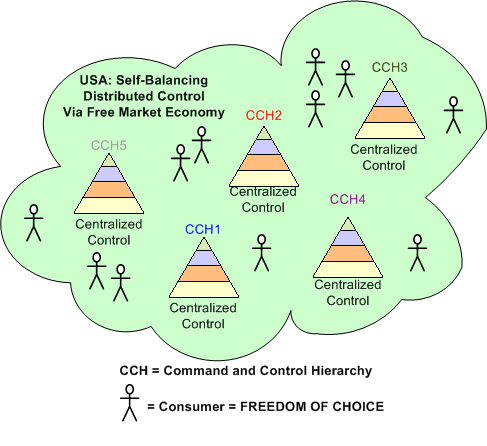
Bureaucracies, being what they are and seeking to survive at all costs, jump through all kinds of hoops to camouflage their worthlessness and keep the money flowing down from the heavens. Since the cabal at the top is too ignorant to recognize that it’s a bureaucracy in its own right, it’s an expert camouflage spinner to the corpocracy’s stakeholders (who gobble up the putrid camouflage with nary a whimper) and it sucks much more out of the corpo coffers than it adds value without being “discovered and held accountable”. In the worst nested bureaucracies, none of the groups in the hierarchy, from the top layer all the way down the tree to the bottom layer, produce enough value to offset their ravenous appetite for resources. They collapse under the weight of their own incompetence and then wonder WTF happened. From excellence to bankruptcy in 24 hours.
The really sad part is that before a bureaucracy auto-snaps into place, it wasn’t a bureaucracy in the first place. Everybody in the “startup” contributed more than they withdrew from the whole, and the excess value translated into external sales and internal profits. Like the boiled frog story, the transformation into a bureaucracy was slooow and undetectable to the CGHs in charge. Bummer.
The answer to this cycle of woe, according to Ackoff, is for the leaders in an org to operate the whole (including themselves) as a system of nested free markets, where each internal consumer of services gets to choose whether it will purchase needed services from internal groups, or external groups. Each internal group, including the formerly untouchable head shed, must operate as a measurable profit and loss center. Mr. Ackoff describes all the details of nested free market operation, including responses to many of the “it can’t work because of……” elite whiners, in his insightful book: Ackoff’s Best. Check it out, if you dare.
Spoiled And Lazy; Hungry And Energetic
A few years ago, I read an opinion piece regarding the demise of the US auto industry. The author stated that because they were spoon fed boatloads of money by the US government to design and build military hardware during WWII, the car companies morphed into spoiled and lazy sloths; they stopped innovating on their own nickel. Unless a sugar daddy (like the US government) was going to externally subsidize the effort, they weren’t gonna open the company coffers to develop new products or vastly improve their existing ones. Because of this overly conservative mindset (and the poo pooing away of Deming’s quality movement), the Japanese eventually blew right by the big three – even though their nation was decimated by the war and they had to start from scratch.
The same danger applies today, every day, to every company that builds things, especially big things, for government orgs. Understandably, since creating and continuously improving big complex systems requires big investments and big scary risks to be overcome, companies are loathe to pour money into what may eventually turn out to be an infinite rat hole. However, if all the competitors in the market space have the same welfare mindset, then no one will sprint out ahead of the pack and all participants may still prosper – until money gets tight. When the external dollar stream slows to a trickle, those (if any) competitors who’ve boldly invested in the future and successfully transformed their investments into product improvements and new product portfolio additions, rise to the top. It’s the hungry and energetic, not the spoiled and lazy, that continuously prosper through good times and bad.

Is your company spoiled and lazy, or hungry and energetic? If it’s the former, what actions does your company take when tough economic times emerge and the money stream slows?

Why am I here?
WTF?
Meh!
D'oh!

My BTC Address



 Bulldozer00's Blog