Archive
Viable, Vulnerable, Doomed
Unless an org is subsidized without regard to its performance (e.g. a government agency, a pure corpocracy overhead unit like HR), it must both explore and exploit to retain its existence. Leaders explore the unknown and managers exploit the known, so competence in both these areas is required for sustained viability.
Exploitation is characterized by linear thinking (projecting future trajectory solely based on past trajectory) and exploration is characterized by loop thinking. Since these two types of thinking are radically different and prestigious schools teach linear thinking exclusively, all unenlightened orgs have a dearth of loop thinkers. Sadly, the number of linear thinkers (knowers) increases and the number of loop thinkers (unknowers) decreases as the management chain is traversed upward. This is the case because linear thinkers and loop thinkers aren’t fond of one another and the linear thinkers usually run the show.
The figure below hypothesizes three types of org systems: vulnerable, doomed, and viable. The vulnerable org has a loop thinking exploration group but most new product/service ideas are “rejected” by the linear thinkers in charge because of the lack of ironclad business cases. Those new product/service ideas that do run the gauntlet and are successful in the marketplace inch the org forward and keep it from imploding. The doomed org has an exploration group, but it’s just for show. These orgs parade around their credentialed rocket scientists for the world to see and hear but nothing of exploitable substance ever comes out of the money sucking rathole. The viable org not only has a productive explorer group, but the top leadership group is comprised of loop thinkers too – D’oh! These extraordinary orgs (e.g. Apple, Netflix, Zappos, SAS) are perpetually ahead of their linear thinking peers and they continually (and unsurprisingly) kick ass in the marketplace.
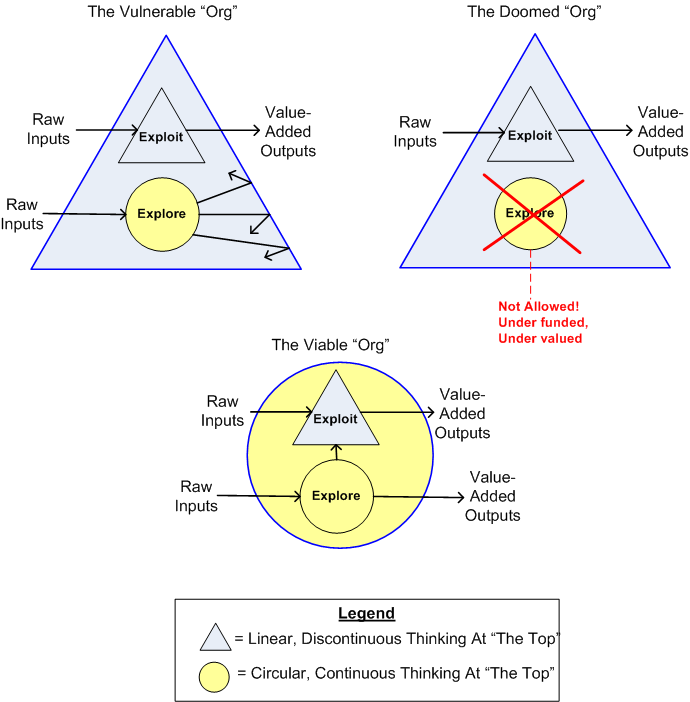
What type of org are you a member of?
The Commencement Of Husbandry
The figure below was copied over from yesterday’s post. Derived from Joseph Tainter’s “The Collapse of Complex Societies”, it simply illustrates that as the complexity of a social organizational structure necessarily grows to support the group’s own growth and survival needs, the adaptability of the structure decreases. The flat and loosely coupled institutional structures originally created by the group’s elites (with the willing consent of the commoners) start hierarchically rising and coalescing into a rigid, gridlocked monolith incapable of change. At the unknown future point in time where an external unwanted disturbance exceeds the group’s ability to handle it with its existing complex problem solving structures and intellectual wizardry, the whole tower of Babel comes tumbling down since the monolith is incapable of the alternative – adapting to the disturbance via change. Poof!
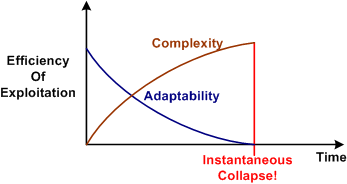
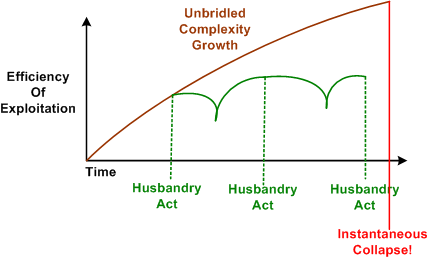
According to Tainter, once the process has started, it is irreversible. But is it? Check out the figure below. In this example, the group leadership not only awakens to the dooms day scenario, it commences the process of husbandry to reverse the process by:
- Re-structuring (not just tinkering and rearranging the chairs) for increased adaptability – by simplifying.
- Scouring the system for, and delicately removing useless, appendix-like substructures.
- Discovering the pockets of fat that keep the system immobile and trimming them away.
- Loosening dependencies between substructures and streamlining the interactions between those substructures by jettisoning bogus processes and procedures.
- Installing effective, low lag time, internal feedback loops and external sensors that allow the system to keep moving forward and probing for harmful external disturbances.

If the execution of husbandry is boldly done right (and it’s a big IF for humongous institutions with a voracious appetite for resources), an effectively self-controlled and adaptable production system will emerge. Over time, and with sustained periodic acts of husbandry to reduce complexity, the system can prosper for the long haul as shown in the figure below.
The Last Remaining Method Of Simplification
In this blog post, “The Collapse of Complex Business Models”, uber-thinker Clay Shirky predicts the impending instantaneous implosion of many (all?) unfathomably complex business models that are currently thought by many to be unassailable. The cruxt of Clay’s compelling argument is based on eerily similar collapses of past complex cultures as told by Joseph Tainter in his aptly named book, The Collapse of Complex Societies.
Tainter’s thesis is that when society’s elite members add one layer of bureaucracy or demand one tribute too many, they end up extracting all the value from their environment it is possible to extract and then some. – Clay Shirky
Adding layer upon layer of bureaucracy (to disconnect themselves from the commoners, of course) and demanding “tributes” in the form of exotic titles, awards, astronomical salaries, and perks (to satisfy their egomania and bolster the false image that they “know what’s best for all“) pushes their elite system over the precipice.
In such systems, there is no way to make things a little bit simpler – the whole edifice becomes a huge, interlocking system not readily amenable to change. When the value of complexity turns negative, a society plagued by an inability to react remains as complex as ever, right up to the moment where it becomes suddenly and dramatically simpler, which is to say right up to the moment of collapse. Collapse is simply the last remaining method of simplification. – Clay Shirky
In this 5 minute video talk, “the current economy“, my favorite spiritual guru, Eckhart Tolle, trumps Clay by rising up one level of abstraction. Eckhart predicts the impending collapse of many of the societal structures that are ego based. Ego loves complexity. And how many large, man-made, socio-technical structures (a.k.a institutions) do you think are not ego based?
The problem is not the content, it’s the conditioned structure of the human mind – Eckhart Tolle
Knowledge, Understanding, And Wisdom
Like growth and development, I’d say that most people tend to equate knowledge with understanding. Until relatively recently, I did too.
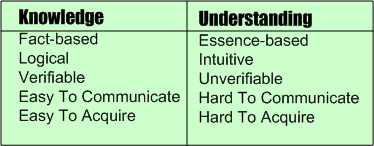
Via memorization, akin to “copying and pasting“, a person can be loaded with knowledge but devoid of understanding. Application of knowledge without understanding in an intellectually challenging endeavor like programming can, and does, lead to future messes for others to clean up.
Always code as if the guy who ends up maintaining your code will be a violent psychopath who knows where you live. – Damian Conway
Wisdom, a close cousin of understanding, can also be orthogonal to knowledge. However, the gap between wisdom and understanding can be much greater than the gap ‘tween understanding and knowledge. Wisdom can be acquired over time, but profound wisdom only arrives on the wings of grace, unscheduled. How do I know this? I don’t. I just like to make stuff up.
Knowledge is knowing a tomato is a fruit; Wisdom is not putting it in a fruit salad. – Peter Kay
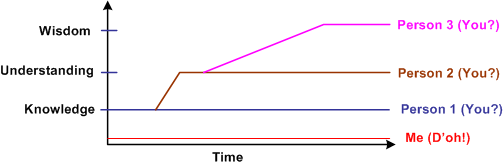
The rocket science financial dudes who literally engineered the global financial disaster have lots of knowledge and understanding in their area of “expertise”, but zero wisdom. Ditto, the eminently credentialed economic Nobel Laureates who championed the downfall of the LTCM hedge fund twelve, yes twelve, freakin’ years ago. It seems that their elegant equation set was devoid of any simple control variables that accounted for the risk of the Russian financial crisis that caused the fund to implode.
As long as people continue to unquestioningly and passively accept the word of narrowly focused knowledge experts with zero wisdom, the saying “history tends to repeats itself” won’t fade away, ever.
All I can say is, beware of geeks … bearing formulas. – Warren Buffet
Morally Irresponsible Stooges
In the first place, it is clear that the degradation of the position of the scientist as an independent worker and thinker to that of a morally irresponsible stooge in a science factory has proceeded even more rapidly and devastatingly than I had expected. The subordination of those who ought to think to those who have the administrative power is ruinous to the morale of the scientist, and quite to the same extent, the objective scientific output of the nation. – Norbert Wiener.
By stealing Norby’s quote and replacing a few words, we can make up this nasty, vitriolic, equivalent passage (cuz I like to make stuff up):
In the first place, it is clear that the degradation of the position of the product creator/developer as an independent worker and thinker to that of a morally irresponsible stooge in a corpocracy has proceeded even more rapidly and devastatingly than I had expected. The subordination of those who ought to think to those who have the bureaucratic power is ruinous to the morale of the wealth creator, and quite to the same extent, the productive output of the CCF. – Bulldozer00.
These days, exploiters are more valued than explorers and makers. In the good ole days (boo hoo!) and in most present day startup companies, the exploiters were/are also the explorers and makers, but because of a lack of respect and support for the species, the multi-disciplined systems thinker and doer has gone the way of the dinosaur. It’s only getting worse because as complexity grows, the need for renaissance men and women to harness the increase in complexity’s dark twin, entropy, is accelerating.
Perverted Inversion
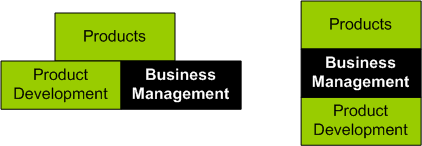
In simplistic terms, material wealth in the form of profits is created through the delivery of products and/or services that provide some sort of perceived value to a set of customers. The figure below illustrates the priorities, from highest on the top to lowest on the bottom, of all successful product-oriented startup businesses.

Since products create the wealth that sustains a business, they receive top billing. The care and feeding of the golden geese via a supportive product development group is next in importance. At the bottom, and deservedly so, is the management of the business. Nevertheless, the fact that it’s on the priority list at all means that managing the business is important – but not as important as the product-centric activities.
Without any facts or any background research to back it up (cuz I like to make stuff up), I assert that most entrepreneurs hate doing the business management “stuff”. Some despise the mundane activities of running a business so much that their negligence can cause the fledgling enterprise to fail just as quick as launching the business without any product or service to sell. Having said that, hopefully you’ll agree that any business priority list without the product portfolio perched at the top is a sure path to annihilation. The other two arrangements of the lower priority activities (shown below) can also work, but maybe not as effectively as the initial proposed stack.
As a business thrives and grows larger, a strange perverted inversion occurs to those who lose their way (but thankfully, not all do). The business management function bubbles to the surface of the priority stack (WTF?). This happens ubiquitously across the land because hot shot, fat headed, generic managers who don’t know squat about the org’s specific product portfolio are chaufeurred in to grow the business. These immodest dudes, thinking of themselves as Godsends from MBA city, put themselves and what they do at the top of the priority stack to…… enrich themselves no matter what. Of course, these wall street stooges perform this magic act while espousing that the product set and those that create it are forever the org’s “most valuable asset“.
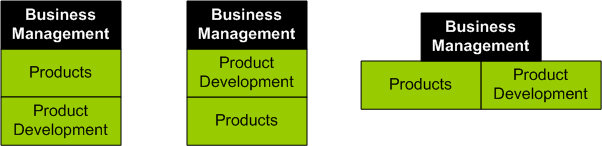
Post-startup businesses can survive with the perverted priority stack in place, but they usually muddle along with the rest of the herd and they aren’t exhilarating or engaging places to work. Do you work for one?
At a certain age institutional minds close up; they live on their intellectual fat. – William Lyon Phelps
A New Title Should Do It
“To solve our decreasing revenue and rising cost problems, we’ll just create a new title and insert the position into the org (thereby adding another layer to the stratified corpo cake). Voila! The problem will be solved (so let’s give ourselves a special bonus for being so smart).”
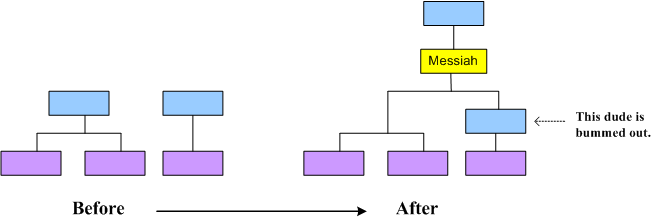
“But wait. What should the title be? Supervisor, Manager, Deputy Manager, Director, Deputy Director, General Manager? Should we bump it up by attaching a “Chief” and/or VP to the label? “We must be careful because the loftier the title, the more we’ll have to pay our new colleague (who will no doubt accomplish what we have failed to do).”

Such is the mindset of MBA trained corpo elites and their stooge press magazines like Business Week, Forbes, Fortune, et al. Do ya really think parachuting a messiah in to jumpstart an org with:
- an apathetic DICforce that is not as stupid as the head shed assumes and doesn’t appreciate management’s patronizing attitude
- an aging product development and manufacturing infrastructure (e.g. tools, processes, know how)
- an old and tired product portfolio that’s continually being usurped by competitor offerings
- a culture of undiscussable but obvious inter-group rivalry and disrespect
is realistic? Fragmented, hero-worshipping mindsets don’t clean up what Russell Ackoff calls, for lack of a better word, “messes”. Systemic thinking, along with the willingness to skinny dip, fully exposed, into the stinky mess is the only way to understand and clean up messes. Sadly, even if one or two dudes in the head shed junta are closet system thinkers and they try to speak out or take action, they’re promptly put back into their assigned slot….. and business resumes as usual…. while the mess grows ominously larger.
And now, for the bad news….. 🙂
Skill Acquisition
Check out the graph below. It is a totally made up (cuz I like to make things up) fabrication of the relationship between software skill acquisition and time (tic-toc, tic-toc). The y-axis “models” a simplistic three skill breakdown of technical software skills: programming (in-the-very-small) , design (in-the-small) and architecture (in-the-large). The x-axis depicts time and the slopes of the line segments are intended to convey the qualitative level of difficulty in transitioning from one area of expertise into the next higher one in the perceived value-added chain. Notice that the slopes decrease with each transition; which indicates that it’s tougher to achieve the next level of expertise than it was to achieve the previous level of expertise.

The reason I assert that moving from level N to level N+1 takes longer than moving from N-1 to N is because of the difficulty human beings have dealing with abstraction. The more concrete an idea, action or thought is, the easier it is to learn and apply. It’s as simple as that.
The figure below shows another made up management skill acquisition graph. Note that unlike the technical skill acquisition graph, the slopes decrease with each transition. This trend indicates that it’s easier to achieve the next level of expertise than it was to achieve the previous level of expertise. Note that even though the N+1 level skills are allegedly easier to acquire over time than the Nth level skill set, securing the next level title is not. That’s because fewer openings become available as the management ladder is ascended through whatever means available; true merit or impeccable image.
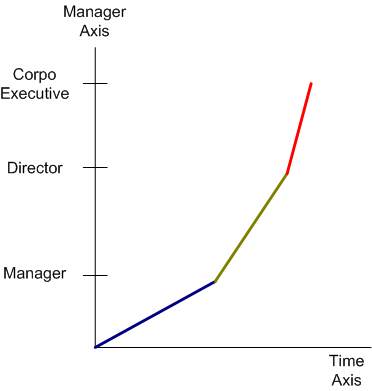
Error Acknowledgement: I forgot to add a notch with the label DIC at the lower left corner of the graph where T=0.
Stakeholders
The figure below shows the major stakeholders associated with a profit making institution. Except for the environment, which ironically but generously supplies the raw resources from which all value and profit are extracted, everyone wants the biggest piece of the profit pie they can get. 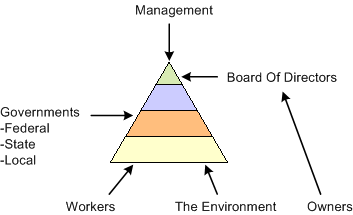
Since management is the biggest influencer of org performance, the dudes in charge feel the greatest pressure to generate profits for themselves and all the other stakeholders. In order to relieve themselves of this pressure and provide themselves with the largest share of the treasury, unscrupulous executive “leadership” teams (and not all of them are so self absorbed) do everything they can to distance themselves from the “other” stakeholders:
- They hire lawyers and lobbyists to fend off taxes and regulations imposed by governments to keep their behavior in check
- They hand pick a group of yes men/women for their board of directors to keep the greedy owners one level removed from themselves
- They keep their workers in check via classic, subtle fear inducing tactics
- They ignore the environment – because it unselfishly makes no direct demands upon them
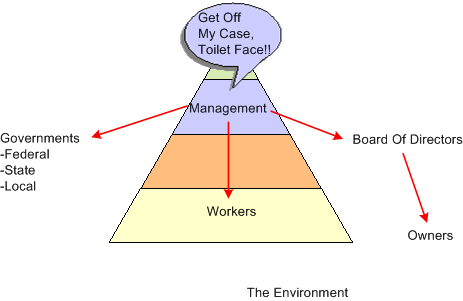
Great leadership teams don’t spend all their waking hours playing defense against the “others” and justifying their exorbitant compensation. They think systemicly and make compassionate decisions that balance the needs of all those involved in the enterprise.
And now, as a preview to next week’s self-righteous do-as-I-say-and-not-as-I-do sermon………………
Loop Dee Loo
I first learned about cause-effect diagrams from one of Jerry Weinberg’s books. I can’t remember which one because I have so many of them and I’m too lazy to browse through them all to find the exact source. Cause-effect diagrams are useful two dimensional tools that can be used to understand cyclical loops of relationships in a system of interacting components.
In the RWEP loop example below, revenue leads to work, which leads to execution, which leads to profit, which leads to more revenue. If a profit seeking organization is well run, the org leaders vigilantly keep track of the “whole” RWEP loop and influence each malleable component so that the loop is positively reinforced and the org prospers. Neglecting one or more of the dominant RWEP loop components can lead to an unstable system that breaks the loop and collapses the system.
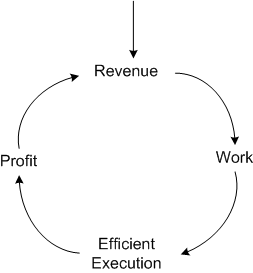
Let’s investigate the ways the loop can break down so we can appreciate what good leaders actually do. The first obvious system buster is a halt to the revenue stream. This single point of failure can bring the whole shebang to a screeching halt in an instant. Since the importance of revenue to institutional viability is so patently obvious and measuring it is ridiculously easy, both good and bad leaders watch revenue closely and act (hopefully) accordingly to keep revenues rising.
The less scrutinized and harder-to-directly-measure system element, “efficient execution”, is a more subtle system buster. Crappy BMs who don’t (cuz they’re lazy or apathetic)) or can’t (because they’re incompetent) directly recognize efficient execution as a system buster take the easy way out by solely measuring profit as an indicator of execution performance. When profit declines, BMs thrash about because they’re at least one level of indirection away from where the rubber meets the road – execution. Since they’re out of touch, BMs make “suboptimal” decisions and issue ineffective mandates that actually accelerate the downward spiral in profits. Good leaders either directly evaluate execution efficiency according to their previous experience or they rely on frequently solicited feedback from those directly executing the work.
So there you have it in simple, maybe simplistic terms. Great leaders watch and positively influence both the (obvious) revenue and (subtle) execution contributors in the RWEP system loop.

Why am I here?
WTF?
Meh!
D'oh!

My BTC Address



 Bulldozer00's Blog