Archive
The Road To Here
Having jumped into the world of Bitcoin investment, I recently reflected on how I was bitten by the BTC bug and influenced into making the decision to buy and hold some BTC. So I pieced together the following timeline of events on how I got to here:

My random road to BTC investment reminds me of the speech that Steve Jobs gave at the 2005 Stanford University commencement ceremony. He told of how his learnings in multiple, seemingly unrelated, topic areas led to the serendipitous creation of the revolutionary MacIntosh computer.

By a large margin, the Wences Cesares interview had the greatest impact on my decision to invest in Bitcoin. Incredibly, Wences mentioned Graeber’s book on debt, which I had read before I even knew what Bitcoin was. He also told his story of growing up in Argentina and how his family lost everything they owned multiple times because of rampant inflation due to incompetent government handling of the Argentinian peso. In the worst of times, whenever his family received a paycheck they would rush to the store and buy as much food as they could before prices increased – sometimes on an hourly basis. As they were putting items in their shopping cart, store employees were simultaneously walking down the aisles with their pricing guns and jacking up the prices.
We fat cats in the US and other relatively stable financial environments can’t relate much to the wildly volatile living conditions in Argentina and other countries in the same rickety boat. However, as the near financial meltdown in 2008 hinted at, we might not be as insulated from a catastrophic black swan financial event as our so-called leaders imply we are.
The bitcoin economy may collapse and my investment in BTC may end up dropping to zero, but since I’m adhering somewhat to Taleb’s 80-20 investment guidance, it won’t put me out on the streets begging for food if it does. In the best case, the BTC/USD price ratio will keep steadily rising and BTC’s price volatility will decrease over time. If those trends come to pass, then I win and unfortunate people in countries run by bozos have a chance of winning too. For them, BTC may become a stable hedge to insulate their accumulated wealth against crash-prone fiat currencies issued by their irresponsible governments.
It’s A Governance Issue
The “blockchain” is the heart of the Bitcoin system. It’s a fully transparent, publicly visible, ledger of every transaction ever performed over the network. Approximately every 10 minutes, a new block of verified BTC transactions is added to the blockchain by a “miner“.

The figure below shows a simplified view of the BTC blockchain. As you can see, the system’s current design parameters only support a throughput rate of less than 10 Transactions Per Second (TPS).

If the usage of Bitcoin as a secure, decentralized, private, payment system continues to grow, the low TPS rate will become a bottleneck if the system doesn’t scale to accommodate the increased load on the network.
Two obviously simple ways for increasing the Bitcoin system throughput are to:
- increase the maximum block size, S
- decrease the block addition period, T
A major bone of contention in the Bitcoin community is how to scale the TPS rate to accommodate the anticipated growth in usage due to more and more people “discovering” the benefits of this peer-to-peer cash system over traditional banking systems of dubious credibility. This “block size” debate has been raging on for 2 years now. There are a range of proposals in play for solving the scaling problem; some are dirt simple and some are mind-boggling complex.
Resolving the dispute is exacerbated by the fact that, by design, there is no central authority controlling the system’s evolution. It’s a governance issue not dissimilar from growing a “flat” startup company into a hierarchical, “mature” organization. If a centralized authority with control over the evolution of the Bitcoin protocol is established, the doors will burst wide open for political intrigue and clever, special interest group agendas to infiltrate the currently egalitarian system.

What’s In Your Wallet(s)?
My Bitcoin iPhone Wallets
Since I’m a nouveau BTC investor, I downloaded a bunch of free Bitcoin apps onto my iPhone:

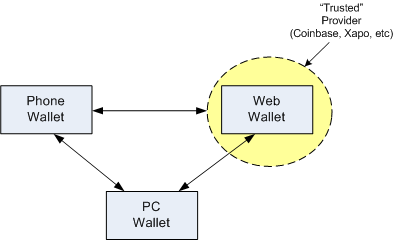
Out of those nine apps, four of them are “on-device” wallets: bitWallet, BlockChain, bread, and Airbitz. Two of the apps, Coinbase and Xapo, allow me to connect to my online accounts at those two major, reputable, Bitcoin currency exchanges. The remaining three apps are for keeping up with the latest BTC news and Blockchain statistics/metrics.
Inter-Wallet Transactions
PC To iPhone
The following figure shows the home screen of my iPhone Blockchain wallet app at the time of this writing. To test out and evaluate the wallet’s feature set and UI, I sent approximately $13 USD worth of BTC from one of my PC wallets to my Blockchain app wallet. As you can see, the bottom transaction shows the reception of $13.27 USD worth of BTC at my Blockchain wallet’s public address (1Ni….vvC).

I executed this PC-to-iPhone, inter-wallet, transaction by:
- Copying and pasting my Blockchain wallet receive address into an e-mail and sending the e-mail from my iPhone to my account.
- Opening the e-mail on my PC and copying/pasting the address into one of my PC wallets (Bitcoin Core).
- Initiating a “send BTC” transaction from my PC wallet back to my iPhone Blockchain wallet.

iPhone To Web
The top transaction on the Blockchain home screen shows that I subsequently sent $1.00 USD (with a 2 cent transaction fee to the miner who successfully added the block containing my transaction to the BTC blockchain) from my iPhone to another BTC wallet whose public receive address is 1H….kx1L. That destination wallet happened to be associated my account on the Coinbase.com web site.
I executed the iPhone-to-Web, inter-wallet, transaction by:
- Copying and pasting my Coinbase.com wallet receive address into an e-mail on my PC and sending the e-mail to my account.
- Opening the e-mail on my iPhone and copying/pasting the address into my iPhone Blockchain wallet.
- Initiating a “send BTC” transaction from my iPhone wallet to my Coinbase.com wallet.

There is an alternative, perhaps even easier way to send/receive Bitcoins than copying/pasting long addresses to/from your device/PC clipboard. You can use a wallet-generated QR code in conjunction with your device camera.
The figure below shows the QR code graphic associated with one of the Bitcoin receive addresses (1A8…GDqT) on my iPhone Blockchain wallet. If you wanted to send some bitcoin to an address represented by a QR code, you’d:
- Open up your wallet app (PC, iPhone, or web),
- Instruct the app to scan the QR code of the destination address,
- Enter the amount of BTC or USD you want to send,
- Initiate the transaction.
You can try scanning the QR code below and sending me some bitcoin if you’d like 🙂
Citizen To Citizen, Phone To Phone
Assuming that the BTC economy doesn’t implode due to a black swan event and the “permission-less innovation” that the decentralized platform provided by the bitcoin protocol keeps the technology progressing forward, the user experience will only improve with time.
As long as smartphone prices keep decreasing and incompetent central governments keep consistently debasing their currencies (Argentina, Venezuela, Zimbabwe, Cyrus, Greece, etc), most of the world’s population might soon be executing inter-wallet BTC transactions for goods and services using a process similar to the experimental ones I described in this post – especially phone-to-phone transactions (no PC ownership or web access required).
Exchanging BTC for common goods and services may never take hold in advanced countries with stable currencies like the USA, but most of the globe may be ripe for the taking. What do you think?
Me, The Banker, And You
Me, the banker, and you, before Bitcoin:

Me and you, after Bitcoin:

People who have experimented with Bitcoin can relate to this cartoon. People who haven’t, can’t; it’s simply too alien for them.
And yes, that pic on the “right” is intended to represent you, Phil 🙂
A Daunting List
In “The Ultimate Guide to Bitcoin“, Michael Miller provides us with a daunting list of the risks associated with Bitcoin:

For BD00, the biggest existential risk on the list is “Powerful People Don’t Like It“. It’s also one of the top reasons he is into Bitcoin for the long haul. How about you?

The One Million Dollar Pizza
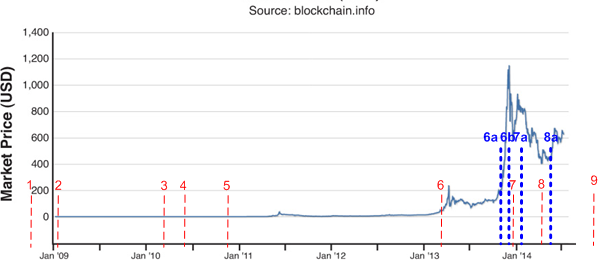
The following chart traces the Bitcoin price in USD since the system was first placed into operation in 2009.
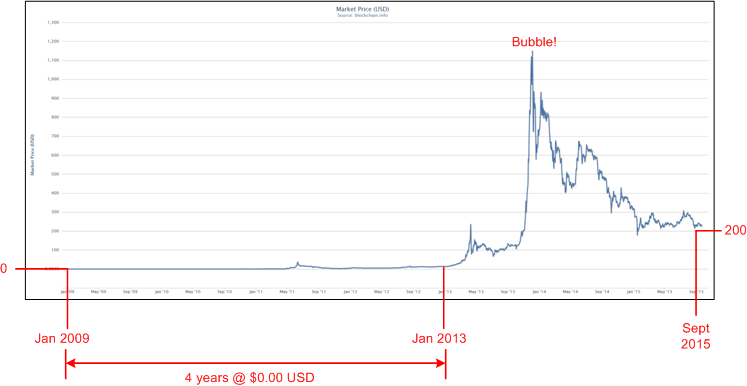
For approximately four years, each Bitcoin was worth close to $0.00 USD. The very first exchange of Bitcoins for goods occurred in 2010. It was 10,000 BTC for two pizzas worth approximately $25 USD. At $200+ USD/BTC today, those pizzas would cost $1M each!
Imagine all those early experimenters who purchased or mined Bitcoins during the 2009-2013 time span – and then deleted their wallets from their PCs because they concluded that Bitcoin was a passing fad. I’m glad I’m not one of them. On the other side of the “coin“, I’m also glad that I didn’t jump into the market during the peak of the bubble in late 2013 at $1100 USD/BTC.
After entering the market this year at $230 USD/BTC, I wonder how I’ll feel about that decision in 5 years…..
Robust And Resilient
A few posts ago, I laid down a timeline of significant events in the history of the Bitcoin movement. All of those events are positive developments that give the reader an impression of steady forward progress. However, it has been no bed of roses for the world’s first decentralized currency system. To highlight this fact, I decided to superimpose four of the events (in blue) that could have signaled the death of Bitcoin – but didn’t.
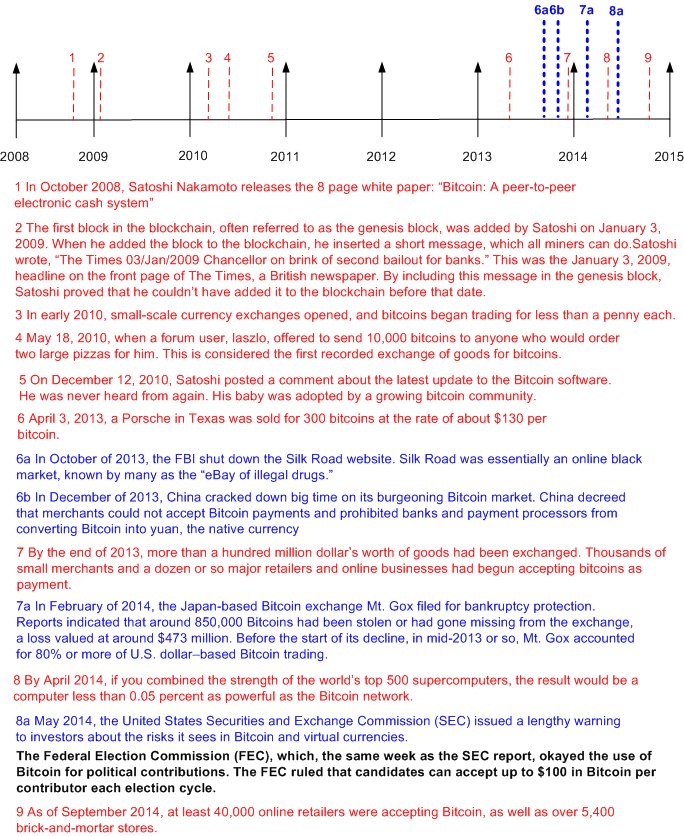
The Silk Road disaster, the China crackdown, the Mt. Gox implosion, or the dire SEC warning each in their own right could have caused the value of Bitcoin to go back to its initial value of zero and stay there – but it didn’t. Thus far, Bitcoin has shown remarkable robustness and resiliency. Perhaps it’s even antifragile – gaining strength with each attempt to kill it.
As long as enough people believe that Bitcoin has value, then it will have value. As cell phones become more and more affordable to the poor and third world countries continue to act fiscally irresponsible with their fiat currencies, Bitcoin’s volatility will decrease and its utility as a fast, low fee, direct, mechanism of economic exchange will increase.
Bitcoin was never designed out of the box to “fit in” with the established ways of dealing with money through centralized institutions that can collapse or go bankrupt via greed/corruption. Perhaps it never will fit in, but Bitcoin can exist side-by-side with the established big wigs; acting as a deterrent to incompetent governments (Zimbabwe, Greece, Cyprus?) and serving as an escape valve to those affected by that incompetence.
Full Transparency
Besides being the first fully distributed, peer-to-peer cryptocurrency, every aspect of bitcoin is fully transparent to anyone who wants to study the protocol rules for security/safety or peruse the “blockchain” in real-time on the web.
The blockchain is a living, dynamic, accounting ledger upon which every single network transaction has been, and is being, recorded in real-time. Thousands of cooperating Bitcoin “miners”, via an innovative, incentive-based, decision process that solves the Two Generals problem toil away 24 X 7 without ever sleeping. They are robot accountants that race against each other to verify the validity of “blocks” of transactions. Each winner gets to place its block at the head of the blockchain and collects a reward for its hard work. The reward consists of some newly minted bitcoins (25 BTC per block as of today) and a nominal fee from each transaction that appears in the block.
Once a block gets added to the blockchain, all the miners diligently get back to work on the next block of incoming transactions – no coffee breaks or water cooler gossiping for them. They’re all business and they don’t need any stinkin’ motivational speeches or performance improvement plans imposed on them by know-it-all supervisors and HR Nazis. The miner workforce is a tyrant manager’s dream team. 🙂
As you can see from the 15 minute snapshot below (snipped from Bitcoinmonitor.com), there were thousands of bitcoin transactions taking place as I wrote this post.
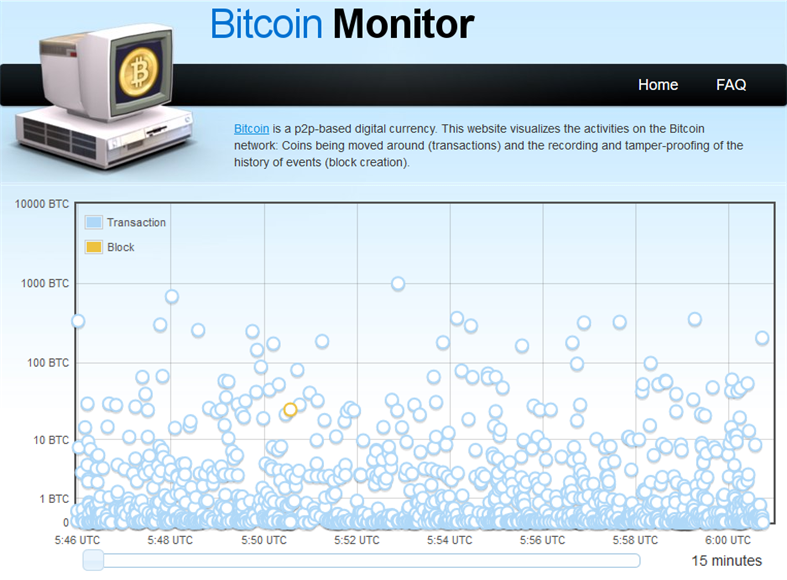
Notice the 1000 BTC transaction in the middle of the chart. At $200 BTC/USD, that represents a $200,000 transfer. If you watch the chart long enough, you’ll see some 10,000 BTC transactions taking place. Sheesh! Also notice that at the 5:51 UTC mark a lucky bitcoin miner has successfully added its block to the blockchain and collected its reward. Good for him/her!
Since I think the Bitcoinmonitor.com site is really useful, I sent the site owner a token of appreciation – in BTC of course:
 And of course, I didn’t have to disclose any personal credit card information to do it. The ability to execute micro-payments instantaneously like I just did is one of the (many) big pluses propelling Bitcoin forward.
BTC Swag
I just ordered some Bitcoin swag from Amazon. Sorry @RiczWest. 🙂

The Bitcoin Timeline
From “Bitcoin For The Befuddled“, I give you the path from paper-to-reality of a potentially world-changing technology:


Why am I here?
WTF?
Meh!
D'oh!

My BTC Address



 Bulldozer00's Blog