Archive
Thurman On Buddhism
Via the magical low cost and high quality combo of Roku’s hardware and Netflix‘s “instant watch” feature, I just watched lovable Robert Thurman give a passionate and endearing talk on Buddhism. If you’re not into spiritual “stuff”, then don’t bother watching it cuz you’ll be bored out of your gourd after two minutes. However, if you are interested, please watch it because I think it may put you in a peaceful and wondrous place for its duration.
I first discovered Mr. Thurman a couple of years ago when he gave this moving TED talk. He’s a talented story teller and a tireless promoter of compassion in the true spirit of Buddhism. If you do watch him, be sure to note the gentle passion he exudes. I think it’s quite contagious.

Fieldstones
Since I started blogging over a year ago and I enjoy the intense feeling of liberation it brings forth, I’ve been trying to get better at it. The most helpful book that I’ve read to help me in this personal goal seeking behavior is Jerry Weinberg‘s “Weinberg On Writing – The Fieldstone Method“. Jerry is a well known software consultant who’s spent many years in the trenches and has written over 40 technical books that transcend the disciplines of software and systems engineering.
Jerry’s method is based upon the idea of being diligently aware of, and recording “fieldstones” of personal interest as they serendipitously appear in your consciousness by the grace of god (little “g” on purpose). Since I’ve read that an average of 50,000 thoughts per second (approximately 1 thought every freakin’ 2 seconds!) appear in an individual’s head every day, I figure that 1 or 2 of my thoughts must be helpful in some way to me or others. Thus, I try to, as Jerry recommends, keep paper and pen within striking distance so that I can pull these fieldstones out of the ether and usher them into the physical world. Periodically, I peruse these mostly BS notes and build a fieldstone wall in the form of a blog post that I cast into the wind with the help of wordpress.com.
Here is some of Jerry’s sage, and maybe unconventional, writing advice that resonates with me. Maybe some of it will resonate with you.
Never attempt to write (about) something you don’t care about.
One way for smart people to be happy is to express themselves.
Most of the work is gathering the fieldstones.
The key to effective writing is the human emotional response to the fieldstone. Always be guided by the emotional response (in you).
The secret isn’t in the fieldstone, it’s the response to the stone.
Steal all the words you can. If you steal from one source, it’s plagiarism. If you steal from many, it’s research.
Overabstraction is the number 1 enemy of meaning and understanding.
If you care less about the material after you finish than before you started, then junk it.
Quality is personal.
Gather, then organize.
So what do you think? Ready to start expressing yourself?

Meta-test Tools
A meta test tool ties together other lower level workhorse test tools in one place. Users interface with a meta test tool to launch and control the underlying system tool set that exercises the system under test. However, if you don’t have any low level test tools (out of dumbass neglect or innocent ignorance), a meta test tool is useless. But hey, the user interface and the camouflage it generates look good.

Undiscussable Unfairness
Assume that two similar projects are underway at your company. Also, assume that one of the teams is encumbered by a heavyweight process and the other is given a blank check to do as they please – no processes or procedures to follow, no external reviewers, no forms to fill out, no design or maintenance documentation to be generated. Would you confront management about the inequity? If so, why would you do something so stupid? Don’t you think the dudes in charge know what they’re letting happen? Don’t you think they would be pissed at you for pointing out the obvious but undiscussable stank of unfairness in the air?
I think perfect objectivity is an unrealistic goal; fairness, however, is not. – Michael Pollan

MITRE
I work in the aerospace and defense industry. This industry is typically slow moving and not known for bleeding edge innovation. Thus, I was intrigued when I discovered that the MITRE corporation came in at number 30 in Fast Company magazine’s 2010 list of the 50 most innovative companies in the world. I scanned the list for other companies in the industry, but I (unsurprisingly) didn’t find any more industry stalwarts among the innovative elite.
In addition to the world class innovators, Fast Company also lists the top 10 innovative companies in a slew of industries, including the the defense business. Here is their list of innovators, subjectively decided by someone, or some group, at Fast Company.
- Mitre
- DARPA
- iRobot
- QinetiQ
- Northrup Grumman
- Raytheon
- Lockheed Martin
- Boeing
- Aurora Flight Services
- ATK
After reading the summary for each company, it appears that most money and brainpower are being invested in unmanned moving, sensor packed products like robots and aerial vehicles. For companies looking to branch out and explore new business opportunities, they may do well to invest in these areas and see if anything emerges.

Docu-centric, Model-centric
Let’s say that your org has been developing products using a Docu-Centric (DC) approach for many years. Let’s also say that the passage of time and the experience of industry peers have proven that a Model-Centric (MC) mode of development is superior. By superior, I mean that MC developed products are created more quickly and with higher quality than DC developed products.
Now, assume that your org is heavily invested in the old DC way – the DC mindset is woven into the fabric of the org. Of course, your bazillions of (probably ineffective) corpo processes are all written and continuously being “improved” to require boatloads of manually generated, heavyweight documents that clearly and unassailably prove that you know what you’re doing (lol!) to internal and external auditors.
How would you move your org from a DC mindset to an MC mindset? Would you even risk trying to do it?

Multividual Contributor
The most politically correct (a.k.a. least offensive) way to ensure that employees take note of the fact that they are a notch below them, managers love to use the term “individual contributor” to DICs. Managers use this term repeatedly during annual performance reviews to subtly pre-empt any discontent over the measly 2% raises almost all non-managers get every year. The unspoken but unambiguous top-down message is: “You shouldn’t expect more because you’re only an individual contributor. I, on the other hand, am a manager – a multi-vidual contributor.”

Say what? Aren’t managers individuals? Aren’t managers (well, at least the non-BMs amongst them) contributors? Individual + contributor = individual contributor, no? Is it time to come up with a new, creative, and clever replacement term that will continue to promote the false impression that all managers are more important than all DICs? How about “limited influencer” or “lesser contributor”? Nah, these are not politically correct enough. Got any suggestions?
Breakfast Interpretation
While e-conversing with a colleague the other day, I used the following quote that encapsulates the chicken and pig story:
In a bacon and eggs breakfast, the chicken is involved but the pig is committed – Ken Schwaber
Surprisingly (it’s surprising because my colleague isn’t a member of the management guild), my infallible and self-righteous peer castigated me with a retort of “that’s inappropriate!”.
Dude, gimme a break. You see, just because the quote was created by a semi-famous software dweeb to belittle BMs, it doesn’t have to be interpreted that way. It can be interpreted as the exact opposite:
“managers who decide to provide financial backing for a project have more skin in the game than the engineers who spend the money – because if the project fails, the pecuniary loss is pinned on the manager by his/her manager(s)“.
This interpretation certainly has as much validity as it’s polar opposite, no?
Nevertheless, when I did utter the quote, I was using it to convey Mr. Schwaber’s original intent. Bad dog – as my colleague was quick to point out. He seems to delight himself whenever he clearly points out how stupid I am – which is often. Gotta love pumping yourself up at the expense of others. I should know, cuz I do it all the time. Mooo hah hah hah! Bad dog!

Buy this poster at motivatedphotos.com. Post it on your cubie wall – if you dare.
Wealth And Effort
Any form of “ism” can work if it creates and sustains a large middle class that feels it can make it to the top of the pyramid of privilege by the fruits of their own labor. As soon as the bubble bursts and the middle class feels that the rich keep getting richer without any effort and the poor keep getting poorer regardless of effort, all is lost and a revolution is in the offing. Sure, a powerful police force may temporarily stave off the revolution, but not forever. Over time, the innate human desire for liberty trumps oppression like water dissolves rock.

In the USA, democracy and the right of every person to vote has worked pretty well to stave off the destruction of the middle class. However, when rich elites gain publicly invisible control over all political parties and force the government to allow them to operate unfettered without any oversight, the result is extreme capitalism and the potential fall of the middle class. I don’t know if it’s happening in America, but it sure seems like it. When big fat corpo bureaucracies demand and get capitalism on the way up and socialism (bailouts) on the way down, there’s no risk of consequences to their behavior and they have no reason to change their middle class busting ways. “Too big to fail” and “too little to succeed” sux for the middle class. Let them eat cake.
Competitive Edge
Check out the figure below. Which model more closely maps to your company’s way of operating?
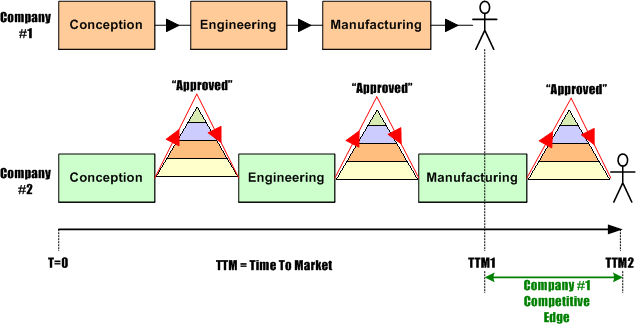
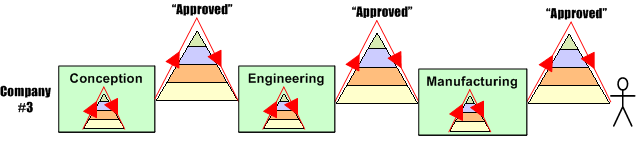
If you picked company #2, does the nested approval model below represent your company even more closely? Does every swingin’ dick (not DIC) in the house with one or more titles feel the need to be informed and bestow his/her approval before anything of substance can get done within the corpo citadel?

Why am I here?
WTF?
Meh!
D'oh!

My BTC Address



 Bulldozer00's Blog