The Value Zone
Even though it’s been on my Kindle for a year, I just finished reading HCLT CEO Vineet Nayar‘s book, “Employees First, Customers Second“. It was low on my priority list because I already had read a slew of articles about the book when it was first released.
In EFCS, Vineet describes “the value zone” and “the so-called enabling functions” as follows:
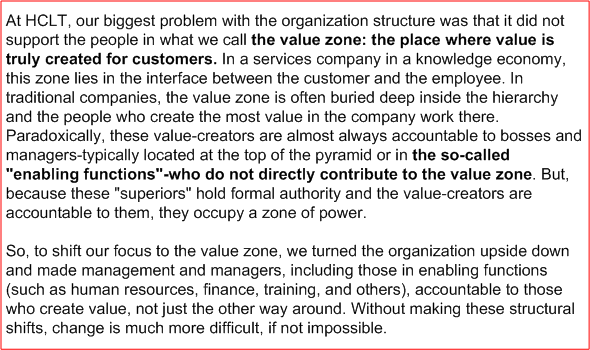
So, how did Mr. Nayar “force” the superiors who dwell in the enabling functions to be accountable to the value-creators? He did it by effectively implementing the HCLT “Smart Service Desk” (SSD) – a twist on the typical problem management system employed by most companies to resolve customer issues. Here’s how it works:
- Whenever an employee has a problem or needs information, he or she opens a ticket that is directed to the appropriate department for handling (including senior management and the CEO).
- Each ticket has a deadline for resolution.
- The system is transparent so that all could see the contents of the tickets and where they are in the process.
- The employee who had opened the ticket is the one to determine whether the resolution is satisfactory, or if the issue has been resolved at all.
Shortly after placing the SSD into execution, people “were opening tickets at an average of thirty thousand per month (at a time when there was a total of about thirty thousand employees in the company)“. Vineet sums up the system’s success as follows:
People were embracing the system. It was a victory for honesty, transparency, and openness!

Related articles
- HCL Technologies quarterly net profit rises 50 percent (news.bioscholar.com)
- Why HCL Technologies puts employees ahead of customers (tech.fortune.cnn.com)
- HCL Tech Q1 net up 50% at Rs. 496.7 crore (thehindu.com)
- Valuing Employees (Really!): Lessons from India (forbes.com)
Leave a comment

Why am I here?
WTF?
Meh!
D'oh!

My BTC Address



 Bulldozer00's Blog
Thanks for this blog Bulldozer. Employees first, Customers Second is a ground breaking book and I look forward to more organisations embracing it. Unless your staff in the value zone (that is the ones who deal directly with customers) feel supported/love the organisation, then it is unlikely that customers are going to love the organisation. It is seemingly so logical, but way too uncommon.
You’re welcome Erica. The astonishing thing to me is how Vineet inverted the pyramid at such a big company.
Sadly, the people who have the power to embrace Vineet’s ideas have too much invested in maintaining the status quo.