Distributed Functions, Objects, And Data
During a discussion on LinkedIn.com, the following distributed system communication architectural “styles” came up:
- DF == Distributed Functions
- DO == Distributed Objects
- DD == Distributed Data
I felt the need to draw a picture of them, so here it is:
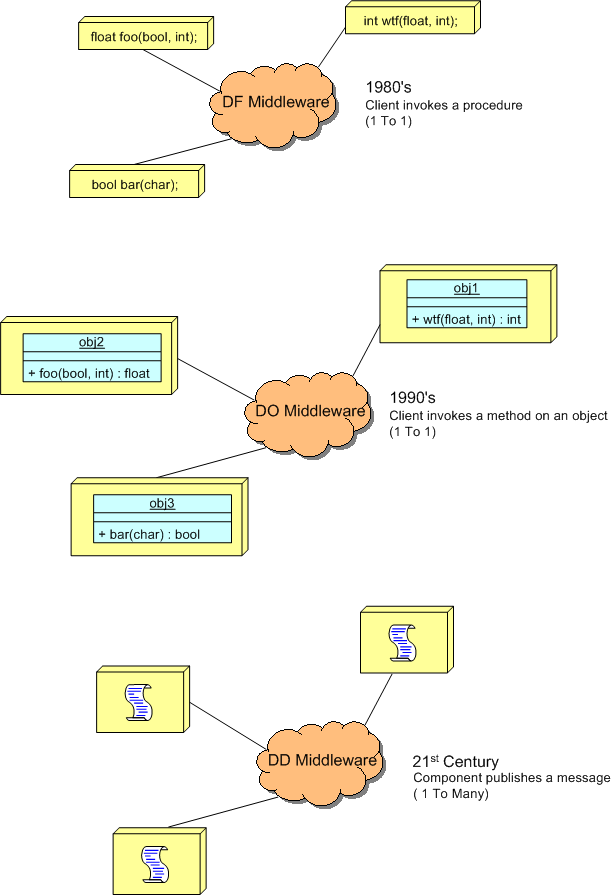
The DF and DO styles are point-to-point, client-server oriented. Client functions invoke functions and object methods invoke object methods on remotely located servers.
The DD style is many-to-many, publisher-subscriber oriented. A publisher can be considered a sort of server and subscribers can be considered clients. The biggest difference is that instead of being client-triggered, communication is server-triggered in DD systems. When new data is available, it is published out onto the net for all subscribers to consume. The components in a DD system are more loosely coupled than those in DF and DO systems in that publishers don’t need to know anything (no handles or method signatures) about subscribers or vice versa – data is king. Nevertheless, there are applications where each of the three types excel over the other two.
Leave a comment

Why am I here?
WTF?
Meh!
D'oh!

My BTC Address



 Bulldozer00's Blog
Good explanation.
May i know some more examples to visualize the above models.
Thanks.
Check out this wikipedia page for more details and examples: http://en.wikipedia.org/wiki/Distributed_computing