Structure And Behavior
One of the principles of systems thinking is that structure facilitates or inhibits specific behaviors. For example, if we didn’t have hands (or, in some cases, neither hands or feet), we wouldn’t be able to write – the structure wouldn’t allow it. If we didn’t have vocal chords, we wouldn’t be able to speak – the structure wouldn’t allow it. If a car’s engine didn’t connect to the drive shaft, it wouldn’t be able to “transport” – the structure wouldn’t allow it. If a system didn’t have redundant elements, it wouldn’t be able to automatically recover from failures – the structure wouldn’t allow it.
The same holds true for organizational structures that group people together for a purpose. The org structure can be an enabler or inhibitor of the behaviors required to fulfill the purpose for which the group has been assembled. A mismatch between purpose and structure usually leads to failure at some unknown time in the future.
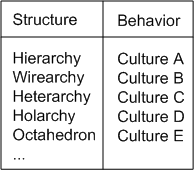
The table below lists several org structures concocted by BD00, including the ubiquitously pervasive and manager-revered “hierarchy“, along with the obscure, Fuller/Beer “octahedron“. What are the strengths and weaknesses of each structure?
-
July 4, 2011 at 2:26 pmOneThing27: the snowball effect « itsallonething

Why am I here?
WTF?
Meh!
D'oh!

My BTC Address



 Bulldozer00's Blog