Home
> management > What’s On Your List?
What’s On Your List?
In Russell Ackoff‘s “Idealized Design” method, he suggests that designers assume that the system they’re trying to improve/re-design exploded last night and it no longer exists. D’oh! He does this in order to put a jackhammer to the layers of unquestioned, un-noticed, outdated, and hard-wired assumptions that reside in every designer’s mind.
So, if you were part of an emergency task force charged with re-designing your no-longer-existing org, what candidate list of ideas would you concoct? To help jumpstart your underused, but innately powerful creative talents, here’s an outrageous example list that I stole from a raging lunatic:
- Provide two computer monitors for every employee and religiously refresh workstations every three years.
- Provide two projectors and multiple whiteboards in each conference room. Ensure a plentiful supply of working markers. No exclusive executive conference rooms – all rooms equally accessible to all, with negotiated overrides.
- Physically co-locate all product and project teams for the duration. Disallow a rotating door where projectees can come and go as they please or management pleases – with rare exceptions of course.
- Put round tables in every conference room.
- Distribute executive and middle manager offices throughout the org. No bunching in a cloistered, elitist corner, space, or glistening building with HR/Marketing/PR/finance/contracts or other overhead functions.
- Require every manager in the org with direct reports to periodically ask each direct report: “How can I help you do your job better?” at frequent one-on-one meetings. If a manager has too many direct reports – then fix it somehow.
- Require every manager who has managers reporting to him/her to ask each of his/her subordinate managers: “Can you give me an example of how you helped one or more of your direct reports to grow and develop this year?“.
- Require periodic, skip-level manager-subordinate meetings where the manager triggers the conversation and then just listens.
- If “schedule is king” all the time, then write it into your prioritized core values list – just above “engineering excellence and elegant products“. If your core values list contains conflicting values, then prioritize it.
- Carefully and continuously monitor group (not individual) interaction protocols and behaviors. Diligently prevent protocol bloat and convert tightly coupled, synchronous client-server relationships into loosely couple, asynchronous, peer-to-peer exchanges.
- Explicitly budget X days of user-chosen training to every person in the org and enforce the policy’s execution.
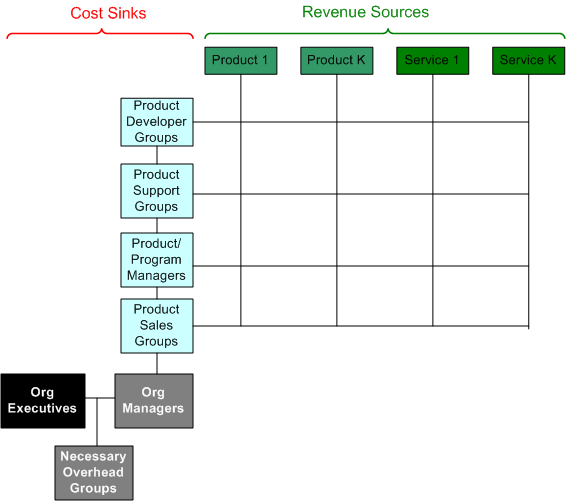
- To reinforce why the org exists and de-emphasize who is “more important” than who, publish a product and/or service-centric org chart with products/services across the top and groups, including all managers, down the side. Preferably, the managers should be on the bottom propping up the org. (See figure below).
- Abandon the “employee-in-a-box” classification and reward system. Pay each person enough so that pay isn’t an issue, and publicly publish all salaries as a self-regulating mechanism.
- Create policy making and problem solving councils up and down the org. Members must consist of three levels of titles and include both affectees in addition to effectors.
- Give leadees a say regarding who their leaders are. Publicly publish all reviews of leaders by leadees.
- Require periodic job rotations to reduce the org’s truck number.
- Frequently survey the entire org for ideas and problem hot spots. Visibly act on at least concern within a relatively short amount of time after each survey.
- Provide every employee with an org credit card and budget a fixed amount of money where no approvals are required for purchases. Fix the purchasing system to make it ridiculously easy for expenses to be submitted.
Categories: management
idealized design, leadership, linkedin, postaday2011, Russell Ackoff, systems thinking
Comments (0)
Trackbacks (0)
Leave a comment
Trackback

Why am I here?
WTF?
Meh!
D'oh!

My BTC Address



 Bulldozer00's Blog