Requirements Stability
Over the years, I’ve been assigned to the roles of specifier, designer, documenter, writer, and maintainer of source code for radar sensor systems that are used in safety-critical applications. These sensors get deployed in noisy, interference-infested environments and they must perform at high levels of availability and with great fidelity.
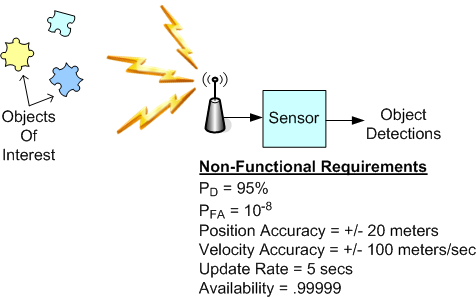
The figure below shows a generic sensor system context diagram along with some typical non-functional requirements (with made-up values) that are critical for customer acceptance. My experience has indicated that once these black-box level requirements are specified, they rarely change. Thus, the agile war cry to continuously “embrace requirements change” may not fully apply to the development of this class of systems, no?
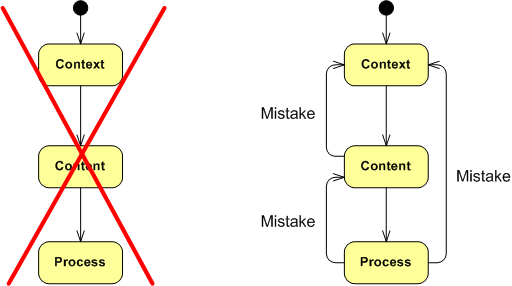
The point I’m trying to make here is to be wary of morphing into a lap-dog zealot for any technique, process, method, or practice – which includes the hallowed “agile” brand. For a long time, my motto (thanks to the work of W. L. Livingston and John Warfield) has been: Context, Content, and then Process (CCP). Synthesize an understanding of the problem context, design the content of the solution (structure and behavior), and only then design the solution construction process – tailored to the context and content. Of course, since mistakes and errors will be made during the journey, backtracking and iterative convergence are expected. Thus, “embrace mistakes, errors, backtracking, and iteration” is my war cry. What’s yours? What’s your org’s?

Why am I here?
WTF?
Meh!
D'oh!

My BTC Address



 Bulldozer00's Blog