Recursive Interpretation
In their classic book, Design Patterns, the GoF defines the intent of the Interpreter pattern as:
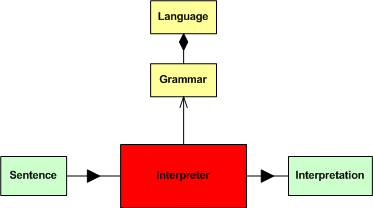
Given a language, define a representation for its grammar along with an interpreter that uses the representation to interpret sentences in the language.
For your viewing pleasure, and because it’s what I like to do, I’ve translated (hopefully successfully) the wise words above into the SysML block diagram below.
Moving on, observe the copied-and-pasted pseudo-UML class diagram of the GoF Interpreter design pattern below. In a nutshell, the “client” object builds and initializes the context of the sentence to be interpreted and invokes the interpret() operation – passing a reference to the context (in the form of a syntax tree) down into the concrete “xxxExpression” interpreter objects in a recursive descent so that they can do their piece of the interpretation work and then propagate the results back up the stack.
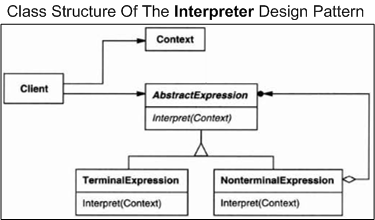
In their writeup of the Interpreter design pattern, the GoF state:
Terminal nodes generally don’t store information about their position in the abstract syntax tree. Parent nodes pass them whatever context they need during interpretation. Hence there is a distinction between shared (intrinsic) state and passed-in (extrinsic) state.
Since the classes in the Interpreter design pattern aren’t thinking, feeling, scheming humans concerned about status and looking good, the collection of collaborating classes do their jobs effectively and efficiently, just like mindless machines should. However, if you try to implement the Interpreter pattern on a project team with human “objects”, fuggedabout it. To start with, the “client” object (i.e. the boss) at the top of the recursion sequence won’t know how to create a coherent sentence or context. Even if the boss does do it, he/she may intentionally or unitentionally withhold the context from the recursion chain and invoke the interpret() operation of the first “XXXExpression” object (i.e. worker) with garbage. When the final interpretation of the garbled sentence is returned to the boss, it’s a new form of useless garbage.
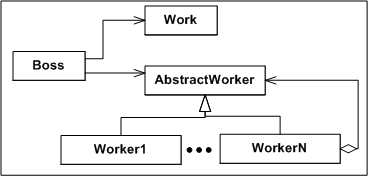
On it’s way down the stack, at any step in the recursive descent, the propagated context can be distorted or trashed on purpose by self-serving intermediate managers and workers. Unlike a software system composed of mindless objects working in lock-step to solve a problem, the chances that the work will be done right, or even defined right, is miniscule in a DYSCO.

Why am I here?
WTF?
Meh!
D'oh!

My BTC Address



 Bulldozer00's Blog