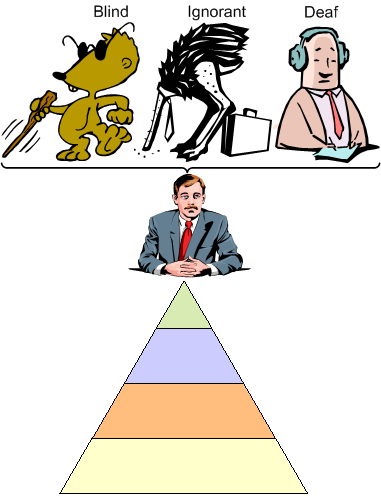
Blind, Ignorant, Deaf
In “The Thought Leader Interview“, HCL Technologies CEO Vineet Nayar describes his shocking “Employees First, Customers Second” method of management to a pair of Strategy+Business magazine reporters. In keeping with my biased approach of culling only those quotes and passages that support my view of what the wildly successful company of the future looks like, I’ve assembled this self-serving list for your consideration:
Somebody said to me about the Employees First program, “Vineet, your competitors will copy this, and therefore, it will not be a differentiator.” My response was, “If our competitors can post the results of 360-degree evaluations, more power to them.”
The moment the recession hit we went out to our employees and said, “We have a problem. We’re going to solve it together.” We had thousands of ideas coming in, and we implemented them. Most of them were operational: There were no new products, services, geographies, or contracts. But HCL grew 23 percent and increased global market share by 21 percent. Our employees felt they were a part of everything we were doing, because of our inclusive approach. Even if it may take a bit longer to arrive at decisions, this approach helps ensure that implementations are smooth and that initiatives are sustained after the initial hype.
We created a 360-degree process where anybody can give feedback to anybody, including to me. We post the results internally so that all employees can see them. Good or bad, we all learn from the results. It’s open, it’s transparent, and the impact is positive. We find that this practice is motivating people to change their behavior. They try harder.
We also looked for symbolic ways to be a model of openness. One thing I did was publicly dance in front of all my employees. This was to remove the halo that a CEO has around his head. Meaningful conversation happens after you have set the stage in this way, after you make clear that you are as open as anyone else — crazy but effective.
So I held an open house with a group of employees. “I’m feeling pretty bad,” I said. “Nobody is saying what is positive about our company. Do you think I’ve unlocked a genie that is spreading demotivation?” Their answer was interesting. They said it is good to wash dirty linen in public, in this case on the blog, because it builds trust. There are no rumors. We discuss everything openly and honestly. We don’t always have solutions to problems, but at least we expose them.
Whatever trust is left in command-and-control management structures has been deeply tested during the recession. I am told that in business in general, employee trust in management is at its lowest point ever.
Even though Mr. Nayar is a breath of fresh air, I’m not too optimistic that his ideas on effective corpo governance will spread like wildfire to a company near you. You see, Ricardo Semler, CEO of Semco Inc., was Vineet Nayar twenty years before Vineet Nayar. Of course, since Mr. Semler’s version of participative management was also an all out assault on the draconian, patriarchical, system of management that pervades the globe today, he was ignored by mainstream business too.

Why am I here?
WTF?
Meh!
D'oh!

My BTC Address



 Bulldozer00's Blog