Feedback Insertion
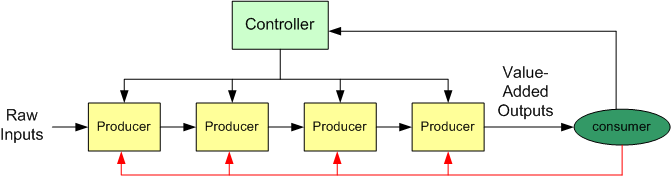
Let’s say that you come up with a great product idea that is both wanted and needed by a large market (ka-ching!). Let’s also say that your product is non-trivial and it requires specialized expertise to produce it from raw inputs to its value-added end state. After mustering up enough courage and scrounging up enough money, you become an entrepreneur – whoo hoo! So, you design the system below, hire the expertise you need, and kick off the enterprise. Of course, you rightly put yourself in the controller position and serve as the system coordinator.
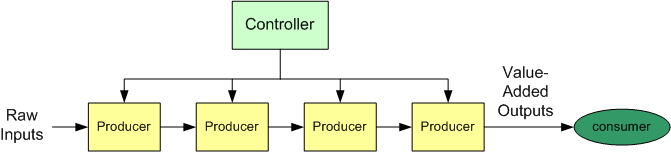
Uh, what’s missing from your design? Does the next picture below help? Still can figure it out?
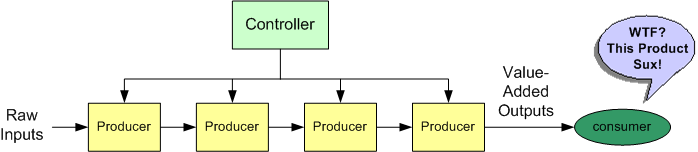
Is feedback missing? Even though your customers need and want and buy your product, how do you know when/if your quality goes down hill and/or your customers want and need new features? Voila! You figure it out and design/install a feedback channel from your customers to you, and only you:
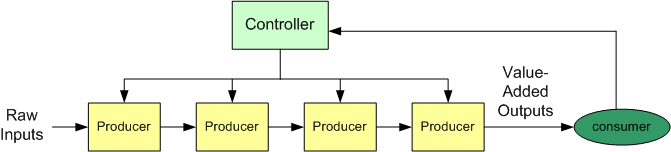
By responsively acting on customer inputs on your new feedback channel, you steer, guide, and direct your team back on track – until the complaints on the feedback channel start rising again. What’s wrong with your system now? Does the system augmentation below answer the question?
Because of increasing product complexity and your lack of in depth knowledge of it, (if you’re not an egomaniacal control freak,) you own up to the possibility that you could be misunderstanding and filtering out some customer feedback and you could be directing your team poorly. Accepting your humility, you set up a second feedback channel from your customers directly to your development team.
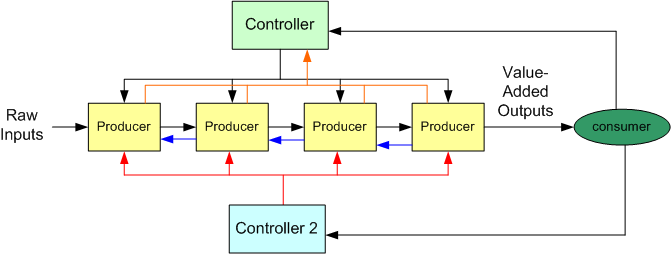
Now you’re back on track again – whoo hoo! But wait, something goes awry again and the customer complaint rate starts rising again. Since feedback solved your problems before, you set up additional feedback channels between yourself and your producer team and between your sub-teams:

Will this latest system enhancement work? Hell, I don’t know. Complexity begets complexity. Your increasingly complex system design might implode because of all the communication channels in the system and the fragmentation of contradictory messages that flow at high rates within the channels. If it doesn’t work, you could keep experimenting with changes to fine tune the system for stability and robustness.
The figure below shows yet another system enhancement possibility – the addition of another controller to ensure that the production sub teams receive coherent and filtered info from your customers. It may work, but it will fail if your second controller issues guidelines, advice, commands, and orders to your production team that contradict yours.
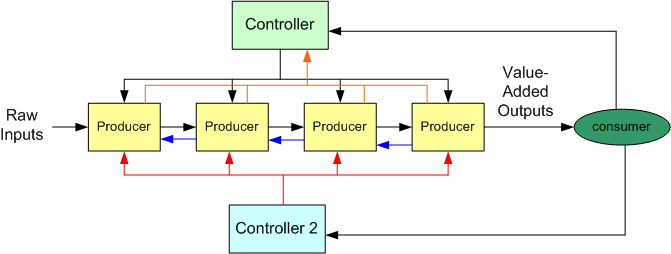
To solve your cross-management problem, you can setup a two way channel between yourself and your second controller to resolve contradictions and ambiguities:
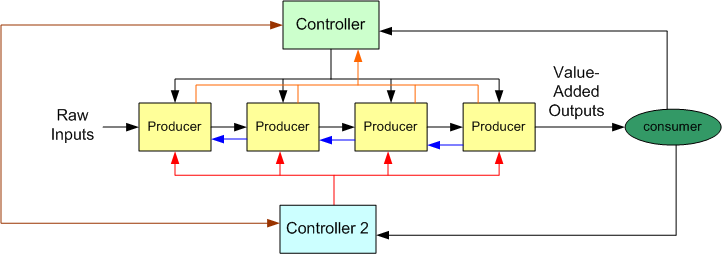
So, what’s the point of this long and boring, multi-picture post? Geez, I don’t know. I wrote it on the fly, in a stream of consciousness with no pre-planned point in mind.
But wait, a possible answer to the question just popped into my head out of nowhere. The point of this post is to keep adapting and trying new things when your external environment keeps changing – which it always will. One thing is for sure: don’t design your operation like the very first picture in this post – open loop. Ensure that feedback channel(s) from your customers are in place and the information that flows on it (them) is acted upon to keep your product in synch with your customers.
Sheesh, I’m finally done!

Why am I here?
WTF?
Meh!
D'oh!

My BTC Address



 Bulldozer00's Blog