Science, Philosophy, Systems Thinking
In Michael C. Jackson‘s rich and engrossing “Systems Thinking: Creative Holism For Managers“, Mr. Jackson describes 10 holistic systems thinking approaches designed to solve complex social managerial problems. As he progressed from the earlier, purely science based, hard-systems thinking approaches to the modern, soft-systems approaches that attempt to fuse science with philosophy, I composed the two pictures below to help clarify my understanding. As usual, I felt an internal urge to externally express my discombobulated thoughts on the topic; so here are the pics.
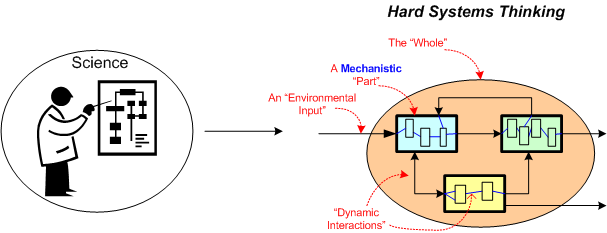
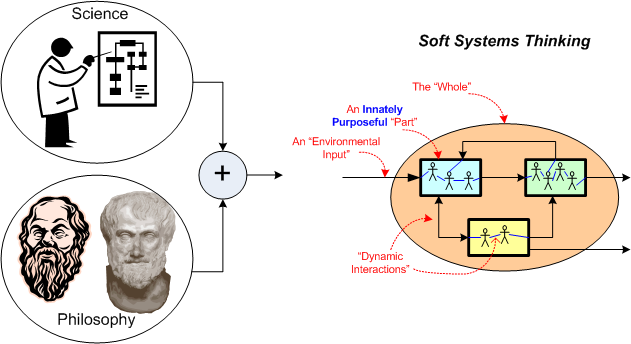 The main distinguishing difference that I see between the hard/soft models is the way that internal system “parts” are characterized. In the hard systems approaches, the system parts are conveniently assumed to have no self-purposes. This, as some people know from experience, is a horribly wrong assumption for systems composed of individual persons – social organizations.
Social org BOOGLs, SCOLs, and BUTTs are forever mired in the hard systems thinking mindset of yesteryear. Their simplistic solution for suppressing any externalization of self-purpose that is at odds with their own is to either consciously or unconsciously apply force to extinguish it. History has shown that this ubiquitously applied technique works – temporarily.
Leave a comment

Why am I here?
WTF?
Meh!
D'oh!

My BTC Address



 Bulldozer00's Blog
I like to see it more as the initial systemic vs. the cybernetic approach (instead of “hard vs. soft”). It’s been reported that von Bertalanffy didn’t like Wiener’s approach – and I dont see much sense in the mechanistic-cybernetic POV as well. To me, cybernetics is just the variant for people who feel (!) uncomfortable with uncertainty: it’s more than just a bit to the engeneering or physicists side, where everything “has to be” precise. Systems thinking without complexity doesn’t seem right to me, and the approaches that we already had before the systems approach will do for less than complex problems.
Thanks for pitching in Chris.