Conceptual Integrity
Like in his previous work, “The Mythical Man Month“, in “The Design Of Design“, Fred Brooks remains steadfast to the assertion that creating and maintaining “conceptual integrity” is the key to successful and enduring designs. Being a long time believer in this tenet, I’ve always been baffled by the success of Linux under the free-for-all open source model of software development. With thousands of people making changes and additions, even under Linus Torvalds benevolent dictatorship, how in the world could the product’s conceptual integrity defy the second law of thermodynamics under the onslaught of such a chaotic development process?
Fred comes through with the answers:
- A unifying functional specification is in place: UNIX.
- An overall design structure, initially created by Torvalds, exists.
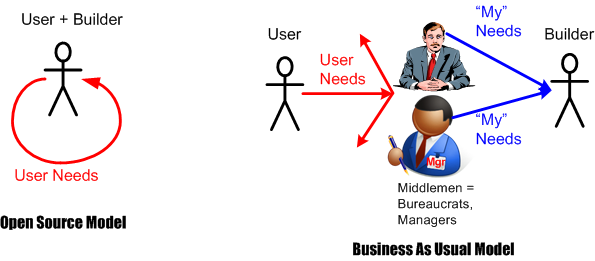
- The builders are also the users – there are no middlemen to screw up requirements interpretation between the users and builders.
If you extend the reasoning of number 3, it aligns with why most of the open source successes are tools used by software developers and not applications used by the average person. Some applications have achieved moderate success, but not on the scale of Linux and other application development tools.
-
July 1, 2010 at 6:08 amOpen Loop « Bulldozer00's Blog

Why am I here?
WTF?
Meh!
D'oh!

My BTC Address



 Bulldozer00's Blog