Fifty-Fifty
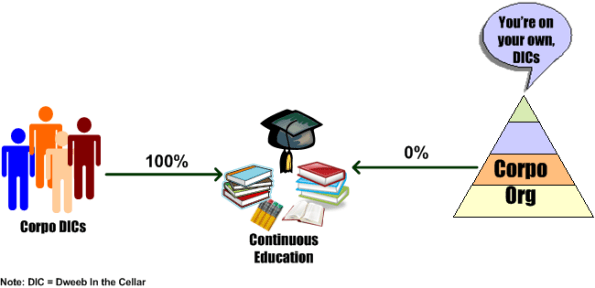
Because of the current economic environment, lots of recycled articles (take charge) regarding continuous education have appeared. Almost every one of them dispenses the same advice: “only you are responsible for continuously educating yourself and keeping your skills up to date”. Of course this is obviously true, but what about an employer’s duty to its stakeholders for ensuring that its workforce has the necessary training and skills to keep the company viably competitive in a rapidly changing landscape? Because of this duty, shouldn’t the responsibility be shared? What about fifty-fifty?

There are at least two ways that corpo managements (if they aren’t so self-absorbed that they’re actually are smart enough to detect the need) react to the need for continuing education of the people that produce its products and provide its services.
- Hire externally to acquire the new skills that it needs
- Invest internally to keep its workforce in synch with the times
Clueless orgs do neither, average orgs do number 1, above average orgs do 2, and great orgs do 1 and 2. Hiring externally can get the right skills in the right place faster and cheaper in the short run, but it can be much riskier than investing internally. Is your hiring process good enough to consistently weed out bozos, especially those that will be placed in positions that require leading people? If it’s a new skill that you require, how can your interviewers (most of whom, by definition, won’t have this new skill) confidently and assuredly determine if candidates are qualified? As everyone knows, face-to-face interviews, references and resumes can be BS smokescreens.
If external competitive pressures require a company to acquire deep, vertical and highly specialized skills, then hiring or renting from the outside may be the right way to go. It may be impractical and untimely to try and train its workforce to acquire knowledge and skills that require long term study. If you have a bunch of plumbers and you need an electrician to increase revenue or execute more efficiently, then it may be more cost effective and timely to hire a trained electrician than to train your plumbers to also become electricians (or it may not).
Which strategy does your corpocracy predominantly use to stay relevant? Number 1, number 2, both, or neither? If neither, why do you think that is the case? No cash, no will, neither?

Why am I here?
WTF?
Meh!
D'oh!

My BTC Address



 Bulldozer00's Blog