Productivity Lag II
In part I, we saw that the learning curve for each person is different (duhhh). I also defined the Critical Mass Time (CMT) to be the time lag between starting a new project and actually being able to “start contributing something useful”. The figure below recaps this idea.
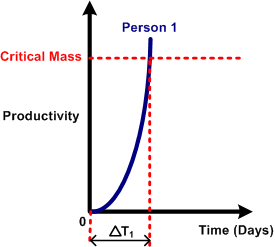
Other factors, besides experience and expertise, that determine the CMT value are: the amount of, the quality of, and accessibilty of pre-existing information about the problem to be solved. If the information is sparse, fragmented, and/or inefficiently stored in other people’s fallible memories (tribal knowledge) because of the failure of management to lead, then the CMT will be larger than if the critical-to-success information is coherent, integrated, and recorded somewhere that is easily navigable and accessible.
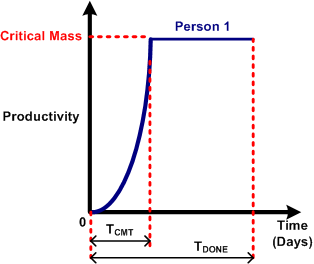
At the CMT point, productivity starts manifesting in the physical world as visible intermediate work outputs. Product specifications, designs, test definitions, equipment assembly, prototyping, model definitions, etc., begin to emerge and push the project forward. Like any activity that is predicated on fallible human thought, the creation process is iterative and chaotic. It is not smooth and organized as the final output may imply to an after-the-fact external observer (like most managers). It takes iterative, mistake-prone work and structure to temporarily harness the ever present increase in entropy.
The figure below shows the full time lag between project start and project completion. Again, the time lag ‘tween CMT and project “done” is highly person-specific.
The figure below shows the end-to-end project start time to project done time for three different people that were given the same project task to perform. The difference between the total “schedule” performance of person 3 and person 2 is the case we want to zoom in on. How could it be that person 2 ramped up faster than person 3 but finished the project later? WTF?
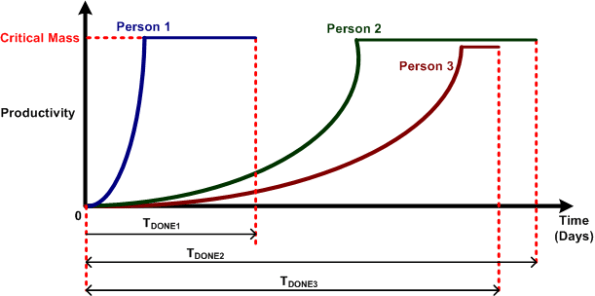
Some reasons that may explain this anomaly are:
- Person 3 had a hard time finding and absorbing high quality, pre-existing information about the project and task at hand.
- Person 3 is slower at learning, but more talented at applying.
- Person 2 lost some motivation for one or more reasons and slacked off somewhat
- Person 3 rushed through the task and produced crappy output that may not be discovered until the project is further downstream; where the cause might not be connectable to the person’s output.
I’m sure that there are a gazillion other factors that may explain the anomaly. You can form your own list.
The main point of this article was to discuss what everyone knows, but often forgets: Numbers don’t always tell the truth. Superficially looking at hard and cold “schedule performance” numbers without digging in to examine their validity can be unfair to those who are quantitatively measured for personal performance evaluation by hierarchs. Lazy bozo managers who do this deserve what they get: the exodus of some of their best performers, an unmotivated workforce, a low quality product portfolio, and an unfair reward system. In essence, it’s one of the hallmark characteristics of the herd of mediocracies that cover the landscape of the business community.

Why am I here?
WTF?
Meh!
D'oh!

My BTC Address



 Bulldozer00's Blog