Problems, Growth, And Serious Shrinkage
I first encountered the word “problematique” in John Warfield’s book “An Introduction To Systems Science“. A big problem isn’t singular in nature. It is comprised of an intertwined mess of pseudo-individual problems. This hairball produces painful symptoms that are greater than the sum of its parts. Hence, the word “problematique” seems to better convey the seriousness of a big problem.
The figure below shows a general model of a problematique along with its accompanying set of causes and symptoms. Assume that the size of the problematique is not static. Fueled by the unchecked amplification of its set of causes, it grows uncontrollably over time . New symptoms appear and existing symptoms get worse. It’s bummer city.
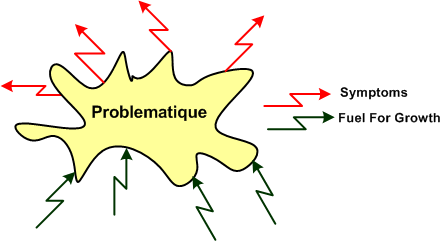
As an example, assume that some of the nasty symptoms of a hypothetical organization’s problematique are as follows:
-
Dissatisfied customers,
-
Disengaged employees, and
-
Low quality products
Also assume that the problematique’s true (but usually undiscussable) underlying causes are:
-
Shoddy workmanship,
-
Schedule pressure,
-
Management and worker incompetence,
-
Unscalabe and stifling work processes,
-
Useless and unhelpful documentation (a.k.a. camouflage)
Now, assume that in a sincere attempt to control and ameliorate its problematique, the organization designs and implements what it thinks is a problem control system but is really a symptom control system.

Assume that the symptom control system provides the following capabilities:
-
Frequent damage control trips by executives to customer sites to medicate customers.
-
Free upgrade offers,
-
Lower product maintenance prices,
-
Increased schedule pressure on the work force,
-
The imposition of more constraining processes on the work force,
-
The addition of more self-medicating status meetings,
-
The generation of more useless documentation (a.k.a. camouflage squared).
The symptom control system may work for a while, but since the fuel sources haven’t been cut off, the problematique’s growth soooner or later overwhelms the system’s capability to keep the symptoms in check. The chains break and the symptoms reappear. As the problematique continues to grow, new symptoms appear in the form of decreased demand for the organization’s products, decreased revenue, and decreased profits because of rising internal costs.
Next, assume that by the grace of God, the organization awakens and becomes conscious of the true fuel sources that facilitate the problematique’s uncontrolled growth. The organization then designs an effective problematique control system that severs the fuel source connections to the problematique. In order to pull this miracle off, the control system executes the following unconventional behaviors:
-
Increases work force competence through real mentoring and meaningful continuous training.
-
Recognizes and rewards high quality work over heroic crisis response. Merit over conformance.
-
Relieves schedule pressure
-
Streamlines work processes and eliminates obsolete and useless processes.
-
Calls fewer status meetings.
-
Oversees the creation of less, but more useful/helpful, documentation.
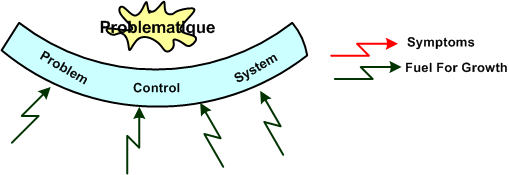
Due to the effectiveness of the integrated control system, the problematique experiences “serious shrinkage”. The symptoms are attenuated, or eliminated entirely, and the organization’s health gradually improves.
Sadly, the effort required to design and implement a symptom control system is much easier than the effort required to design and implement a problematique control system.
Leave a comment

Why am I here?
WTF?
Meh!
D'oh!

My BTC Address



 Bulldozer00's Blog
hiya – you may enjoy reading this interview.. http://tomstine.com/newsletter-bonus-download/
Thanks. Nice find!